



Wi-Fi 6/Wi-Fi 6E
Enrich your life through wireless connectivity
Wi-Fi 6 and Wi-Fi 6E use the IEEE 802.11ax protocol, which is designed to improve network efficiency, speed, and capacity in environments with many connected devices. Wi-Fi 6E, which is an extended standard of Wi-Fi 6, operates in the 6 GHz band (5.925 to 7.125 GHz) as well as the 2.4 GHz and 5 GHz bands, while Wi-Fi 6 uses the 2.4 GHz and 5 GHz bands. The 2.4 GHz and 5 GHz bands offer a maximum frequency bandwidth of 572 MHz, whereas the 6 GHz band provides an extremely wide bandwidth of up to 1,200 MHz. As a result, high-speed, large-capacity data communications are driving the introduction of new services including image/video transmission in AR/VR and smart factories.
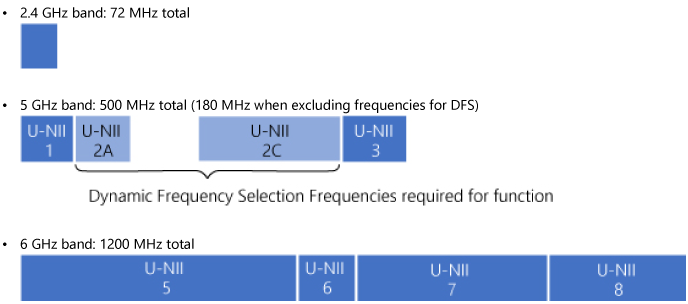
Advantages of Wi-Fi 6E Utilization
Wi-Fi 6E with the 6 GHz band has resolved several challenges faced in the 2.4 and 5 GHz bands.
- Stable Communications through Wide Bandwidth
With a wide bandwidth of up to 1,200 MHz, the use of the 6 GHz band can avoid congestion and interference of radio waves, allowing stable and high-speed wireless communication. - High-Speed Communications through Channel Width Extension
The extended channel width of 160 MHz doubles the maximum data transfer rate compared to the previous 80 MHz channel width.
Challenges for Wireless Devices in 6 GHz Band
While the use of the 6 GHz band has several advantages, the existence of current licensed services restricts the use of the 6 GHz band in the following.
Regulations to protect existing licensing systems
The 6 GHz band is used for communication services that require high reliability. To ensure that the operations of these services remain unaffected, regulations mandate implementing transmission power limits and interference avoidance technologies such as Automated Frequency Coordination (AFC) * in countries such as the United States. The frequency, transmission power, and power density permitted for the use of WLAN differ depending on the role of the devices which works as the Access Point (AP) or Station (STA) and the installation location (outdoor or indoor). Therefore, vendors of WLAN products need to validate the product type-specific regulations to ensure compliance.
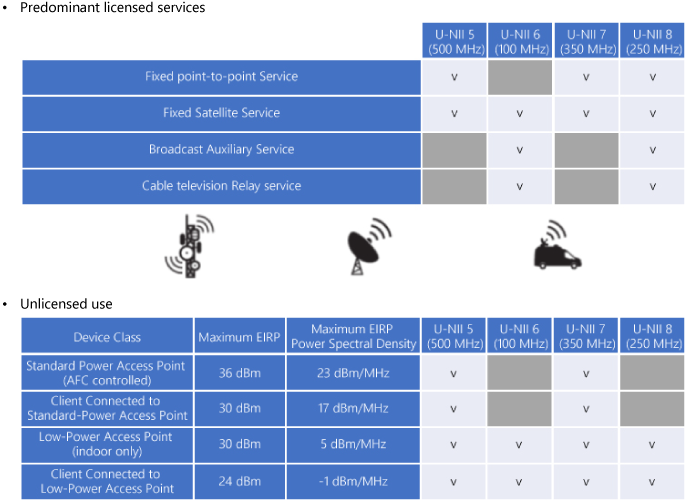
* AFC: When operating an outdoor WLAN AP, information about frequencies that do not interfere with licensed systems is captured from the AFC system.
Challenges for Wi-Fi 6/6E Compliant Devices
In addition to the challenges specific to the 6 GHz band, Wi-Fi 6 and 6E devices have some specific challenges, as follows.
Coexistence of Radio Frequencies
The 2.4 GHz and 5 GHz bands, known as the Industrial, Scientific and Medical (ISM) bands, have been allocated by the International Telecommunication Union (ITU) for general use in industrial, scientific, and medical fields.
The 2.4 GHz band, used without the need for a license, is also utilized by devices such as microwave ovens, Bluetooth®* technology, and specified low-power radio equipment. Additionally, portions of the 5 GHz band are prioritized for weather and maritime radar use. Furthermore, the increase in other wireless LAN devices has led to congestion in both the 2.4 GHz and 5 GHz bands. This may cause connections to become unstable and data transmission speeds to decrease due to interference from other devices. Therefore, determining that such instability and slowdowns are not caused by the devices' own performance is essential when developing wireless devices.
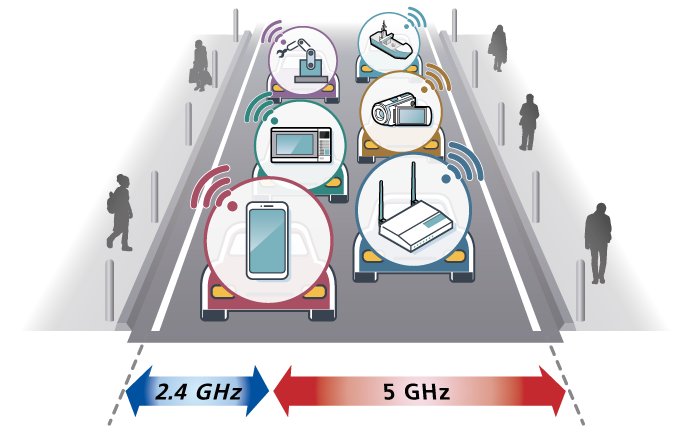
* The Bluetooth® word mark and logos are registered trademarks owned by Bluetooth SIG, Inc. and any use of such marks by Anritsu is under license.
160 MHz Channel Width with Usage Restrictions
The use of a channel width of up to 160 MHz allows for high-speed data transmission at speeds of several Gbps. However, the spectrum available to support this channel width is limited in the 2.4 GHz and 5 GHz bands. As a result, to maximize the number of devices that can be connected, the channel width is often set to 40 MHz or less. Consequently, verification of the appropriate channel settings for the actual operating environment is crucial when evaluating the performance of wireless LAN devices.

Anritsu Test Solutions for Wi-Fi 6/Wi-Fi 6E Compatible Devices
The 6 GHz band is expected to solve several challenges in wireless LAN (WLAN) communications. However, the development of products that are compliant with Wi-Fi 6E requires evaluating their wireless communication characteristics and improving their performance to address these issues.
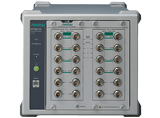
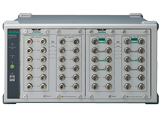
The Wireless Connectivity Test Set MT8862A (WLAN Tester) offered by Anritsu can be used to measure the RF transmit/receive (TRx) characteristics of IEEE 802.11ax wireless LAN devices supporting the 2.4 GHz, 5 GHz and 6 GHz bands. The MT8862A has standard wireless LAN protocol messages (wireless LAN Signalling) to connect with a device under test (DUT) for measuring each TRx performance item as “Network Mode”, and features built-in “Direct Mode” to support flexible test environment. Additionally, by adding an option, it is possible to test the RF TRx characteristics of 2x2 MIMO in an Over-the-Air (OTA) environment.
Application Note:
IEEE 802.11be Compliant TRx Characteristics Evaluation
Related Products
Related Link



Contact Us


Copyright 2026