



Compute Express Link® (CXL®)
Enabling cache coherency between main memory and devices
Compute Express Link® (CXL®) is a high-speed interconnect standard based on PCI Express® (PCIe®), enabling data consistency across devices, such as CPUs, GPUs, and AI accelerators. CXL provides cache coherency functionality, ensuring that data in main memory remains synchronized with the cache contents of connected devices. By drastically reducing the synchronization overhead required in conventional PCIe-based systems, CXL helps reduce CPU workload and latency, improving the overall system performance.
Compute Express Link® and CXL® are registered trademarks of Compute Express Link Consortium.
PCI-SIG®, PCIe® and PCI Express® are registered trademarks of PCI-SIG.
Testing Challenges for CXL Devices

Challenge 1: Reproducing and Identifying Link Training Issues
During CXL device development, engineers need to verify that a device can successfully establish a link with the host platform at the expected data rate and lane configuration through link training. Link training is the process by which a device and host negotiate parameters, such as data rate and lane width, while performing equalization to establish a PCIe or CXL link.
However, engineers may encounter issues, such as link-up failures, links operating at lower-than-expected speeds, or unstable link behavior under specific conditions. While reproducing these issues is essential for identifying the root cause, recreating the required conditions on a host platform is often difficult, making fault isolation and root-cause analysis time-consuming. This increases debugging efforts and impacts development schedules.
Challenge 2: The Difficulty of Evaluating Noise and Jitter Tolerance
Since CXL is designed to support wide-bandwidth, low-latency data transfers, thorough evaluations of the effects of noise- and jitter-induced signal degradation on transmission quality are essential. In practice, cache-coherent data sharing across processors, accelerators, and memory devices can involve sustained high-speed traffic, making it important to verify that sufficient signal margin is maintained under realistic operating conditions.
Therefore, engineers must intentionally apply controlled amounts of noise and jitter to evaluate a device’s noise and jitter tolerance margins. However, conventional compliance-oriented test environments may not provide sufficient flexibility, equipment capabilities, or test time to accurately emulate real-world operating conditions. Consequently, latent signal integrity issues may remain undetected during development, leading to performance degradation and reduced product reliability after deployment.
CXL Device Test Solutions
Solution 1: Reproduce Issues by Controlling Link Training Conditions
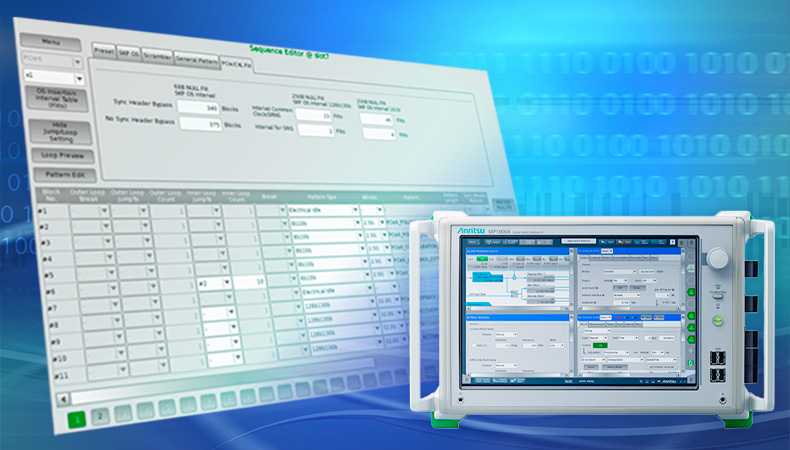
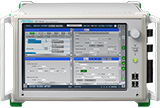
The Sequence Editor Function implemented in Anritsu’s Signal Quality Analyzer-R MP1900A enables engineers to control the link training conditions and reproduce abnormal operating states.
The Sequence Editor Function can flexibly create test patterns and sequences for high-speed digital interfaces. Engineers can modify training patterns and transmission counts within the link training sequence and configure loops and breakpoints. This enables detailed verification of device behavior under specific communication conditions and fault scenarios that are difficult to reproduce on host platforms. In addition, comparing normal and abnormal operating conditions helps streamline fault isolation and root cause analysis, allowing engineers to identify issues faster, reducing debugging effort and shortening development cycles.
Leaflet:
Sequence Editor Solution
Solution 2: Quantitative Evaluation of Noise and Jitter Margins Under High-Traffic Conditions
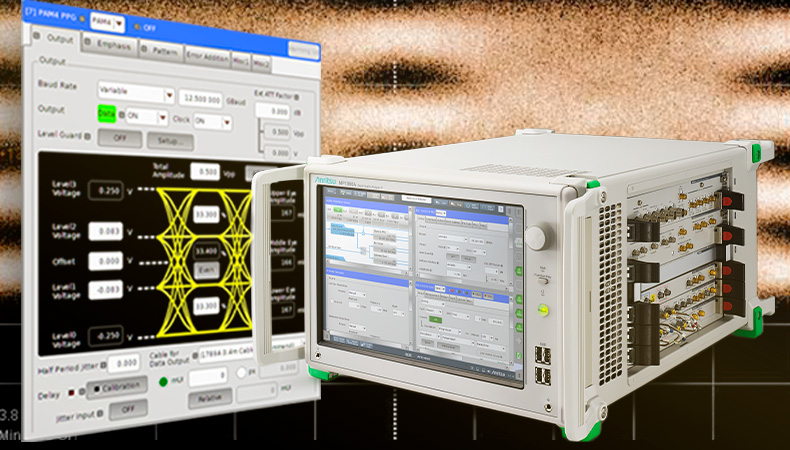
The Sequence Editor Function in the MP1900A allows engineers to edit test sequences that emulate CXL communications. Following these sequences, the MP1900A can reproduce heavy traffic conditions while applying controlled and quantifiable amounts of noise and jitter.
This enables efficient evaluation of a device’s allowable noise and jitter margins under operating conditions that closely resemble actual system environments. The solution also supports multi-lane scenarios, allowing users to assess CXL communications across multiple lanes and evaluate tolerance to lane-to-lane skew.
Combining the MP1900A with the Sequence Editor Function enables engineers to perform stress testing in high-traffic environments that would otherwise be difficult to achieve. This helps reduce the risk of communication instability and performance degradation after products are deployed in the field.
Resources

See More


Related Products
Contact Us



 Your Privacy Choices
Copyright 2026