



Automotive
Build your future through connected car testing
Connected Car
Connected car uses various wireless communications standards, such as cellular (2G/3G/4G/5G), wireless-LAN (IEEE 802.11p, IEEE 802.11a/b/g/n/ac/ax/be, Wi-Fi®), and Bluetooth® technology. Using these technologies expands a range of automotive applications, such as data communications through the Internet, vehicle position detection, remote control, and more. However, there are potential challenges, such as radio interference and noise as the radio waves in various standards co-exist in the connected car. Moreover, blocking and reflection of radio waves by metal parts of a car body cause concerns about degraded communication quality.
Automotive OEMs and Tier 1 and Tier 2 component suppliers must resolve these challenges and avoid potential problems by testing during product development. Testing and verification facilitate improving functions and performance to realize high-quality automobile communications systems.
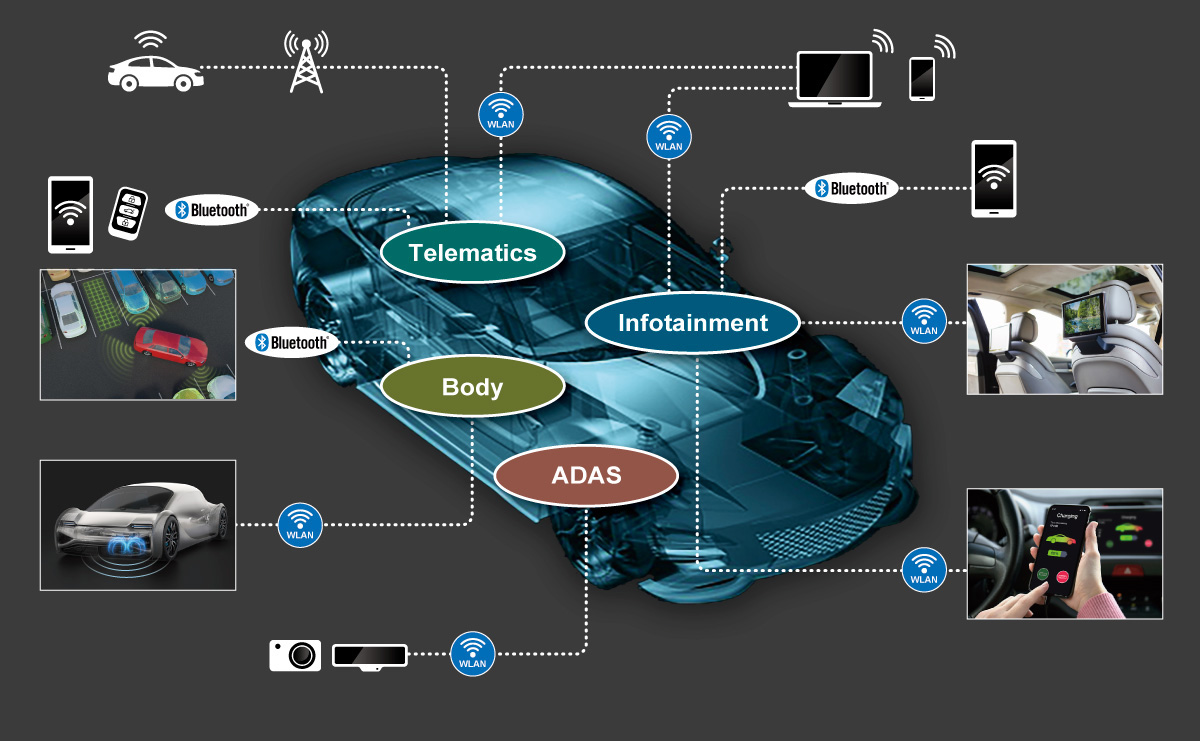
* The Bluetooth® word mark and logos are registered trademarks owned by Bluetooth SIG, Inc. and any use of such marks by Anritsu is under license.
* Wi-Fi Alliance® and Wi-Fi® are registered trademarks of the Wi-Fi Alliance®.
5G Connectivity Test Solution
Bi-directional vehicle and mobile cloud network data communication ensures safe and comfortable driving. To achieve this, the connected cars use built-in communications units, including a Telematics Control Unit (TCU), working as the core of systems such as the AD/ADAS, eCall and infotainment. Upgrading the speed and capacity and minimizing the latency of the in-vehicle communications system is essential to improve function and performance.
The various wireless connections between the vehicle and network must be stable while supporting roaming and quick handover, which requires testing during the product development stage. However, generating these operations at the appropriate timing on a live network is difficult, so a test environment is necessary to simulate practical networks. Additionally, conformance to the government legislation and regulations in each country on allocated radio frequencies as well as satisfying 3GPP standards all require extensive and varied testing during product development.
eCall/NG-eCall/Hybrid eCall Test Solution
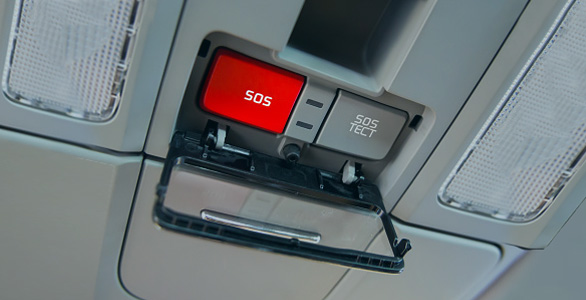
Emergency Call (eCall), Next Generation eCall (NG-eCall), and Hybrid eCall are all emergency call systems that automatically notify Public Safety Answering Points (PSAP) in the event of a vehicle being involved in an accident. They achieve this using In-Vehicle Systems (IVS) and the mobile networks. In major European countries, the installation of eCall/NG-eCall systems in newly registered vehicles is legally mandated, and their implementation is progressing.
Vehicles with built-in eCall/NG-eCall systems for the European market are required to comply with relevant international standards and regulations. In addition, they must earn type approval from the relevant certification bodies. Hybrid eCall systems are not currently subject to type approval. However, several car OEMs are considering their implementation, and technical verification is currently underway to ensure that such systems will be reliable and safe if adopted for use in the future.
Therefore, manufacturers need to use a suitable testing solution. For example, a solution that simulates mobile networks and supports standards-compliant tests is the key enabler for efficient approval and verification.
Infotainment Test Solution

Car infotainment systems offer various information and entertainment applications using the in-vehicle communications terminal and driver’s cell phone. For example:
- Vehicle navigation system uses the Global Navigation Satellite System (GNSS) to help the driver plot the best route, and to display nearby information including parking, restaurants and gas stations based on the vehicle’s position.
- Hands-free phone calls and playing a music uses Bluetooth.
- Music and video streaming uses Wireless LAN.
- The internet connection and remote control of the car’s air conditioning uses cellular communications.
Using wireless communication in various standards improves the quality of user experience, while interference, noise, and signal blocking can all impact the signal reception in the car. Consequently, development of these systems require extensive testing of the wireless communications functions and quality.
Autonomous Driving/Advanced Driver Assistance System
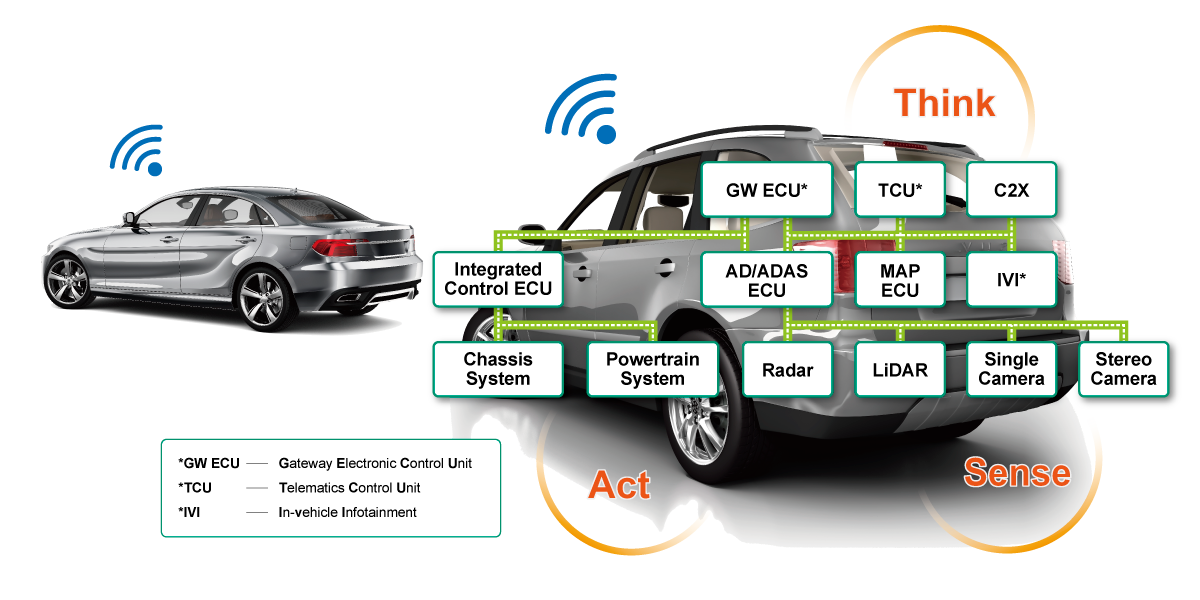
Research and development of the advanced driver assistance system (ADAS) and the autonomous driving system (AD) is progressing worldwide with the goal of reducing traffic accidents and assuring a safe and comfortable driving experience. ADAS supports various driver's operations such as collision warning, automatic braking, and parking assist, using built-in cameras and various sensors including mmWave radar to monitor external environment. Both AD and ADAS use a wide range of different technologies, including wireless communications via mobile networks as well as wired communications between various types of sensors and the ECU, which controls electronic communications within the vehicle.
Additionally, AD and ADAS require safety functions keeping risks within permissible levels to assure safety, which means AD and ADAS development requires testing and certification assuming abnormal operations such as system faults and communications failures, as well as the assurance of normal wireless communications operations.
AD/ADAS
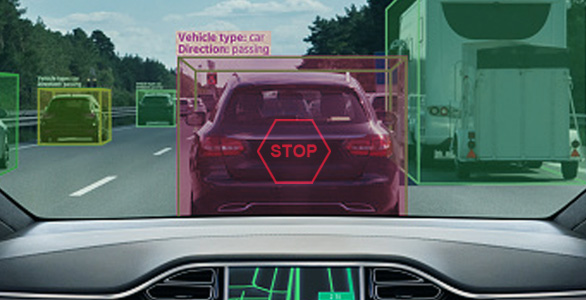
Development of AD and ADAS functions requires performance evaluation of individual components, such as sensors, communications equipment, and control units, as well as the evaluation of the overall system simulation.
- Simulate use cases in autonomous driving cooperated with telecommunication, for example, automated valet parking (AVP) function
- Evaluate performance of sensors, including millimeter-wave radar
- Evaluate latency of data transmissions between mobile communications network and TCU
- Increase network data communications speed
V2X (Cellular & DSRC)
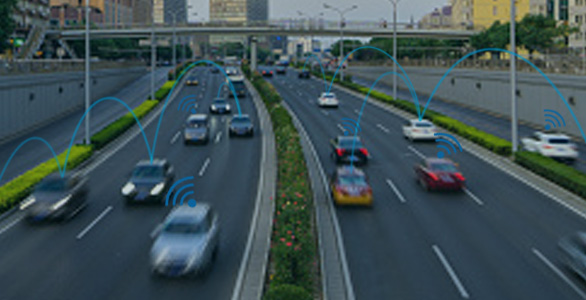
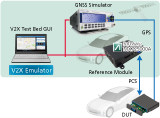
To improve driving safety, effort in social implementation of cooperative systems such as Vehicle-to-Vehicle (V2V), Vehicle-to-Roadside Infrastructure (V2I), and Vehicle-to-Network (V2N) into society is advancing using wireless communications. Each standards organization is progressing with consideration and development of technical specifications. There are two categories in Vehicle-to-Everything (V2X) standards:
- Dedicated Short Range Communications (DSRC) standard based on the IEEE 802.11a/b/g/n/ac/ax/be Wireless LAN standard.
- Cellular V2X (C-V2X) standard based on 3GPP cellular communications.
In addition to required compliance with various in-vehicle communications standards, implementation of V2X also requires compliance with government legislation in each country. Furthermore, there is a future need for an expandable V2X performance testing environment to cover evolving networks.
Case Study
HYUNDAI MOBIS Co., Ltd.
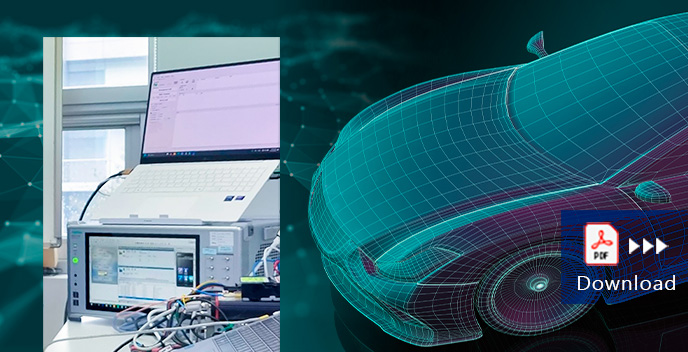
The global automotive parts vendor significantly enhanced the reliability and development efficiency of its Hybrid eCall systems using Anritsu's test solution.
Resources

White Paper:
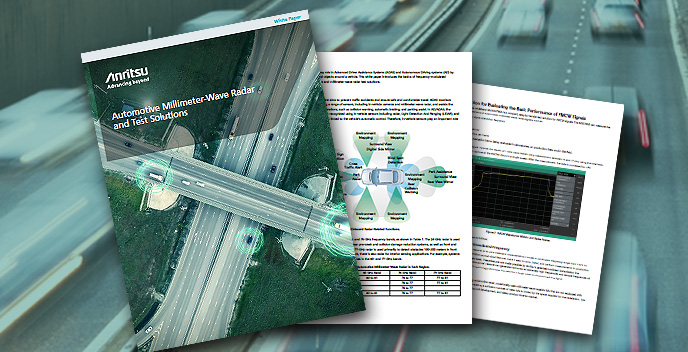
Automotive Millimeter-Wave Radar and Test Solutions
This white paper introduces the test challenges, solutions for automotive radar, and its fundamental method, Frequency Modulated Continuous Wave (FMCW).


Related Links


Related Products
Contact Us


 Your Privacy Choices
Copyright 2026