



Wi-Fi 7
Enable tomorrow's wireless connectivity technologies
IEEE 802.11be (Wi-Fi 7) Outline
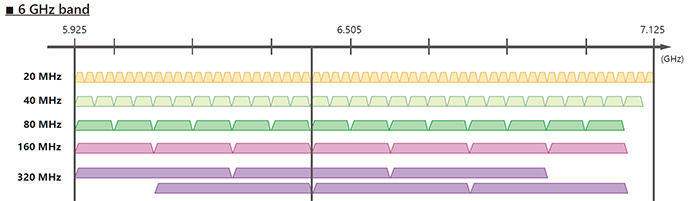
The IEEE 802.11be (Wi-Fi 7) standard aims to achieve significantly higher speed and larger capacity communications than the 802.11ax standard. 802.11be extends the channel width to up to 320 MHz, and the modulation scheme to up to 4096QAM. As a result, 802.11be technologies with more than 30 Gbps data throughput are expected to be the foundation for cutting-edge applications and services including high-definition video streaming beyond 4K, Augmented Reality (AR), and Virtual Reality (VR).
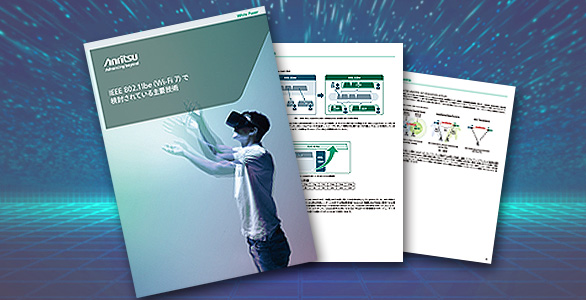
White Paper:
Key Technologies for IEEE 802.11be (Wi-Fi 7)
Describes the technical details and standardization schedules for 11be, as well as the latest status of the 6 GHz band, which has become indispensable for high-speed data communications.
The Evolution of IEEE 802.11 Technologies
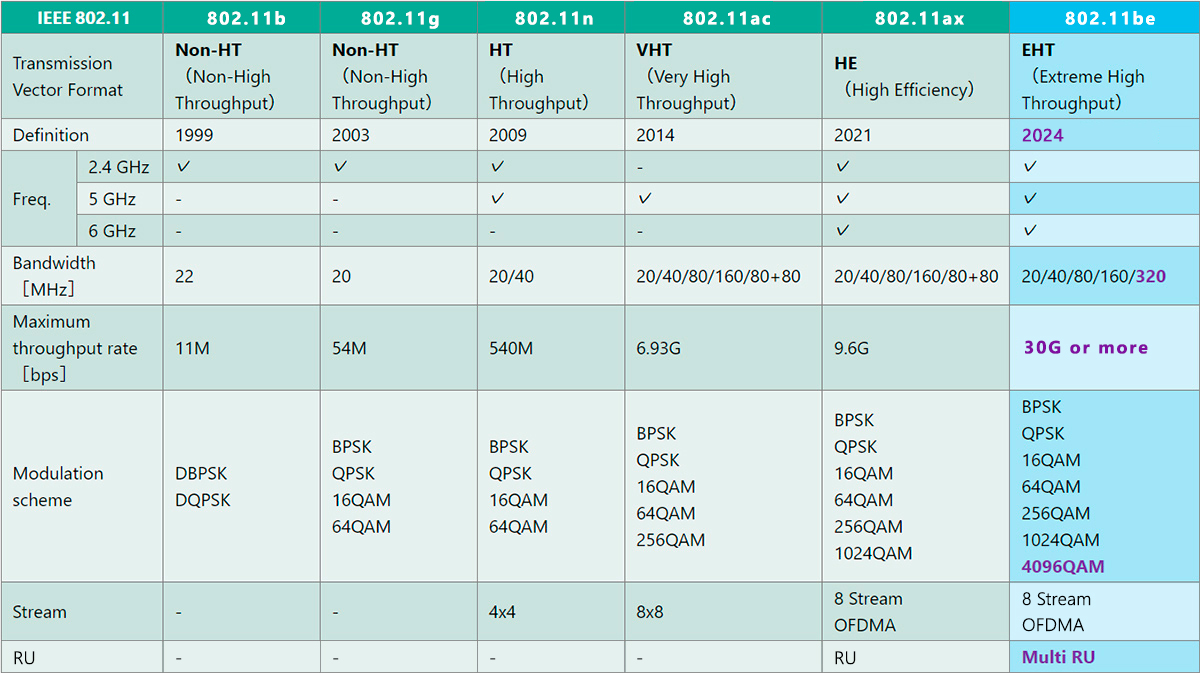
New Functions of IEEE 802.11be (Wi-Fi 7)
IEEE 802.11be aims to further improve the throughput by extending the technology already available in 802.11ax.
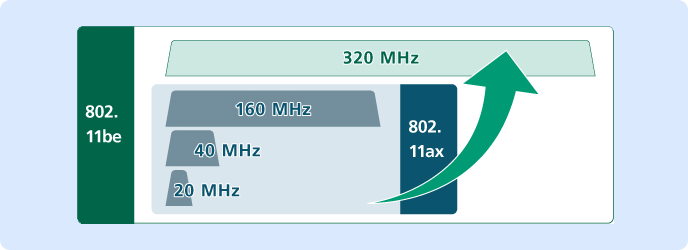
Channel width supported by IEEE 802.11be and 802.11ax
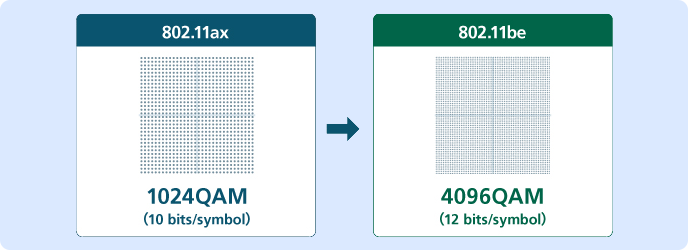
Maximum modulation scheme for IEEE 802.11ax and 802.11be
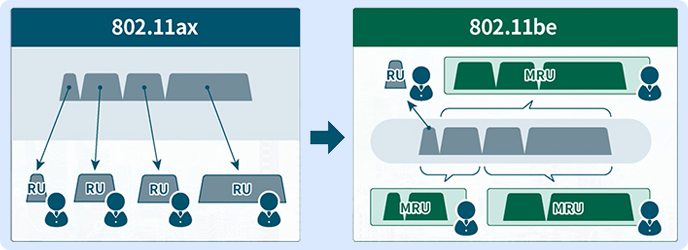
Comparison between IEEE 802.11ax RU and 802.11be multi-RU
New Multi-Link Device (MLD) and Multi-Access Point Coordination technologies, which were not implemented in standards prior to 802.11ax, have been introduced in 802.11be to ensure efficient frequency utilization and stable throughput.
IEEE 802.11be (Wi-Fi 7) Device Development Challenges

Impact of Extended Channel Bandwidth
To achieve extremely high data throughput, IEEE 802.11be has added the new 4096QAM of modulation scheme and extended the maximum bandwidth to 320 MHz. This means that devices supporting the standard require higher modulation accuracy (EVM) as well as even distribution of power across 320 MHz channel width. Furthermore, the widespread adoption of MIMO, which uses multiple antennas, requires advanced techniques for design and implementation.

Rising Test Costs
The IEEE standards have several defined Modulation and Coding Schemes (MCS) and require performance verification of numerous combinations of MCS, channel bandwidths, and other operating conditions. Since the IEEE 802.11be standard introduces extended channel bandwidth, 4096QAM, and Multi-RU, engineers need to evaluate additional test patterns, as well as verify backwards compatibility with legacy 802.11 standards.
Typically, when the 802.11 technical specifications change significantly, device vendors may need to replace their measurement equipment, facing the challenge of an increase in capital investment.
IEEE 802.11be (Wi-Fi 7) Test Solutions Advantages
320 MHz Channel Bandwidth Support
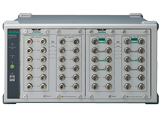
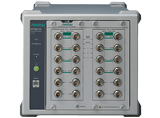
Anritsu Wireless Connectivity Test Set MT8862A supports IEEE 802.11be standard with 4096QAM and bandwidth of up to 320 MHz, enabling evaluation of wideband RF TRx characteristics. RF characteristics can be visually confirmed through spectrum analysis and pass/fail determination as well as numerical results. Additionally, by adding an option, it is possible to test the RF TRx characteristics of 2x2 MIMO in an Over-the-Air (OTA) environment.
Application Note:
IEEE 802.11be Compliant TRx Characteristics Evaluation
Reducing Development Costs
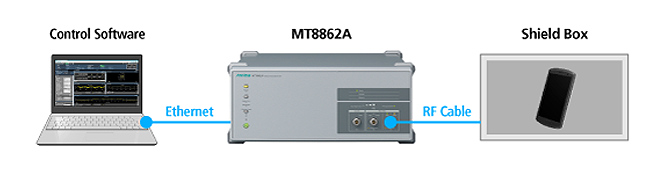
The MT8862A facilitates automated testing through remote commands, offering comprehensive support for IEEE 802.11be as well as previous 802.11 standards in one tester.
Automation also makes it easier to set MCS parameters and bandwidths of each 802.11 standard as well as the IEEE 802.11be multi-RU parameters. Automated testing can significantly reduce the person-hours for verification, reducing development costs. In addition, customers can upgrade to support IEEE 802.11be by adding options to the Anritsu Wireless Connectivity Test Set, which contributes to the suppression of capital investment.
Plus, the Network Mode of MT8862A can test the DUT in the nearly practical conditions. The built-in Frame Capture Logging function captures transmitted and received Frame logs for analysis to identify causes of problems during testing.
Resources

Related Products
Related Links



Contact Us



Copyright 2026