



Non-Terrestrial Networks (NTNs)
Extend coverage through satellite communications
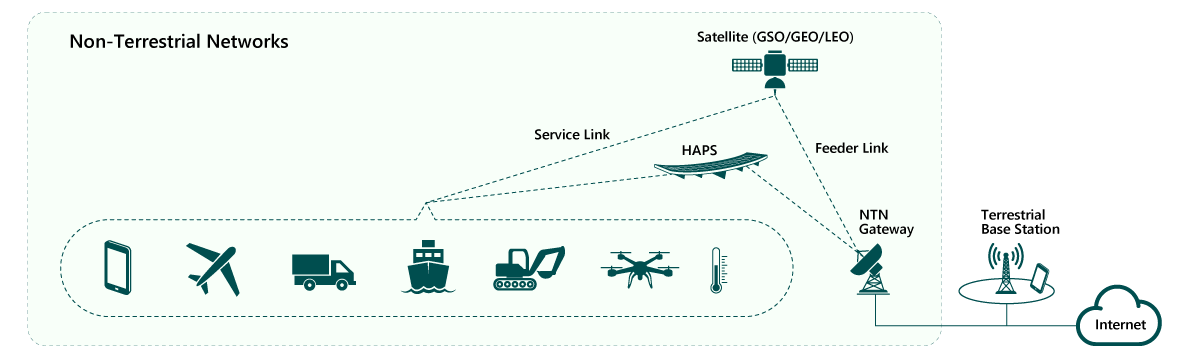
Non-Terrestrial Networks (NTNs) are communication network systems that seamlessly connect IoT devices and mobile devices on land, at sea, and in the sky. 3GPP has defined the fundamental technical specifications for NTNs in Release 17. Enhancements to the NTN specification are underway even after Release 18. They include a proposal to add the Ka-band, beyond the 17 GHz frequency band, to the service link between IoT devices and satellites.
As NTN continues to evolve, users will be able to utilize stable communication services anywhere in the world, without being aware of whether they are connected to a terrestrial base station or a satellite.
NTN Use Cases
NTN using terrestrial base stations and satellites delivers communication services to any location, such as mountainous areas and at sea. There are two types of standards. One is NTN NB-IoT, the other is NTN NR. The broad coverage capability of satellites can provide a stable mobile communications environment for high-speed trains and airborne vehicles. As a result, the range of use cases in mobile communications increases, as described below.
NTN NB-IoT operates based on the NB-IoT standard used in 4G. Due to its low power consumption and low data rates, it is suitable for the following use cases:
- Sending and receiving emergency calls and other short messages as an emergency backup link if terrestrial communications infrastructure becomes unusable.
- Transmitting and receiving non-real-time data from remote locations in agriculture, construction, forestry, shipping, and other industries.
NTN NR is based on 5G and supports higher data rate communications such as voice and video calls and media streaming. It is used in the following use cases:
- Communication for the remote control of heavy machinery and the autonomous driving of vehicles.
- Providing seamless coverage over land, sea, and skies by supplementing the coverage areas of terrestrial base stations.




Challenges in NTN Device Development
Challenge 1: Delay and Frequency Shift
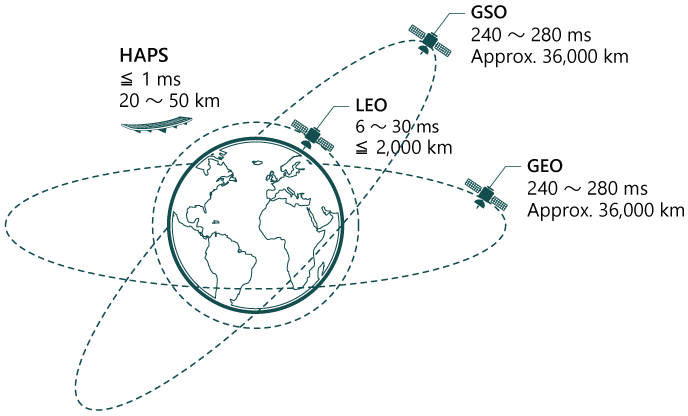
Communications satellites such as Geostationary Earth Orbit (GEO), Geosynchronous Orbit (GSO), Medium Earth Orbit (MEO), and Low Earth Orbit (LEO) satellites incur delays between the satellite and devices due to their distance from the ground. For example, GEO and GSO delays range from 240 to 280 milliseconds, while LEO delays range from 6 to 30 milliseconds. In addition, for non-GEO satellites, the satellite movement causes a Doppler shift in the radio signal frequency. Therefore, NTN-enabled IoT devices and mobile devices must compensate for delay and Doppler shift according to the 3GPP standard.
Challenge 2: Reselection and Roaming
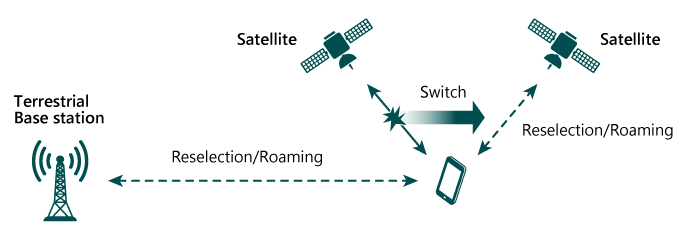
In terrestrial networks (TNs), IoT devices and mobile devices switch their registered base stations by monitoring the difference in signal strength between neighboring base stations. This process is called reselection, which is defined by 3GPP. The reselection for NTN also applies to switching from a TN to an NTN. In addition, the reselection is conducted while monitoring the exact location of the satellites and the devices. This results in a more complex operation than TN reselection. Furthermore, satellite communications, which easily cross borders, cause roaming with different operators, such as switching between a TN operator and an NTN operator. Therefore, when developing NTN-enabled IoT devices and mobile devices, engineers need to ensure that the roaming behavior complies with the 3GPP standard to enable seamless switching between operators.
NTN Device Test Solutions
Anritsu's NTN test solution provides a simulation and quality evaluation environment for NTN device development. This enables NTN devices to be validated without needing a connection to an actual satellite.

- RF TRx Testing
Anritsu offers the NTN NR test solution using Radio Communication Test Station MT8000A and the NTN NB-IoT test solution using Radio Communication Analyzer MT8821C. Both products provide a 3GPP-compliant test environment, and their simple operation and flexible parameter settings contribute to improving the efficiency of RF TRx tests.
- Protocol Testing
Anritsu's chipset protocol testing supports NTN NR with the Radio Communication Test Station MT8000A and NTN NB-IoT with the Signalling Tester MD8430A. Both products allow for rapid creation and evaluation of test cases, facilitating efficient protocol development and validation.
- Conformance Testing
Anritsu offers test solutions for conformance testing of chipsets and devices supporting the NTNs. These solutions include the New Radio RF Conformance Test System ME7873NR, which facilitates RF conformance testing for NTN NB-IoT and NTN NR, as well as the 5G NR Mobile Device Test Platform ME7834NR, which supports protocol conformance testing for NTN NB-IoT.
Resources

Article (PDF):
6G: From Spec-Driven to Experience-Driven — Enabled by Accurate Simulation
In 6G, evaluation is shifting toward a focus on user-perceived quality. However, real-world radio conditions constantly vary, making comparisons difficult. This article explains a method to evaluate the true performance of devices and chipsets by reproducing real-world signals in a lab using Field Simulation Test (FST).
White paper:
Next-Generation Technologies for Non-Terrestrial Network (NTN) Implementation
This document introduces the next-generation technologies in the future NTNs such as Network Optimization Using AI, Inter-satellite Optical Communications, and Quantum Satellite Network.
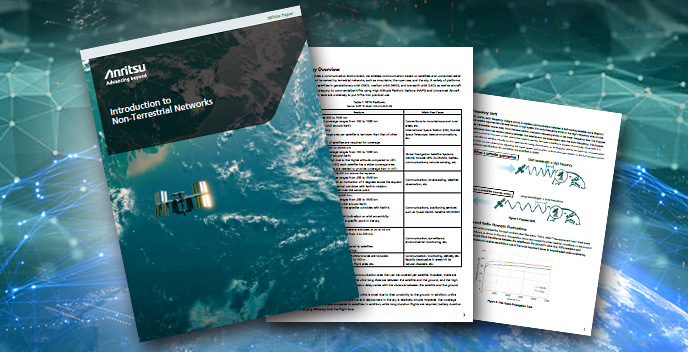
White paper:
Introduction to Non-Terrestrial Networks
This white paper describes the fundamentals and issues of NTNs, communication network systems that seamlessly connect mobile terminals which cannot be served by ground communication base stations.


Related Links







Related Products

Contact Us


Copyright 2026