



DisplayPort
Delivering High-Definition, Ultra-Reliable Video Transmission
DisplayPort (DP) is a digital interface standard for transmitting high-quality video and audio. The DP standard was established by the Video Electronics Standards Association (VESA), an industry organization supporting interface standards for PC video equipment, as a successor to the traditional analog VGA and DVI standards. DP supports high-resolution video, High Dynamic Range (HDR), and multi-display configurations, and has been widely adopted in devices such as monitors, PCs, and docking stations. With each version, DP continues to evolve; the latest, DP 2.1, supports transmission rates up to 80 Gbps and enables high-refresh-rate video. Additionally, given the versatility and widespread adoption of USB, there has been significant progress with integration with the USB Type-C specifications. For example, DP Alternate Mode (DP Alt Mode) * supports the simultaneous transmission of video, power, and data over a single USB Type-C cable. Enhanced cable and physical layer specifications also ensure stable communication, even over long distances.
* DP Alt Mode:
DP Alt Mode enables the transmission of DP signals through a USB Type-C connector. It is interoperable with the USB4 and Thunderbolt standards.
DisplayPort Test Challenges

Challenge 1: Need for Quality Assurance and Efficiency in Advanced DP Interfaces
With the ongoing release of new and improved DP versions, the demands for higher data rates and greater compatibility have become increasingly complex. This makes reliable communication and seamless interoperability more critical than ever. To ensure optimal performance of the receiver, or SINK, in the DP interface, verifying digital signal quality, tolerance to jitter, and noise immunity is crucial. Failing to check these elements thoroughly can result in an increased workload during both development and manufacturing and may also reduce product reliability.
Furthermore, the introduction of new features, such as DP Alt Mode in DP 2.1, has increased the need for comprehensive verification to confirm that SINK devices meet all required specifications. When engineers design products that comply with these updated standards, manual checking of transmission signal quality and device calibration can be highly time-consuming. As a result, the efficiency of both the verification and calibration processes must be optimal.
Challenge 2: Ensuring the Electrical Characteristics of the DP Interface
Devices and connectors that include the DP function as transmission lines carrying high-speed digital signals. When components such as semiconductors, printed circuit boards, electrical wiring, connectors, and digital communication cables do not have a sufficient operating frequency bandwidth, the system can experience problems such as signal loss and waveform distortion caused by crosstalk, which can prevent a system from attaining its designed level of performance. Also, ignoring impedance control in wiring and connectors can lead to reflections, adversely affecting the quality of digital signals. For these reasons, engineers need to evaluate the electrical properties and confirm that the required performance level is achieved during the development of devices and connectors.

DisplayPort Test Solutions
Solution 1: Ensuring Quality and Improving Verification Efficiency for DP Interfaces
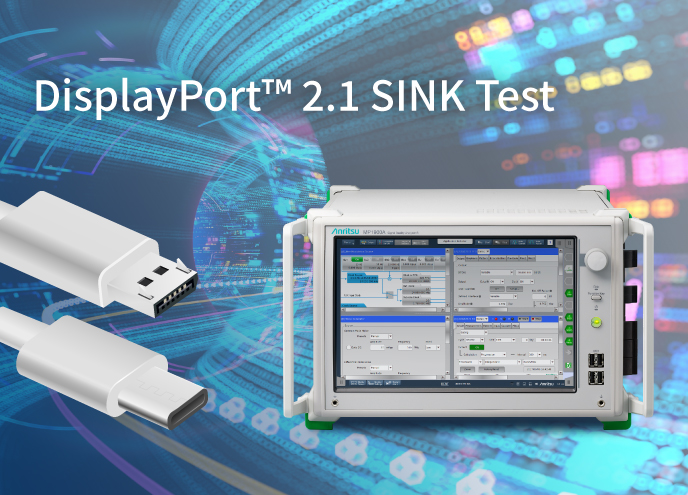
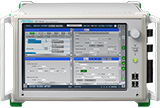
Anritsu’s Signal Quality Analyzer-R MP1900A supports transmission quality testing for DP 2.1 certification as well as for previous standards, including DP 2.0 and 1.4. A testing solution that combines the MP1900A with automation software from Granite River Labs or Teledyne LeCroy has obtained VESA certification for DP 2.1 SINK testing. This solution enables the complete automation of the data transmission quality and calibration verification procedures.
The MP1900A is equipped with a pulse pattern generator that outputs high-quality multi-channel NRZ signals over a wide frequency range, a highly sensitive error detector, and a jitter modulation source for detailed jitter tolerance testing. Integrating the MP1900A with a high-performance oscilloscope and automated measurement software gives a system that ensures reproducibility in SINK device testing for parameters such as bit error rate, jitter tolerance margin, and noise tolerance, while also significantly streamlining the testing process.
Solution 2: Ensuring the Quality of Products Equipped with DP-Compatible Hardware
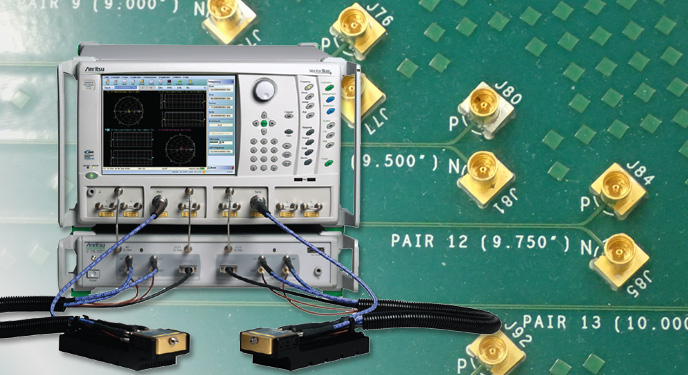
The frequency and reflection characteristics of printed circuit boards, components, and materials can be evaluated using a vector network analyzer.
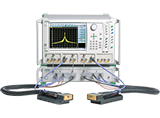
Anritsu’s ME7838 series and MS4640B series Vector Network Analyzers are used to verify the frequency and reflection characteristics (S-parameters) of printed circuit boards, materials, connection interfaces, connectors, and other hardware that incorporate DP. The impedance of electrical wiring can also be checked. When combined with a four-channel vector network analyzer, engineers can measure the crosstalk between electrical wires.
The MS4640B series supports measurements up to 70 GHz, while the ME7838 series covers frequencies above 110 GHz. These capabilities help maintain the electrical performance of DP interfaces.
Related Product:
- VectorStar Broadband VNA ME7838 Series
- VectorStar 4-Port Broadband VNA ME7838x4 Series
- VectorStar Family of RF, µW, mmW VNAs MS4640B Series
Product Introduction:
Case Study
Qualitas Semiconductor Co., Ltd.
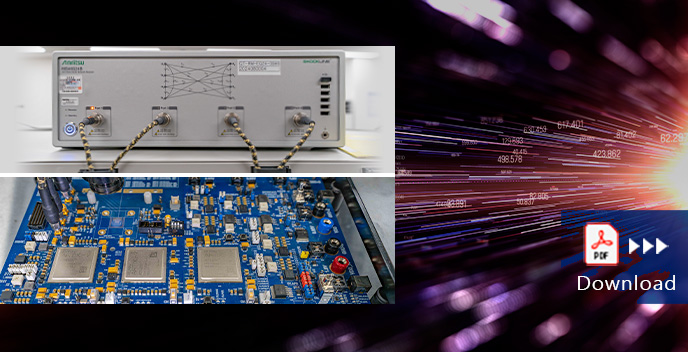
A leading company in high-speed interconnect IP development enhanced its verification capabilities and development efficiency by leveraging Anritsu’s vector network analyzer.
Resources






Related Products


Contact Us


Copyright 2026