



Universal Serial Bus (USB)
Accelerate your USB testing
The Universal Serial Bus (USB) is a protocol and hardware standard for connecting peripherals to other equipment, especially computers. Standards such as USB 3.2, USB4® Version 1.0, and Version 2.0 have been discussed and developed by the USB Implementers Forum (USB IF).
With the recent adoption of the USB Type-C connector, USB transmission performance has improved and is moving towards parity with HDMI, Thunderbolt, DisplayPort, and others. It also supports the USB Power Delivery (USB PD) standard for rapid charging, and enables simultaneous charging and the transmission of large files and high-resolution video with a single cable.

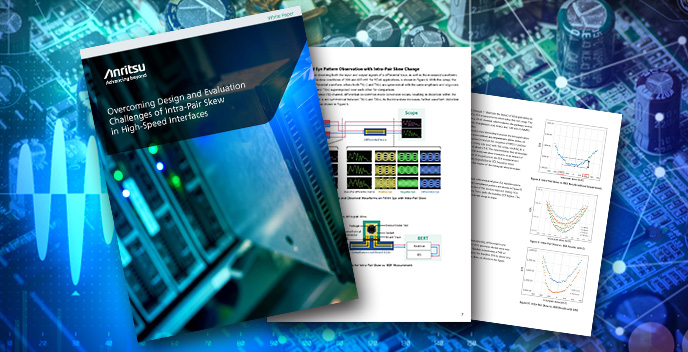
White Paper:
Overcoming Design and Evaluation Challenges of Intra-Pair Skew in High-Speed Interfaces
The impact of intra-pair skew in differential signals, such as PCIe and USB, is becoming increasingly apparent in high-speed digital transmission.
This white paper discusses the effects of intra-pair skew, the associated technical challenges, and methods for evaluating skew.
USB Testing Challenges
With the upgrading of the USB standard, the data transmission speed of the interface has increased, reaching 25.6 Gbaud with USB4 Version 2.0. At such high speeds, the effects of noise and jitter are increasingly difficult to ignore.
Additionally, since the connection of multiple USB devices and cables is permitted, signals carried by USB cables are easily degraded by device and cable transmission losses. Development engineers must tackle these difficult challenges by identifying sources of problems, such as noise and jitter, revising electrical wiring and peer layout, and providing the results back to designers. In addition to normal operation, validation of abnormal (error) scenarios is also required.
The USB standard specifies many test items, making the evaluation of USB devices a time-consuming process. It is also necessary to have measurement equipment that can evaluate the required performance each time a new version of the USB standard is developed. Reducing these man-hours and the capital investment is another challenge facing R&D.
USB Test Solutions in R&D
A bit error rate tester and an oscilloscope are used to perform the tests required to improve and maintain the digital signal quality of the physical layer of the USB device.
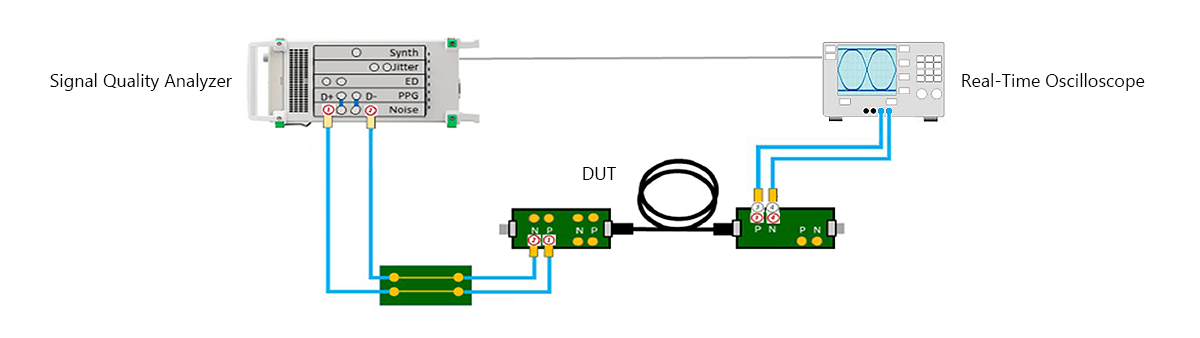
Anritsu's Signal Quality Analyzer-R MP1900A has an option which allows the supported standard to be upgraded from USB 3.2 to USB4 Version 2.0. In addition, the use of software to automate testing reduces the time required for testing.
Leaflet :
USB4 v2 Rx Compliance Test Solution
Transmitter and Receiver Tests
The transmitter (Tx) test uses a Real-Time Oscilloscope (RTO) to evaluate the rise/fall times, amplitude, eye width, jitter, and more of the reference clock and data-signal output from the USB device. In addition, the Phase-Locked Loop (PLL) bandwidth is measured by the RTO using the Pulse Pattern Generator (PPG) of the Anritsu Signal Quality Analyzer-R MP1900A as the signal source.
The receiver (Rx) test evaluates the USB device jitter tolerance, crosstalk, operating margin, and more, by using the MP1900A's PPG and Bit Error Rate (BER) measurement functions to apply stress, such as noise and jitter, to the electrical signals.
Anritsu’s Signal Quality Analyzer-R MP1900A is a high-performance, 8-slot modular BERT. It supports physical layer measurements of high-speed bus interfaces, such as PCI Express, using NRZ/PAM4 signals—all in a single instrument.
Furthermore, Anritsu’s Sequence Editor function option 051 for the SI and PAM4 PPG provides a comprehensive solution for everything from constructing test patterns and sequences for high-speed digital interfaces to executing those tests, combining both efficiency and reliability. The Sequence Editor features an intuitive GUI, making it easy to construct sequences for normal, abnormal, and stress test scenarios. This enables flexible testing aligned with compliance requirements, as well as validation of physical layer performance, reproduction of logical layer fault behaviors, and efficient root cause analysis.
Leaflet:
Protocol Tests
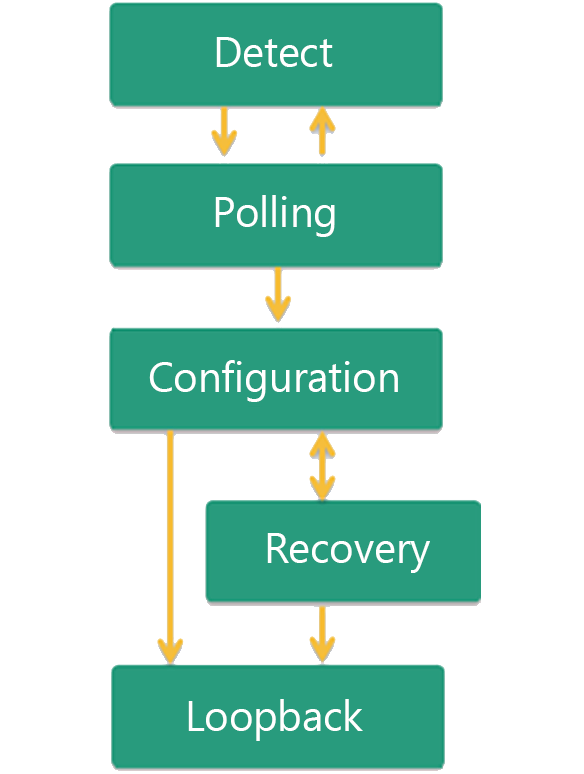
USB uses a Link Training and Status State Machine (LTSSM) to manage the state transition of the connection (link) in the PHY layer. The Protocol Test evaluates whether the LTSSM transitions normally. In addition, it can analyze Link Training and LTSSM when link problems occur to identify whether the cause is either a physical or logical error.
The Tx, Rx, and Protocol tests can all be executed by combining a supported RTO from a partner provider with the all-in-one Anritsu MP1900A which incorporates a PPG and BER tester.
In addition, it is easy to set complex test parameters by using the test software to automatically control the MP1900A and an RTO from a supported partner to reduce man-hours required for debugging and compliance testing.
Brochure:
Signal Quality Analyzer-R MP1900A - PCIe/USB/Thunderbolt/Display Port Test Solutions
Interconnect Tests
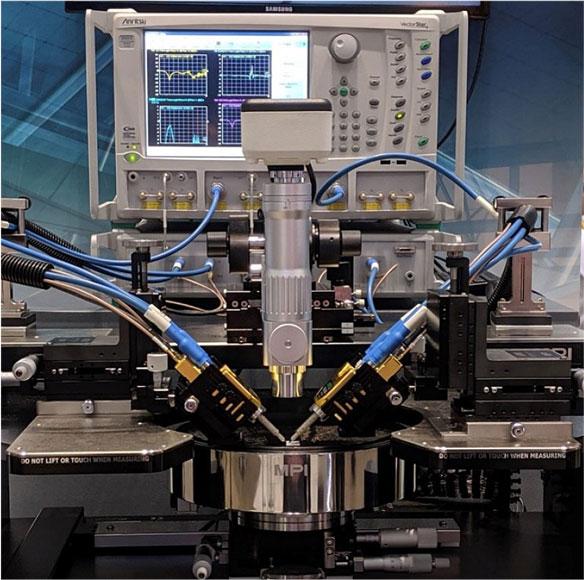
Debugging, such as characterizing causes of degraded signals in prototype devices under development, as well as improving performance, requires evaluating insertion and return losses. This is called an interconnect test.
Anritsu's Vector Network Analyzers, such as the ME7838 series and MS4640B series, can evaluate the frequency characteristics, reflection characteristics (S-parameters), and impedance of electrical wiring in hardware, including printed circuit boards with USB devices or materials.
White Paper:
Exploring VNAs: The Definitive Tool for Signal Integrity in High-Speed Digital Systems
Video:
Teledyne LeCroy × Anritsu
Anritsu offers USB test solutions in partnership with Teledyne LeCroy.
>>Learn More
Case Study
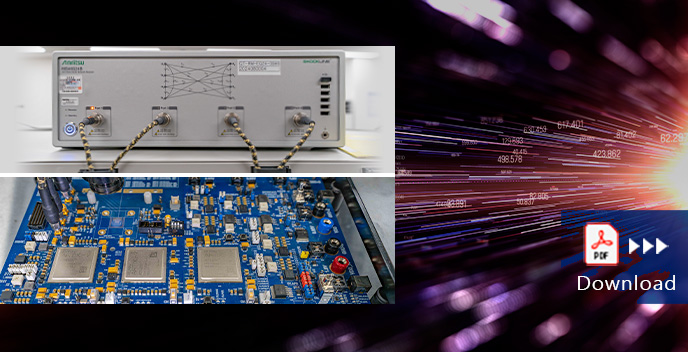
Qualitas Semiconductor Co., Ltd.
A leading company in high-speed interconnect IP development enhanced its verification capabilities and development efficiency by leveraging Anritsu’s vector network analyzer.
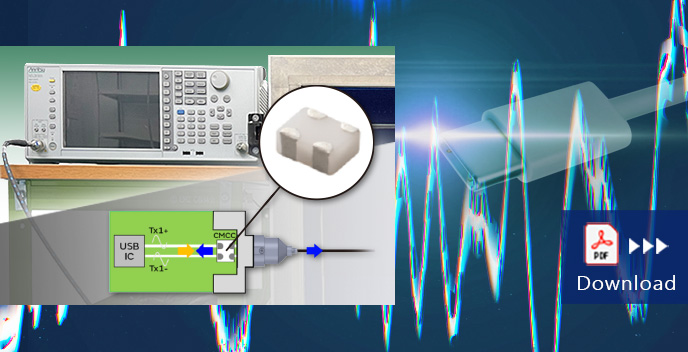
Murata Manufacturing Co., Ltd.
Addressing electromagnetic noise issues in USB 3.2 communication,
while establishing an evaluation environment compliant with RFI testing spec
Resources






Related Products


Contact Us



Copyright 2026