Header image

Bakery Product Inspection: Addressing the Misconceptions

17.09.2025
10 min

There’s a common misconception about bakery products: because they are considered “dry” product inspection, particularly metal detection, is thought to be less challenging than with wet foods such as meat or dairy.

It’s true that wet products present greater challenges for metal detectors. Metals are relatively easy to detect due to their conductivity and magnetic permeability, which create strong disturbances in a magnetic field. The difficulty with wet products is that water is also conductive. Moisture within a product can create a signal similar to that of metal, making it harder to distinguish between product and contaminant. This interference is known as the product effect, and it is also found in foods high in iron or salt, as well as in products packaged in metallized film.

But here’s the misconception: bakery products are often not as dry as they appear. For example, a loaf of bread straight out of the oven may have a dry crust, but the crumb inside retains significant moisture and remains hot. That heat further increases conductivity. Add moist fillings such as fruit or cream, or packaging made with metallized film, and the detection challenge increases even further.


Why Metal Matters in Bakery Production

Metal deserves particular attention in bakery inspection because it is the primary source of foreign material contamination. With most equipment manufacturers having eliminated plastics and rubbers from machinery design, metal is now the most common risk.

The first entry point for metal contamination is often bulk ingredients such as flour and sugar. These materials frequently pass through industrial grinders before delivery, where worn components can shed flakes that end up in the product.

Along the production line, contamination can occur at nearly any stage: during mixing, forming, or baking. Baking trays and conveyor belts exposed to high oven heat may crack or wear at the joints, leading to broken wires or links. Rollers, sprockets, and guide rails may also scrape or shear with repeated use, introducing additional risks.


Designing an Effective Bakery Inspection Line


There are several proven ways to reduce product effect and improve metal detection performance in bakery environments:

  • Minimize the aperture size – A smaller coil distance increases sensitivity. Products such as cookies or biscuits are typically inspected before packaging, while still in individual format, using very small aperture detectors.

  • Allow products to cool – For items like bread, inspections are best performed downstream from the oven, once heat and moisture levels have stabilized.

  • Use product-specific calibration – Detectors should be calibrated with product-specific settings (often called recipes). High-quality auto-calibration software is critical for phasing out product signal while maintaining the sensitivity required to catch the smallest contaminants.

Beyond Metal Detection

Metal detection is essential in bakery lines, but it should be complemented with other technologies.

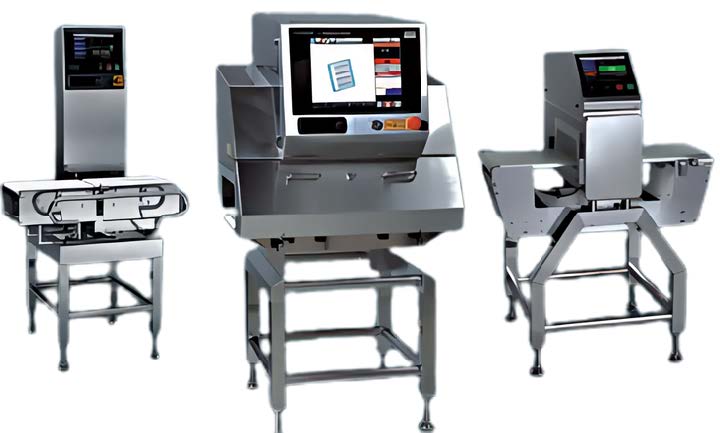
  • X-ray inspection systems – Because they measure product density, they are unaffected by moisture, salt content, or metallized packaging. X-rays can detect a wide range of contaminants (including non-metallic materials) and can also identify quality issues, such as broken items, missing components, or incomplete products.

  • Dynamic checkweighers – These ensure portioning accuracy and help reduce giveaway. Anritsu checkweighers include real-time feedback mechanisms that send data upstream to portioning or filling equipment, enabling continuous adjustments for improved consistency and reduced waste.

Inspection equipment is typically installed at three critical points:

  1. Raw ingredient intake – Free-fall metal detectors check incoming materials such as flour and sugar. Detecting metal here prevents contaminants from breaking down into smaller, harder-to-detect fragments later in the line.

  2. Post-oven – Bread is inspected after cooling; cookies and biscuits, which cool more quickly, can be inspected earlier.

  3. Post-packaging – For products wrapped in foil or metallized film, X-ray systems are preferred. They are also valuable for quality assurance and detecting non-metallic contaminants.

The Business Case for Quality Inspection Equipment

Although inspection systems don’t make bakery products, they are a form of insurance with measurable returns, not just a regulatory cost. Metal detectors, X-ray systems, and checkweighers help bakeries:

Reduce giveaway

By sending feedback to portioning systems for dough, fillings, or inclusions, checkweighers help minimize overfill.
Example: A bakery producing 800 g loaves reduces giveaway from 15 g to 8 g per loaf using checkweigher feedback. At 50,000 loaves per month, this saves 350 kg of ingredients monthly. With flour accounting for 60% of loaf weight at $0.80/kg, plus other ingredients, the total monthly savings reach $2,100-over $25,000 annually from just one bread line.

Prevent quality issues

Such as underweight products, broken items, or incomplete composite goods, reducing customer complaints and product loss.

Catch contamination early

Detecting metal in a 1,000 lb batch of flour could prevent up to 1,800 lbs of finished bread from being contaminated.

Maintain compliance and protect brand trust

While the FDA considers hard or sharp foreign objects between 7 mm and 25 mm hazardous in ready-to-eat foods, retailers often impose stricter standards. Even smaller fragments can harm brand reputation and raise doubts about process control.

Minimizing False Rejects

The only scenario worse than shipping contaminated products is discarding safe ones. False rejects are costly because they cause:

  • Product waste – Rejected items are often damaged and cannot be reworked, leading to lost ingredients and reduced throughput.

  • Production downtime – Bakery lines operate continuously, with little or no buffer storage between mixing, baking, and packaging. A single stoppage can disrupt the entire flow.

High-quality inspection systems with advanced auto-calibration can significantly reduce false rejects. By managing the margin between product signal and the metal-detection threshold, superior algorithms adapt to product variations and maintain accuracy without unnecessary waste.

Supporting Bakery Manufacturers

Our range of inspection solutions including models with inspection widths up to 1500 mm for biscuit lines, addresses both performance and budget requirements. With metal detectors, X-ray systems, and checkweighers working in combination, bakeries can ensure safety, maintain compliance, protect their brand, and improve profitability.

Learn more about how Anritsu’s inspection solutions can support your quality and safety goals.


Download The Full Guide Here
undefined

Get it right from the start

Select a country/region