To ensure the safety of patients, pharmaceutical products are inspected at multiple stages of their
manufacturing process using metal detectors, X-ray systems, and checkweighers. In this article, we’ll
examine a typical production line of tablets and capsules, explaining where these inspection systems are
located, and how they help ensure the quality and safety of pharmaceutical products.
Upstream Inspection: Metal Detection for Granulated Ingredients

At the beginning of the production line, raw ingredients are milled, sifted, and mixed, before entering
the granulation process, where powders are converted into granules of larger particles.
It’s at this point that products are first inspected with a metal detector. This check is crucial to
ensure that granules are not contaminated with metal fragments. Despite being made with high-grade
stainless steel, equipment used in pharmaceutical manufacturing contains numerous moving and rotating
parts, which could potentially become damaged and release metal flakes. Detecting contaminants early in
the production process will prevent contamination from spreading to large batches downstream.
Instead of a conveyor belt, the metal detector employs a free fall system, where granules descend through
a vertical chute. The detection head features a small aperture with coils close to each other, improving
sensitivity to stainless steel. The rejection unit, located below the detector head, is equipped with
position-monitoring sensors that ensure contaminants are properly rejected. In case of unexpected
shutdown, a failsafe mechanism directs the rejection gate to the non-good position, automatically
rejecting granules.
The metal detector is designed to resist vibration and noise from peripheral devices, which could
otherwise interfere with the electromagnetic field and cause false positives.
Midstream Weight Verification: Checkweighers for Pre-Lock Capsules
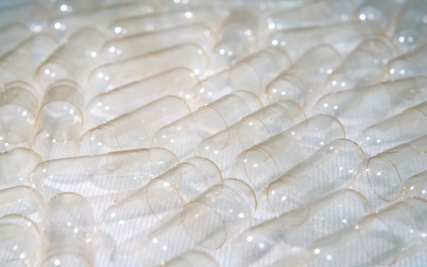
Before capsules are filled, body and cap (the two parts of hard-shell capsules) are joined together in
pre-lock position. As even the slightest variations in the weight of shells can affect the filling process
and the overall quality of capsules, accurate weight of empty shells is measured with a checkweigher.
Checkweighers for pre-locked capsules are designed to provide stable feeding, preventing shells from
bouncing and minimizing product vibration for accurate weighing. They are equipped with a force balance
cell that uses a positioning sensor and electromagnetic force to measure mass, achieving accuracy of ±0.5
mg.
Midstream Contaminant and Weight Control: Tablets and Filled Capsules
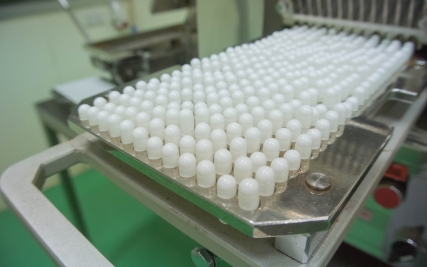
After capsules or tablets are fully formed, they pass through another metal detector that, although not a
free-fall type, takes advantage of gravity by directing products through a sloped antistatic chute. This
design prevents static electricity buildup, which could cause false detections. As with the earlier
detector, the small aperture allows for accurate inspection with high throughput.
The next inspection step involves a checkweigher for tablets and filled capsules, similar to the one used
for pre-locked capsules. Precise weight is crucial for capsules and tablets containing active
pharmaceutical ingredients, as even the slightest variance can have a large impact on a drug's efficacy or
cause adverse side effects.
Since each capsule and tablet must be weighed individually, these machines are equipped with multiple
lanes (up to 30), which can process up to 230,000 capsules per hour with great accuracy.
Downstream Inspection: X-Ray Systems and Final Checkweighing After Packaging

After tablets and pills have been packaged into blisters, they go through an X-ray machine. X-rays
systems are capable of detecting both foreign materials (ferrous and nonferrous metals, as well as
nonmetallic materials) and quality defects, such as missing or broken tablets in blisters.
In the remaining stages of the production line, as the products undergo extra packaging steps, two more
checkweighers are employed: one after other intermediate packaging machines (such as stretch banding for
PTP sheets or pillow packaging), and one after all products have been cased, just before palletization.
The primary goal of these final checkweighers is to identify any missing blisters or cartons.
