


Product-Related Activities
Contributing to solving social issues through our products
Anritsu Group provides products that deliver measurement technology to customers, fostering innovation together with them and contributing to solving social challenges in the environmental field.
Examples of initiatives that contribute to solving social issues by business segment
| Business Segment | Areas of Contribution | Major Activities |
|---|---|---|
| Test and Measurement Business | Reduction of CO₂ emissions through widespread use of electric vehicles | Quality assurance of telecommunications equipment installed in electric vehicles |
| Conservation of resources in the manufacture of measuring instruments, and reduction of CO₂ emissions during customer use | Provision of compact and lightweight measuring instruments that run on batteries | |
| Conservation of resources through longer life, higher functionality, and multifunctionality of measuring instruments (hardware) | Provision of software-based measurement solutions | |
| Provision of measuring instruments that can test multiple mobile terminals with a single unit and measuring instruments that can perform multiple measurement functions in a single unit | ||
| Conservation of resources through longer life of measuring instruments (hardware) | Provision of refurbished measuring instruments | |
| PQA Business | Effective use of food resources, reduction of food loss (resource conservation) | Provision of inspection equipment that can test the quality of food and pharmaceutical products at high speed and with high sensitivity |
| Saving energy and reducing CO₂ emissions during product use | Elimination of the need for a cooling function by suppressing heat generation in the X-ray inspection system | |
| Environmental Measurement Business | Reduction of CO₂ emissions through widespread use of electric vehicles | Provision of measuring instruments for quality evaluation of batteries used in electric vehicles |
| Adaptation to climate change (disaster prevention and mitigation for natural disasters) | Provision of wide-area video monitoring systems for rivers and roads | |
| Sensing & Devices Business | Conservation of resources and reduction of CO₂ emissions by reducing the number of additional data centers | Provision of semiconductor optical amplifiers that enable the introduction of long-distance transmission systems |
Environmentally friendly products
Regarding the Anritsu Group's overall CO₂ emissions, Scope 3 Categories 1 and 11, which are related to products, account for 73% (FY2024 results).
Therefore, each business division provides products that meet customer requirements in terms of functionality and performance while also reducing environmental impact through measures, such as by reducing CO₂ emissions and promoting resource conservation.
The Anritsu Group has established its own certification system for environmentally friendly products. We conduct global assessments for every product under development and, based on the results, certify them as "Excellent Eco-Products" or "Eco-Products." We aim to develop only environmentally friendly products by clarifying the certification criteria.
Global Product Assessment
To develop environmentally friendly products globally, we sought to ensure consistency between product assessment carried out by Anritsu Group companies in Japan and the assessment criteria of Design for Environment (DfE) followed by Anritsu Company (U.S.A.). We implemented global product assessments in fiscal 2014.
■ Operational Procedure
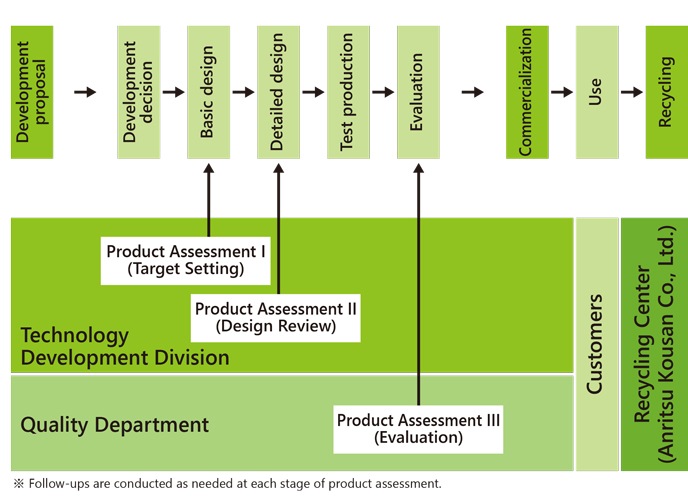
Global product assessments are conducted in three stages that must be concluded prior to commercialization: Product Assessment I (Target Setting), in which targets for the product development process are clarified; Product Assessment II (Design Review), in which progress on attaining the targets is reviewed; and Product Assessment III (Evaluation), in which a final assessment on the product is conducted. During Product Assessment III, a thirdparty evaluation is conducted by Quality Department and other entities.
■ Details of Product Assessments
Global Product Assessment consists of basic items that evaluate improvements in volume, mass, and power consumption compared to a reference product, and evaluation items (see table below) that assess reductions in environmental impact during resource conservation, reduction of hazardous substances, manufacturing, logistics, use, and disposal. The reference product is a conventional product that is similar in function and performance to the product being assessed.
After the new product evaluation phase, we conduct a Life Cycle Assessment (LCA) to review CO₂ emissions in each process of the product life cycle.
The results of product assessments and LCA are utilized in the design of next-generation products, contributing to the development of products with a lower environmental impact.
| Assessment Items | Details |
|---|---|
| Implementation of LCA |
|
| Resource saving/Reduced load during manufacturing |
|
| Reduced harmful substances |
|
| Reduced load in physical distribution |
|
| Reduced load during use |
|
| Reduced load at time of disposal |
|
Environmentally Friendly Product Program
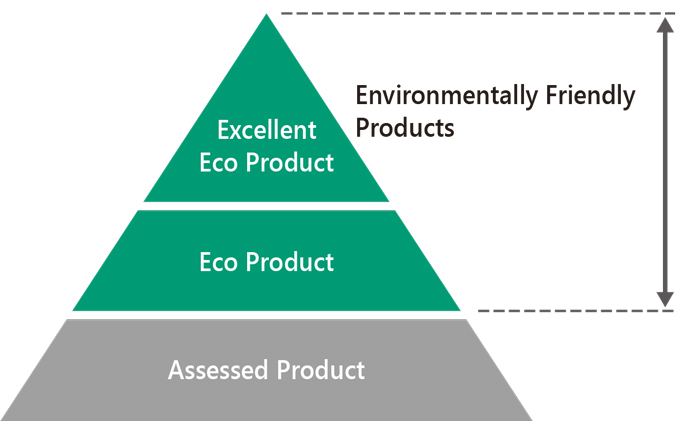
Anritsu Group has established an environmentally friendly product program that certifies products as the Excellent Eco Product and Eco Product based on the results of global product assessment.
| Category | Details |
|---|---|
| Excellent Eco Product | Product that meets Excellent Eco Product requirements |
| Eco Product | Product that meets Eco Product requirements |
| Assessed Product | Product that meets Assessed Product requirements |
■ Major Environmentally Friendly Criteria for Excellent Eco Products
- Top industry ranking for environmentally friendly properties
- Environmental information ready for disclosure
- CO₂ emission evaluated by Life Cycle Assessment (LCA)
- Environmental management system in place at the relevant business entity and main production
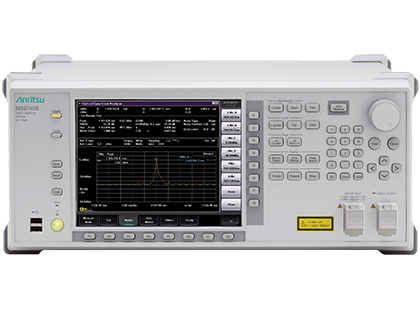
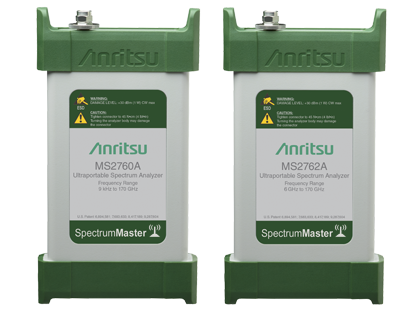
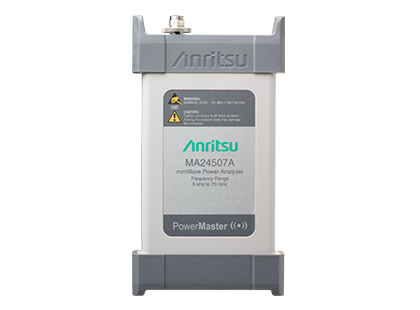
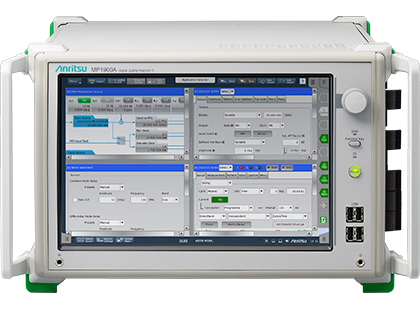
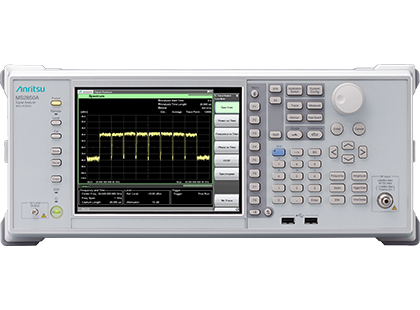
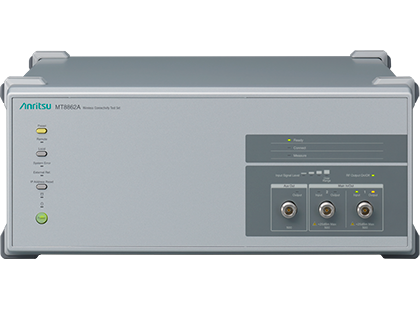
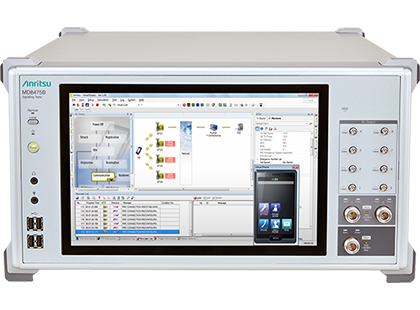
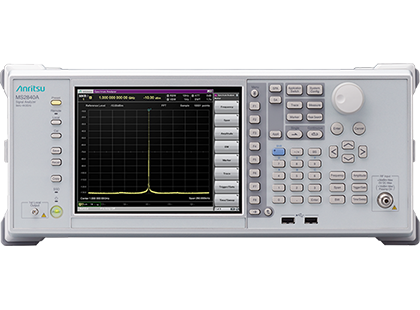
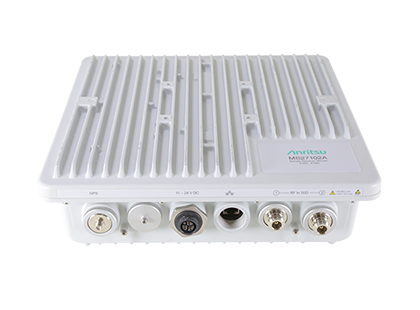
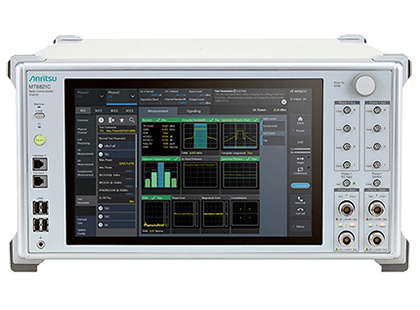
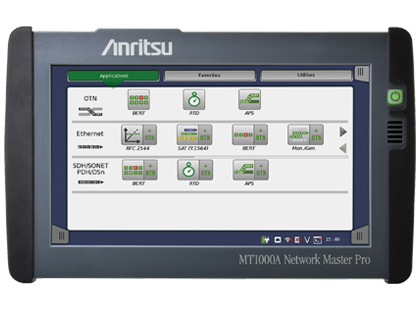
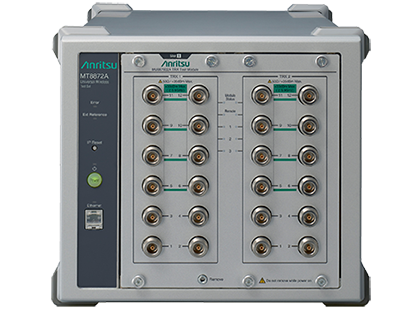
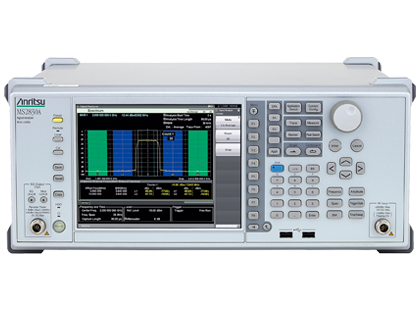
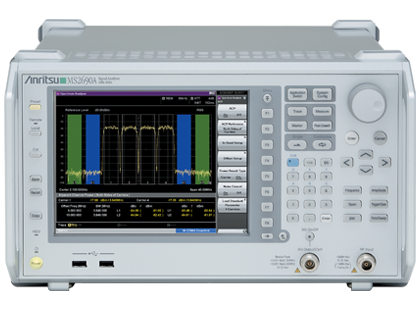
As of the end of fiscal year 2024, there are 19 Excellent Eco-Product models and 65 Eco-Product models on sale. In FY2024, environmentally friendly products accounted for 97% of overall sales of measuring instruments, and Excellent Eco-Products accounted for 91%.
The Domestic Group calculates the economic benefits of environmentally friendly products. The estimated economic impact for FY2024 was 96 million yen.
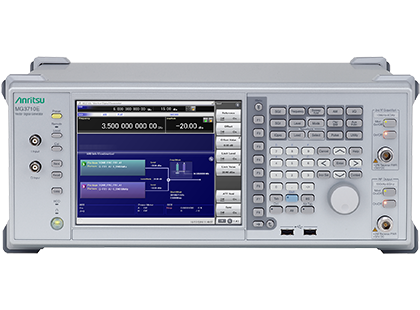
■ Excellent Eco Product Outline (On Sale)


Green Procurement
The Anritsu Group has established the Anritsu Group Global Green Procurement Specification to promote green procurement, giving priority to the purchase of environmentally friendly parts and materials.
 Your Privacy Choices
Copyright 2026