


Creating a Comfortable Working Environment
Policy
The Anritsu Group has made "Work Style Reform" a key management strategy. We are promoting the creation of an environment in which a diverse range of employees can balance their private lives and work while increasing their productivity, based on the company's environmental improvement policy: "Developing systems and an environment that support both "making Anritsu a company where we can work comfortably and enjoy our lives with consideration for work-life balance" and "making Anritsu a company where labor productivity is high and work is rewarding."
We have also identified "responding to changes in the work environment and work style" as one of the priority human rights issues to be addressed going forward, and are promoting the creation of a comfortable working environment from the perspective of respecting human rights.
The collective labor agreement signed with the Anritsu labor union also stipulates necessary matters regarding working conditions, such as working hours, overtime, and various types of leave.
Activities and Achievements
Creating an Environment for Work-Life Balance
Anritsu Group has made "Work Style Reform" a key management strategy, aiming to enable each employee to work according to their lifestyle and improve productivity.
We are implementing measures to diversify work styles and career paths, such as introducing a teleworking system, increasing the number of teleworking days for childcare and nursing care, promoting the use of childcare leave by men, and establishing a new management track that enables flexible working arrangements tailored to life events.
In FY2024, we introduced a mid-workday flextime system and a system for taking paid leave on an hourly basis, creating a more flexible work environment for employees working while raising children or caring for family members.
We hold labor-management meetings through the Committee for Promoting Work-Life Balance on a timely basis to support the need to balance work with childbirth, childcare, and nursing care, and we are considering expanding the systems.
Childcare Support
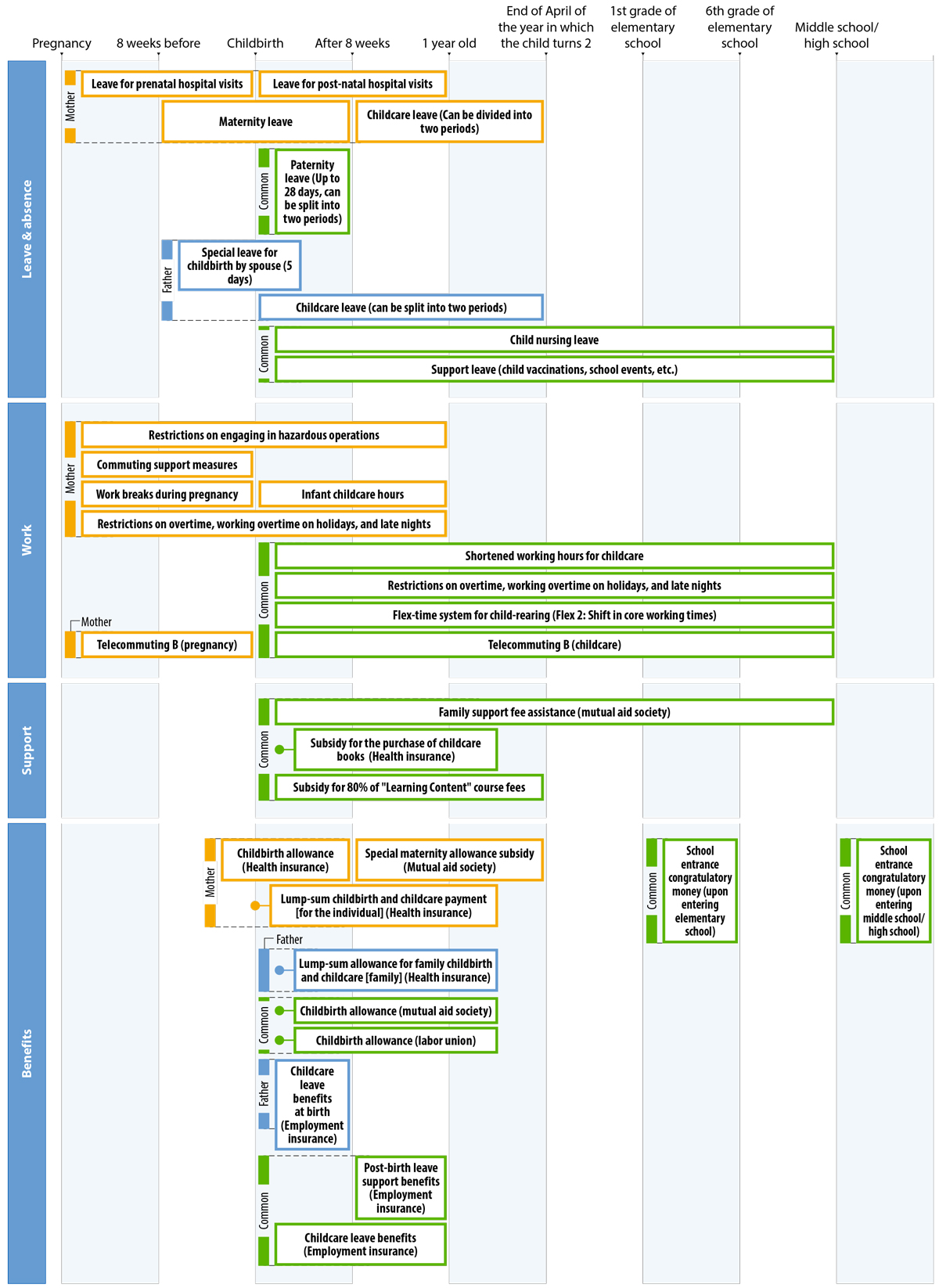
Anritsu has formulated an action plan to support the development of the next generation in accordance with the Act on Advancement of Measures to Support Raising Next-Generation Children* and is working to realize this plan. During childbirth and childcare, we have built an environment in which employees can balance childcare and work by providing leave, leave of absence, and shortened working hour systems that exceed legal requirements.
As a result of these efforts, in March 2025, we received Platinum Kurumin certification from the Minister of Health, Labour and Welfare as a company that supports child rearing. Platinum Kurumin is a program that recognizes companies among Kurumin-certified employers that demonstrate particularly outstanding initiatives.
As one of our key initiatives in recent years, we have set a goal of achieving a 100% childcare leave utilization rate among male employees, and have been actively working to foster a culture and environment that encourages men to take childcare leave. When an employee notifies us of an expected childbirth, our HR staff conducts an interview to explain available support systems and confirm their intention to take childcare leave. As a result of these efforts, the childcare leave utilization rate among male employees increased by 4.9 percentage points from the previous year, reaching 95.2% in FY2024.
* This law stipulates the responsibilities and requirements of the national government, local governments, public organizations, corporations, and citizens in order to create an environment in which the children of the next generation can grow up in good health.
Anritsu Corporation's Action Plan to Support Child-Rearing
(7th Stage: April 1, 2024 to March 31, 2027)
| Target | Measures | Actions |
|---|---|---|
| Improve working conditions toward workstyle reform | Review and improve the workplace environment so employees have a better work-life balance | From April 2024: Considering and designing a flexible system that offers workstyle options (such as hourly use of paid leave) |
| Draw up, consider, and implement a plan for revising and reinforcing childcare systems | Cultivate a workplace culture in which employees feel free to take days off or leave for a better work-life balance | From April 2024: Promoting a workplace culture that is more supportive of male employees taking childcare leave |
Anritsu Childcare Leave Results
| Gender | FY2021 | FY2022 | FY2023 | FY2024 | |
|---|---|---|---|---|---|
| Total number of employees who have had children | Male | 19 | 31 | 31 | 21 |
| Female | 8 | 9 | 7 | 10 | |
| Total number of regular employees who have started childcare leave | Male | 7 | 14 | 28 | 20 |
| Female | 8 | 9 | 8 | 10 | |
| Rate of employees who took childcare leave*1*2 (%) | Male | 36.8 | 45.2 | 90.3 | 95.2 |
| Female | 100.0 | 100.0 | 114.3 | 100.0 | |
| Total number of regular employees who have returned to work after childcare leave | Male | 7 | 12 | 23 | 26 |
| Female | 8 | 5 | 9 | 5 | |
| Rate of regular employees who returned to work after childcare leave (%) | Male | 100.0 | 100.0 | 100.0 | 100.0 |
| Female | 100.0 | 100.0 | 100.0 | 83.3 | |
| Total number of regular employees who returned to work in the fiscal year before last and were still employed 12 months later | Male | 2 | 4 | 7 | 11 |
| Female | 4 | 7 | 8 | 5 | |
| One-year retention rate of regular employees who returned to work after childcare leave (%) | Male | 100.0 | 100.0 | 100.0 | 91.7 |
| Female | 100.0 | 100.0 | 100.0 | 100.0 |
*1 Rate of employees who took childcare leave: Total number of regular employees who started childcare leave ÷ Total number of regular employees who had children
*2 The rate is higher than 100% because the total number of regular employees who started childcare leave includes those who have had children during the previous fiscal year or earlier and started childcare leave during the current fiscal year, apart from those who have had children during the current fiscal year.
Parenting and Childcare Programs (As of April 1, 2025)
Optimization of Working Hours
Anritsu is actively promoting the reduction of overtime work through management-led initiatives, rigorously enforcing attendance management to optimize working hours. In FY2024, the average monthly overtime hours per employee in the domestic group was 9.3 hours, a 19% reduction from FY2022.
Participation in an Industry Group on Labor Standards
Anritsu participates in the Japan Employers' Federation of Electrical, Electronics & Information Industries, and uses information provided by the organization and exchanged with other members to review and improve working conditions. We also cooperate with the federation's policy recommendations to relevant governments and business associations.
Improving Employee Engagement
■ Engagement Surveys
In order to maximize the potential of each employee, it is important to increase engagement by improving satisfaction related to "workplace comfort" and "job satisfaction." The Domestic Group conducts an annual engagement survey of all employees to understand the current status and identify issues, and uses the results to consider measures that contribute to improving job satisfaction.
Results of Engagement Survey
Units: %
| FY2021 | FY2022 | FY2023 | FY2024 | |
|---|---|---|---|---|
| Response rate | 97.2 | 98.3 | 97.1 | 94.7 |
| Satisfaction with the workplace | 90.4 | 89.5 | 88.7 | 88.4 |
| Satisfaction with work | 75.0 | 71.9 | 71.1 | 71.8 |
* Satisfaction = Positive responses (ratio of those who are "Strongly agree" and "agree")
* The survey used a 4-point rating scale, which included the options 'disagree' and 'strongly disagree' in addition to the above items.
■ Role-Sharing Interviews/Self-Assessment Interviews
Anritsu conducts role-sharing interviews and self-assessment interviews between supervisors and subordinates with the aim of improving job satisfaction and supporting the independent career development of each employee.
Role-sharing interviews are held every six months to share departmental goals and expectations for members and their roles, as well as to review work performance. Self-assessment interviews are held once a year, and are a chance for employees to share their career plan with their supervisor. In addition, personnel evaluations are carried out regularly at all group companies, including overseas.
■ Employee Awards
The Anritsu Group has a variety of award programs. Each year, awards are presented to projects and teams that have made significant contributions to the company's performance, as well as to individuals who have served as role models for employees. In FY2024, awards were given for 2,682 employees in total. In preparation for the 2025 awards, we have introduced a framework that incorporates non-financial indicators into the evaluation criteria, enabling fair recognition of diverse contributions.
By creating opportunities to praise employees for their contributions to business performance, personal growth, and work performance, we aim to create an environment in which employees and the company can work together and grow together in a rewarding manner.
| Category | Details | Results for FY2024 | |
|---|---|---|---|
| Number (Awards) | Number of Recipients | ||
| President's Award | Developing new markets, contributing to national projects | 3 | 843 |
| Performance-Related Awards | Outstanding contribution to business performance | 19 | - |
| Commendation for Achievement | Projects and individuals who have achieved particularly outstanding results | 9 | 102 |
| High Performer Award | Award for exemplary employee behavior and performance | 103 | 104 |
| High Performer of the Year | Particularly outstanding individual from among the High Performer Award recipients for the year | 6 | 16 |
| Patent-Related Awards | Performance related to attributed patents, utility models, and designs | 275 | 598 |
| AQU Innovation Award | Award for ingenious improvement ideas, results of business reform and improvement | 325 | 966 |
| Healthy and Safe Workplace Award | Particularly outstanding annual health and safety management activities | 6 | - |
| Long Service Award | Regular employees who have worked faithfully for many years | - | 53 |
 Your Privacy Choices
Copyright 2026