



PCIe® 7.0 Device Test Solutions
Validates 128 GT/s PAM4 signal integrity for PCIe® 7.0 under realistic test conditions
In AI servers and data centers, data traffic between GPUs and accelerators is increasing rapidly, pushing conventional interconnect technologies toward their bandwidth limits. PCI Express® 7.0 (PCIe® 7.0) has been introduced to address this.
PCIe 7.0 uses PAM4 signaling, enabling the data rate to be increased to 128 GT/s. However, PAM4 signaling increases sensitivity to channel loss, reflections, and noise, making design validation and signal integrity evaluation significantly more challenging.
PCIe 7.0 testing is highly sensitive to even minor variations in test conditions, which can lead to inconsistent measurement results, further complicating design validation. To ensure accurate and repeatable evaluations, engineers need to establish stable test environments while complying with industry-standard test requirements.
As the transmission speed increases, electrical transmission distances become more limited, rendering conventional electrical channels insufficient for board-to-board and rack-to-rack communication. To overcome this challenge, Optical Aware Retimers have been emerged as a key enabling technology for systems that rely on optical links to extend transmission reach beyond the limits of electrical channels.
However, as of June 2025, industry-wide specifications and evaluation methodologies for PCIe-based optical interfaces remain under development. Consequently, companies developing and evaluating Optical Aware Retimers often need to define their own test methodologies and build dedicated test environments.
PCI-SIG®, PCIe® and PCI Express® are registered trademarks of PCI-SIG.
Challenges in PCIe 7.0 Device Testing

Challenge 1: Ensuring Test Repeatability for PCIe 7.0 Devices
The reduced signal margins of PCIe 7.0 make signal quality increasingly dependent on the characteristics of channels composed of packages, PCBs, and connectors. Channel loss, impedance discontinuities, and reflections can significantly distort transmitted signals.
During design validation, engineers evaluate not only device functionality but also jitter and noise tolerance to ensure performance requirements are met. However, variations in test signal quality and measurement conditions can significantly affect measurement results, even when evaluating the same device, making it difficult to accurately assess device designs.
Therefore, establishing a highly repeatable test environment is essential. Without it, development teams may face extended debugging cycles and repeated testing, leading to delays in product development.
Challenge 2: Designing Test Environments for Optical Interfaces
With the introduction of Optical Aware Retimers, which compensate for transmissions across both electrical and optical domains, PCIe links now incorporate both optical signal paths and traditional electrical signaling.
Within optical transmission sections, the performance of electrical-to-optical (E/O) and optical-to-electrical (O/E) converters strongly influences overall link behavior. However, test methodologies and evaluation criteria for these components are not currently defined by industry standards.
Therefore, individual vendors must establish their own testing conditions. However, differences in these conditions can lead to inconsistent measurement results, making direct comparisons difficult. For systems incorporating optical interfaces, designing and maintaining appropriate test conditions and test environments is a major challenge.

PCIe 7.0 Test Solutions
Solution 1: Creating a Repeatable and Stable Test Environment
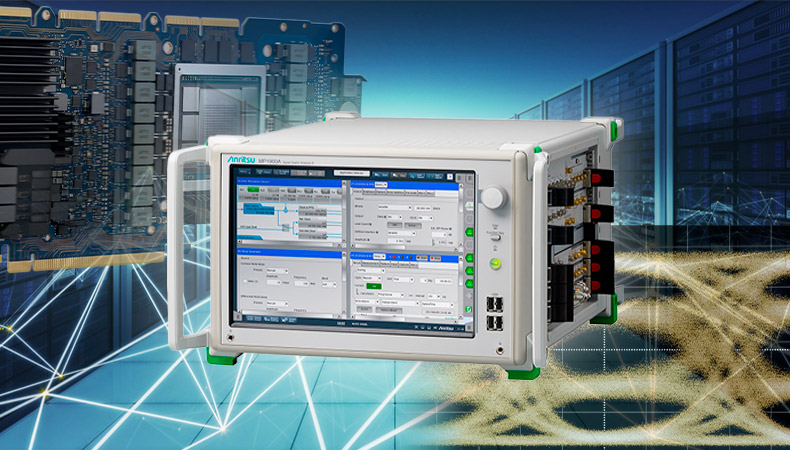
The Signal Quality Analyzer-R MP1900A generates PCIe 7.0-compliant 128 GT/s PAM4 signals, and it provides a stable receiver test environment through signal calibration and controlled jitter and noise injection.
This enables accurate receiver performance evaluations while minimizing measurement variability, allowing engineers to more easily determine whether differences in measurement results originate from test conditions or design modifications.
As a result, design validation becomes more reliable, reducing the need for repeated testing and shortening debugging times.
Solution 2: Integrated Electrical and Optical Interface Characterization
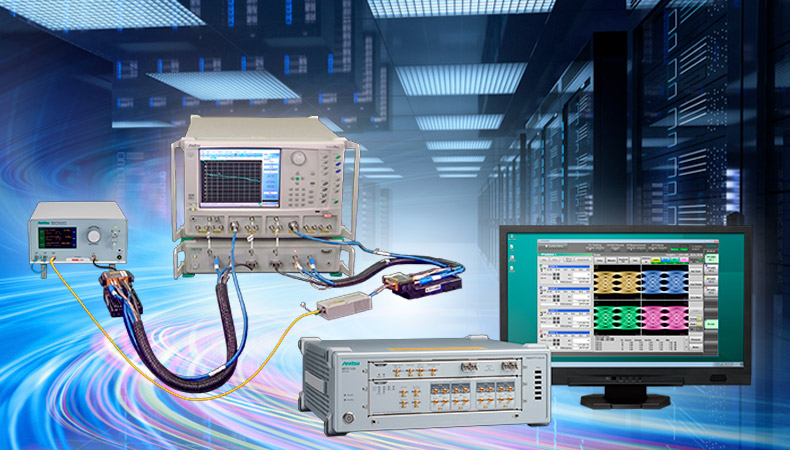
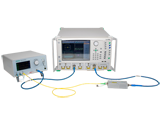
The Opto-Electronic Network Analyzer ME7848A enables high-accuracy characterization of E/O and O/E converters, including frequency response and reflection and transmission characteristics (S-parameters). This enables engineers to quantitatively evaluate the transmission characteristics of systems that have optical segments.
In addition, combining the sampling oscilloscope BERTWave MP2110A and the Optical Spectrum Analyzer MS9740B enables comprehensive characterization of optical eye patterns, multi-lane performance, optical wavelength and optical power, as well as optical signal-to-noise ratio (OSNR).
Combining these solutions provides a consistent methodology for evaluating complete systems that incorporate optical interfaces while reducing testing variability caused by vendor-specific test methodologies.
Resources

See More


Related Products


Contact Us



Copyright 2026