



AI Semiconductor Test Solutions
To assure the signal quality of hardware for providing AI services
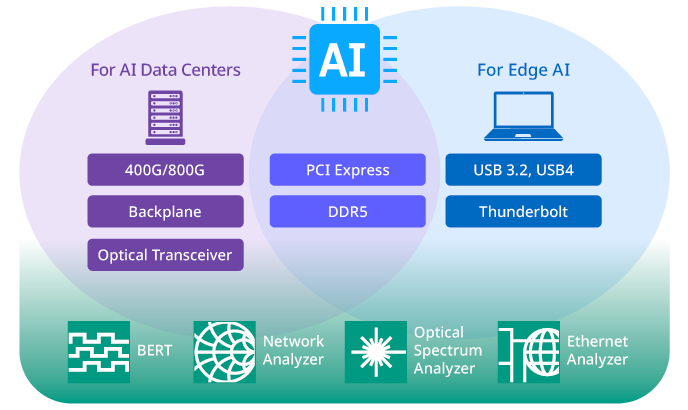
A rapid expansion in the use of artificial intelligence (AI) and machine learning (ML) accelerates technological innovation, including GPUs, AI ASICs, and AI accelerators used in data centers and networks, as well as the hardware components, such as printed circuit boards and connectors that support these devices. This hardware needs to support the high-speed, large-capacity arithmetic processing of AI programs. This hardware is built using semiconductors that are designed specifically for AI processing, referred to as “AI semiconductors.” To support the exchange of huge amounts of data with external devices, AI semiconductors are required to transfer data faster and process it in real time with lower latency than conventional general-purpose processors. To satisfy these performance requirements, engineers must verify hardware by system-level testing that simulates the actual operation of the hardware.
Cloud AI
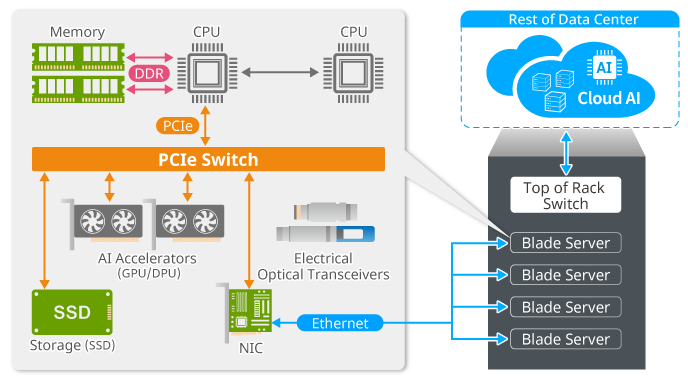
Cloud AI processes data held on a cloud server. Using servers operated by a service provider enables handling complex processes involving large amounts of data, generative AI, and so on.
PCIe is the commonly used interface between the CPU, the GPU board, and storage. Ethernet is the most common interface for communicating with the network. The data rate of the memory interface has increased from DDR4 to DDR5.
CPU: Central processing unit
DPU: Data processing unit
GPU: Graphics processing unit
NIC: Network interface card
Edge AI
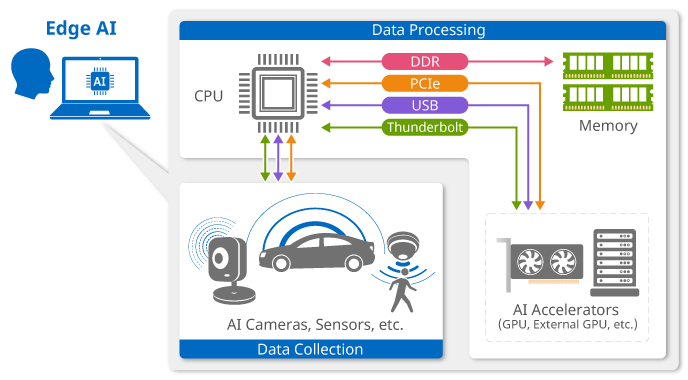
Deploying AI on local edge devices enables real-time data processing and analysis without having to rely on a cloud infrastructure.
Since the edge devices do not require any external communication, their processing can work quickly. For example, Edge AI is applied to image recognition using cameras, self-driving cars, and drones.
In the same way, as for Cloud AI servers, Edge AI devices use the PCIe and DDR interfaces. It occasionally uses Thunderbolt and USB as the camera and sensor interfaces.
AI Semiconductor Testing Challenges

Challenge 1: Ensuring the electrical characteristics of hardware that uses AI semiconductors
If the operating frequency bandwidth of the semiconductors that serve as the transmission lines for high-speed digital signals is insufficient, attenuation of the high-speed digital signals can occur. Additionally, if the bandwidth of the associated printed circuit boards, electrical wiring, connectors, cables for high-speed digital signal transmission, etc., is inadequate, distortion of the signal waveform due to crosstalk may also occur. As a result, hardware based on AI semiconductors may not perform as designed.
Furthermore, if engineers fail to consider the impedance of the electrical wiring and connectors in the design process, the signal quality will deteriorate due to factors such as the reflection of the digital signals. Therefore, during the hardware development phase, engineers need to evaluate the aforementioned electrical characteristics to ensure the required performance.
Challenge 2: Reducing the number of reworks in the design and manufacturing processes
To reduce the number of reworks and ensure the quality of the design and manufacturing of hardware incorporating AI semiconductors, verifying the quality of high-speed digital signals is important in terms of jitter, noise, and channel loss using actual signals in the post-silicon and prototype verification stages.

AI Semiconductor Test Solution
Solution 1: Ensuring the quality of products incorporating AI semiconductors
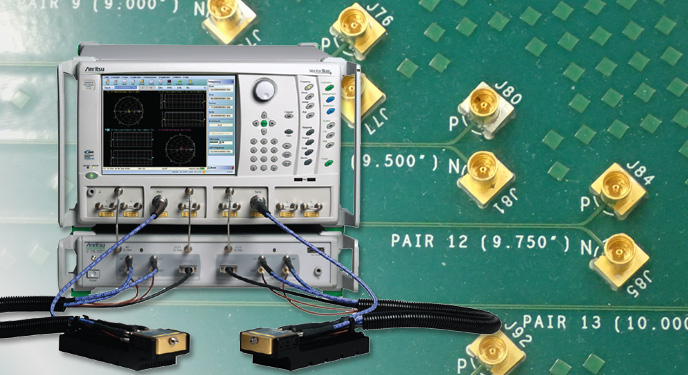
The frequency and reflection characteristics of printed circuit boards, components, and materials can be evaluated with a vector network analyzer.
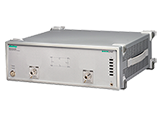
Anritsu’s ME7838 series and MS4640B series vector network analyzers can verify the frequency characteristics and return losses (S-parameters) of hardware such as AI accelerators and printed circuit boards on which AI semiconductors are installed, as well as the impedance of the electrical wiring. Users can also measure crosstalk between electrical wiring using a four-channel vector network analyzer. Furthermore, the Opto-Electronic Network Analyzer ME7848A is ideal for measuring the frequency characteristics of the optical components used in optical wiring.
The MS4640B series can evaluate a wide frequency bandwidth of up to 70 GHz while the ME7838 series supports a bandwidth of over 110 GHz, making them ideal for the evaluation of high-speed digital signals such as PAM4 that are handled by AI semiconductors and hardware, thus helping ensure the quality of products incorporating AI semiconductors.
The MS46522B is suitable for passive performance evaluation up to 43.5 GHz and works effectively in the manufacturing phase of direct attach cables (DAC), active electrical cables (AEC), active copper cables (ACC), and connectors used in data centers for connections within racks and between servers.
Related Product:
- VectorStar Broadband VNA ME7838 Series
- VectorStar 4-Port Broadband VNA ME7838x4 Series
- VectorStar Family of RF, µW, mmW VNAs MS4640B Series
- VectorStar Opto-Electronic Network Analyzers ME7848A
- ShockLine 2-Port Performance VNA MS46522B
Product Introduction:
Solution 2: Verification of high-speed digital signals in the development phase
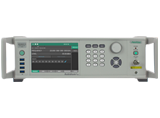
Anritsu’s Signal Quality Analyzer-R MP1900A can generate high-speed digital signals and evaluate the Bit Error Rate (BER). The MP1900A helps customers bring their products to market quickly by providing functions for evaluating and debugging the signal quality of high-speed digital systems at each stage of development, from the first silicon stage of AI semiconductors and the performance verification of prototype hardware including AI semiconductors, to compliance testing in their final form for commercial release.
Sampling oscilloscope BERTWave MP2110A can evaluate the eye patterns of high-speed digital signal waveforms and BER.
The MP2110A can verify the digital signal waveforms for up to four channels, helping to ensure the quality of hardware incorporating AI semiconductors while improving production efficiency.
Related Product:
Product Introduction:
High-Speed Serial Data Test Solutions for AI Semiconductors and Data Center
Leaflet:
Case Study
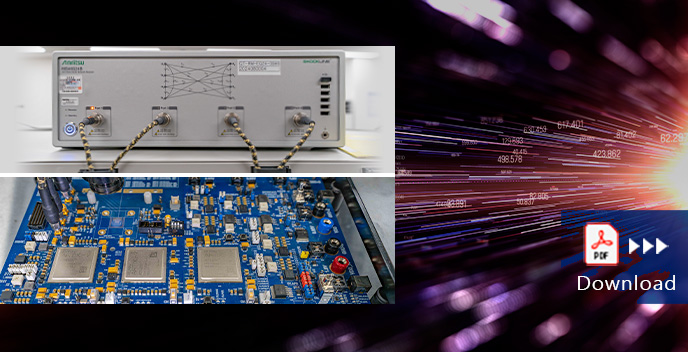
Qualitas Semiconductor Co., Ltd.
A leading company in high-speed interconnect IP development enhanced its verification capabilities and development efficiency by leveraging Anritsu’s vector network analyzer.
Resources




Related Products



Contact Us



Copyright 2026