


Respect for Human Rights
More than seventy-five years have passed since the Universal Declaration of Human Rights. However, the human rights of many people around the world are still threatened today. The Anritsu Group has identified "Respect for Human Rights" and "Promoting Diversity" as materialities in the social area of ESG. To fulfill our responsibility to respect the human rights of all stakeholders involved in our global corporate activities, we have established the Anritsu Group Human Rights Policy based on the UN Guiding Principles on Business and Human Rights. We will take responsibility for respecting human rights based not only on domestic laws and customs, but also on international standards and perspectives.
- Policy
- System
- Activities and Achievements
<Promoting Due Diligence for Human Rights>
<Dissemination of Guidelines on Respect for Human Rights>
<Conducting awareness activities>
<Establishing a System for Handling Complaints>
<Human Rights Issues in the Supply Chain>
<Freedom of Association and the Right to Collective Bargaining>
<Management of Fair Wages> - Response to Modern Slavery, Forced Labour and Child Labour
Policy
The Anritsu Group has shown its respect for human rights in its Sustainability Policy and the Anritsu Group Code of Conduct. In December 2022, we established the Anritsu Group Human Rights Policy to further promote activities that focus on human rights, which have become increasingly important in recent years. This policy is the highest level of the Anritsu Group's commitment to respecting the human rights of all people involved in the group's business activities. It was established based on advice from external specialist organizations and following a resolution by our Board of Directors. We will respect the human rights of all stakeholders involved in the Anritsu Group's business by faithfully carrying out the initiatives set forth in this policy, including compliance with international norms, conducting due diligence for human rights, complying with laws and regulations, and establishing a system for handling complaints.
Anritsu Group Human Rights Policy is available in the PDF below.
Anritsu Group Key Human Rights Issues is available in the PDF below.
System
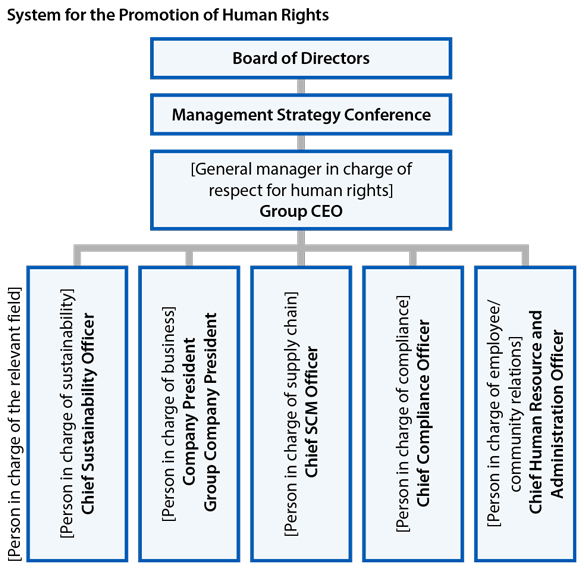
Respect for human rights in the Anritsu Group is the responsibility of the Group CEO, under the supervision of the Board of Directors, with each responsible officer promoting relevant issues. The Corporate Ethics Promotion Committee, chaired by the Chief Compliance Officer, consolidates the status and challenges of specific efforts to address human rights issues, and reports annually to the Board of Directors on the state of ethics and legal compliance within the Anritsu Group.
Activities and Achievements
Please download the PDF for more details.
Activities and Achievements
Promoting Due Diligence for Human Rights
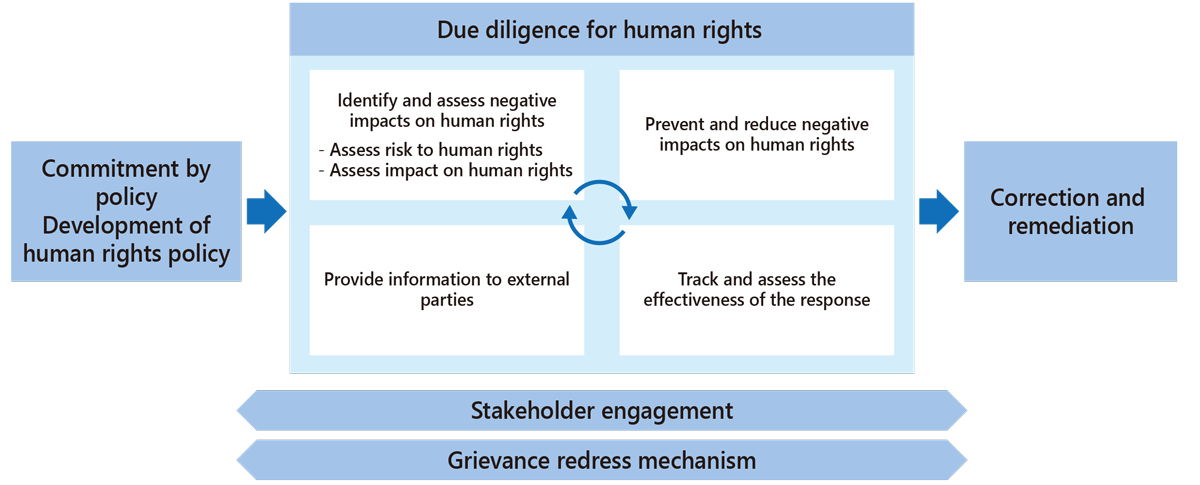
Anritsu Group established the Anritsu Group Human Rights Policy in December 2022 in order to fulfill its responsibility to respect human rights as required of companies by the UN Guiding Principles on Business and Human Rights. We are now working to establish and continuously operate a human rights due diligence mechanism to identify and assess the possible negative impacts of our business activities on human rights, and to further explain how to prevent, mitigate, and address them. We have also prepared a grievance system for a wide range of stakeholders and have a system in place to address remedies for infringements on individual human rights that have not been identified.
■ Identifying, Analyzing, and Assessing Negative Impacts on Human Rights
From January to May 2023, a human rights risk assessment was conducted with the cooperation of the NPO Caux Round Table (CRT) Japan as the first step in a human rights due diligence process to identify risks to human rights in order to determine which human rights issues to prioritize in the future.
The human rights risk assessment was conducted through a desktop survey based on country risk information from CRT Japan’s global human rights risk database and business information from Anritsu, including sales, procurement, and number of employees, as well as workshops conducted by Anritsu and CRT Japan members.
Scope of Human Rights Risk Assessment
- Countries/Regions: The following 24 countries/regions where Anritsu Group has business sites
Japan, Brazil, Canada, Mexico, USA, Austria, Denmark, France, Germany, Italy, Netherlands, Romania, Slovakia, Sweden, UK, Australia, China, India, Korea, Philippines, Singapore, Taiwan, Thailand, Vietnam - Business: All Anritsu Group businesses
Communication measurement business, PQA business, environmental measurement business, sensing & devices business
Human Rights Risk Assessment Axis
- Rights holders (parties whose human rights might be negatively affected)
- Workers and employees (corporate group, suppliers, business partners)
- Consumers and users of products and services
- Community residents, general public
- Human rights indicators: Of the human rights listed in the international norms, the following 21 human rights indicators closely related to business
Fair wages (living wage, equal pay), Working hours, Discriminatory practices, Occupational health and safety, Freedom of association and the right to collective bargaining, Forced labor, Child labor, Rights of young workers, Migrant workers’ rights, Modern-day slavery, Human trafficking, Land and residential rights, Security practices, Indigenous and minority rights, Minority rights, Rights of sexual minorities, Women’s rights, Right to privacy, Freedom of expression, Access to remediation, Complicity in human rights violations (overall human rights indicators) - Value chain
Evaluate each stage of the business process and the extent to which impacts occur- Business processes: Development - Procurement - Manufacturing - Distribution - Sales - Use - Disposal
- Extent to which impacts will occur
- Suppliers and other business partners, corporate group
- Users of products and services
Identifying Risks to Human Rights to be Prepared For
We have identified risks to human rights to be prepared for, based on the risks in the countries and regions where our business bases are located and the risks associated with our business.
Country risk assessment + Business risk assessment → Identification of risks to human rights to be prepared for
- Country risk assessment
Risks to human rights by country and human rights indicators were assessed on a scale of 1 to 4 based on the global human rights risk database for 24 countries and regions where Anritsu Group has business sites. Of the 24 countries/regions covered, the following 7 countries/regions have a high level of risk to human rights (risk level 3 or higher): Brazil, Mexico, China, India, Philippines, Thailand, Vietnam - Business risk assessment
- Of the 7 countries with a high level of risk, the following 4 countries with a large scale of business in terms of sales, procurement, and number of employees* were identified as countries with risks to human rights to be prepared for: China, India, Thailand, and the Philippines.
- Human rights risks related to workers and employees and human rights risks related to the supply chain were evaluated based on employeerelated and procurement-related breakdown data for the 4 countries listed above. In addition, human rights risks related to product complicity were also assessed.
- Anritsu Group companies in Japan assessed the risks to human rights related to foreign workers.
- When assessing business risks, we consider the stakeholder engagement program "Human Rights Issues by Sector" sponsored by CRT Japan.
*Countries where sales, procurement, or number of employees exceed 1% of the total
- Workshops
We held a workshop with members of relevant internal departments on human rights issues to identify specific human rights risk factors related to our business and to organize the status of our management. - Risks to human rights to be prepared for
Based on the country risk assessment and business risk assessment conducted through the desktop survey and workshops, the following 5 risks to human rights were identified as a result of assessment based on three axes: rights holders, human rights indicators, and value chain.- Human rights violations in the supply chain of parts and equipment suppliers
- Use of products for other purposes at the stage of use or disposal
- Human rights violations against foreign workers
- Lack of diversity acceptance in the workplace
- Insufficient response to changes in the work environment and work style
Human Rights Issues to be Prioritized in the Future
The Risk Management Department and relevant risk owners evaluated the risks to human rights identified from the human rights risk assessment from the perspective of their impact on human rights and their relevance to the company.
As a result, the following 3 human rights issues were identified as priorities to be addressed in the future. An overview of each issue, the affected rights holders, the relevant human rights indicators, the applicable value chain, and the actions taken to prevent and mitigate are listed below.
■ Issue 1: Promote working environment surveys of parts and equipment suppliers
- Overview of human rights issues
From the business risk assessment, we additionally investigated the status of respect for human rights of suppliers with respect to production sites in China and Thailand, where the risk to human rights is high and the procurement volume is large. Although no overt risks to human rights were identified in this survey, the assessment indicated a need to be prepared for risks such as child labor and forced labor at mining and refining sites and manufacturing sites in the supply chain of these sites. Therefore, these sites were identified as a priority human rights issues to be addressed in the future. - Rights holders affected
Workers at suppliers - Related human rights indicators
Forced labor, child labor, modern-day slavery, human trafficking, complicity in human rights violations (might relate to various human rights indicators) - Applicable value chain
Supply chain (procurement) primarily related to conflict minerals and countries with a high level of risk to human rights - Actions to prevent and mitigate risk
In the past, our major production sites have developed CSR procurement initiatives, including respect for human rights, for all suppliers with whom we have done business in recent years. We will expand these efforts to our production sites, which have been identified as an issue this time, and incorporate procedures for managing and confirming human rights into our procurement process to prevent risks from materializing. In addition, we will implement a grievance system that can address a wide range of stakeholders, including suppliers. If complicity in human rights violations should occur, this system will allow a prompt response to be taken.
■ Issue 2: Acceptance of diversity in the workplace
- Overview of human rights issues
With the global trend towards diversity acceptance, laws and regulations against discrimination and harassment and social criticism are becoming increasingly severe. From the perspective of communication gaps for foreign employees, responses to LGBTQ people, and the establishment of a system that respects and accepts differences in beliefs and religious values, this issue has been assessed as a risk to human rights that should be prepared for, and has been designated as a human rights issue that will be prioritized in the future. - Rights holders affected
Corporate group employees - Related human rights indicators
Discriminatory practices, migrant workers' rights, minority rights, rights of sexual minorities, women's rights, access to remediation - Applicable value chain
Overall operations of the corporate group (development - procurement - manufacturing - distribution - sales) - Actions to prevent and mitigate risk
To date, we have promoted initiatives to embrace diversity, including human rights training by job level, training on anger management and unconscious bias, lectures on LGBTQ themes, LGBTQ-responsive consultation services, and multipurpose restrooms. In addition to our efforts to date, we intend to expand our policy and management system globally, conduct training and lectures on the themes of non-discrimination and diversity acceptance, including from an international perspective, and develop an accessible grievance mechanism.
■ Issue 3: Response to changes in the work environment and work style
- Overview of human rights issues
In recent years, while Japanese companies have been seeking more flexible work styles through the spread of remote work and the expansion of support systems for balancing work and family life, there have been reports of cases in which the traditional rigid work system has contributed to unpaid overtime work and uneven workloads. Long working hours, in addition to being a direct cause of health problems and mental illness, are also related to the issues of fair wages and equal pay for work of equal value in the form of work without adequate remuneration. Therefore, the need to prepare for risks to human rights regarding responses to changes in the working environment and work styles was evaluated as a priority human rights issue to be addressed in the future. - Rights holders affected
Corporate group employees - Related human rights indicators
Working hours, occupational health and safety, fair wages, discriminatory practices - Applicable value chain
Overall operations of the corporate group (development - procurement - manufacturing - distribution - sales) - Actions to prevent and mitigate risk
To date, efforts have been made to curb long overtime work and unpaid overtime work by sending out messages from top management regarding work style reform, monitoring overtime work, and conducting special health checkups for employees who work long hours. In addition to our past efforts, we will continue to engage with our employees while supporting their "desire to achieve personal growth and contribute to business and society" by increasing their discretionary authority to further improve their job satisfaction and respond to changes in the work environment and work style.
■ Human Rights Risks in Risk Management
Human rights risks should be viewed from the perspective of stakeholders, but they can also be derived from corporate risks. For risk management in the Anritsu Group, human rights risks are addressed as being included in all seven categories.
Dissemination of Guidelines on Respect for Human Rights
The Anritsu Group published its Human Rights Policy on our website, and has used internal newsletters and case studies to improve understanding of respect for human rights among employees. We explained our human rights policy and initiatives for respecting human rights to suppliers at information exchange meetings and requested their understanding and endorsement. During the Corporate Ethics Promotion and Enhancement Week held every April, Anritsu Group conducts an e-learning course on the Anritsu Group Code of Conduct, which sets forth guidelines for actions to be taken by all employees, including respect for human rights, and requires employees to submit a written statement pledging their compliance with the code. The submission rate for FY2024 was 100% for the domestic group and 100% for overseas groups.
Percentage of "Anritsu Group Code of Conduct" statements submitted
Units: %
| FY2021 | FY2022 | FY2023 | FY2024 | |
|---|---|---|---|---|
| Domestic group | 99.8 | 100.0 | 100.0 | 100.0 |
| Overseas groups | 100.0 | 99.4 | 100.0 | 100.0 |
Conducting awareness activities
■ Level-specific training
Training is provided annually for new employees and newly appointed managers of the domestic group, and provides an opportunity to consider the importance of respect for human rights.
Results of Level-Specific Training
| Eligibility | Subject | Tabulation Category | FY2021 | FY2022 | FY2023 | FY2024 |
|---|---|---|---|---|---|---|
| New employees | Human rights, diversity | Number of participants | 52 | 52 | 55 | 41 |
| Attendance rate (%) | 100.0 | 100.0 | 100.0 | 100.0 | ||
| New managers | Promotion of labor management, human rights, and diversity | Number of participants | 26 | 20 | 18 | 24 |
| Attendance rate (%) | 100.0 | 100.0 | 100.0 | 100.0 |
■ Raising Employee Awareness
The domestic group has undertaken the following activities in FY2024 under the themes of "promoting understanding of diverse sexual orientations" and "eliminating harassment."
〈E-learning on the introduction of the same-sex partnership system〉
An e-learning program was conducted to explain the same-sex partnership system, and to teach about precautions regarding coming out and outing.
〈Release of the "Anritsu Guidebook for Understanding and Acting on Diverse Sexualities"〉
To coincide with the introduction of the same-sex partnership system, we have produced and published a guidebook summarizing key points about foundational knowledge regarding diverse sexual orientations and preferred behaviors.
〈Implementation of video training: "Basic Knowledge for Preventing Power Harassment"〉
We conducted video training aimed at eliminating power harassment. We incorporated several case study videos combined with Q&A sessions to enhance understanding.
The case studies clearly illustrated the difference between power harassment and appropriate guidance, presenting examples of conduct that could constitute power harassment alongside examples of firm educational guidance.
■ Human Rights Awareness Month
The domestic group designated December 2024 as "Human Rights Awareness Month" and implemented the following initiatives.
〈Lecture: "Fundamentals of Refugee Issues and the Role of the United Nations High Commissioner for Refugees (UNHCR)"〉
A video lecture on the increasing number of refugees in recent years was conducted by Rika Hakozaki, who works for UNHCR in Geneva.
〈ALLY Gathering〉
We hosted an event featuring Ayato Sakuragi of DIVERSITY STYLE to discuss sexual diversity.
〈SDGs case study: Microaggressions Hidden in Everyday Life〉
We introduced a case study on microaggressions (unintentional contemptuous or demeaning words or actions) in the workplace.
Establishing a System for Handling Complaints
Anritsu introduced a new inquiry form on its website for all stakeholders to consult and file complaints regarding human rights in order to establish a grievance system as set forth in the Group Human Rights Policy. Complaints and reports can be made anonymously, and we will ensure confidentiality and protection of the interests of all concerned.
We are striving to prevent human rights violations by establishing a system that allows a quick response against risks to human rights. There were five inquiries in FY2024. One of these inquiries concerned harassment within the group, and the Legal Department took the lead in handling it appropriately. There were no other matters related to human rights that the Anritsu Group determined required action.
xxx
Human Rights Issues in the Supply Chain
Through its Anritsu Basic Rules for Procurement and the Anritsu Group CSR Procurement Guidelines, the Anritsu Group asks suppliers to respect human rights, including responsible mineral procurement and compliance with the Modern Slavery Act. We conduct CSR procurement surveys to check the status of each company and to identify risks in our supply chain. In FY2024, we focused on expanding surveys to include Takasago and the PQA business, including their overseas production sites. On-site investigations were conducted at a total of 10 companies located in Japan, China, and Thailand. No significant risks were identified in relation to human rights, labor practices, or health and safety at any of the sites. These findings are disclosed in
statements corresponding to the "UK Modern Slavery Act" and the "Australian Modern Slavery Act."
Freedom of Association and the Right to Collective Bargaining
The Anritsu Group has a human rights policy stating that it supports and respects "the freedom of association and the effective recognition of the right to collective bargaining." At Anritsu, Anritsu Customer Support, Anritsu Infivis, Anritsu Devices, and Takasago, labor unions have been formed by employees, and formal labor agreements have been concluded regarding working conditions. The labor union memberships are made up of regular employees (excluding managers). In order to build sound labor-management relations, representatives from both the companies and the labor unions engage in regular dialogue. Issues raised will be addressed through individual labor-management negotiations and consultations.
Even at group companies where a labor union has not been formed, friendly labor-management relations are being built through regular consultations between company representatives and labor representatives.
Percentage of Labor Unions Organized in the Five Domestic Group Companies
As of the end of March 2025
| Company Name | Union Members | Regular Employees | Union Organization Rate*1 (%) |
|---|---|---|---|
| Anritsu*2 | 1,491 | 1,855 | 80.4 |
| Anritsu Customer Support | 53 | 63 | 84.1 |
| Anritsu Infivis | 78 | 87 | 89.7 |
| Anritsu Devices | 34 | 35 | 97.1 |
| Takasago | 147 | 192 | 76.6 |
*1 Labor union organization rate = number of union members ÷ number of regular employees (Regular employees include managers.)
*2 For non-union employees who are not covered by the collective agreement, the working conditions are defined in the work rules.
Management of Fair Wages
The Anritsu Group stipulates fair wages, benefits, bonuses, retirement allowances, etc. in its work rules in accordance with labor-related laws and regulations in each country and labormanagement agreements. We comply with all wage-related laws and regulations in each country, including minimum wages, statutory benefits, and overtime, and pay wages directly to employees at set periods, with notifications provided via pay slips. The Domestic Group sets the same starting wages for men and women, which are sufficiently high compared to the minimum wages in all regions of the country in accordance with the law that establishes minimum wages. In addition to considering employees' abilities, achievements, and company performance when setting wages, recent price increases are also taken into account when giving pay raises, so that wages are set at a level that allows employees to maintain their standard of living.
Response to Modern Slavery, Forced Labour and Child Labour
UK and Australia “Modern Slavery Acts” and Canada’s “Fighting Against Forced Labour and Child Labour in Supply Chains Act” (ANRITSU CORPORATION, Anritsu EMEA GmbH, Anritsu EMEA Limited, and Anritsu Pty Ltd)
*Since 2026, we have adopted a unified statement format to meet the requirements of the laws in the United Kingdom, Australia, and Canada.
- Anritsu Group Statement on Modern Slavery, Forced Labour and Child Labour
UK/Australian Modern Slavery Statement (ANRITSU CORPORATION, Anritsu EMEA GmbH, Anritsu EMEA Limited and Anritsu Pty Ltd)
*From 2020 to 2025, we adopted a unified statement format to meet the requirements of the laws in the United Kingdom and Australia.
- Modern Slavery Statement
- Anritsu Group Statement on "Modern Slavery" (provisional translation)
The UK Modern Slavery Act (ANRITSU CORPORATION, Anritsu EMEA Limited)
- Anritsu Group - Modern Slavery Statement
- Anritsu Group Statement on "Modern Slavery" (provisional translation)
- Anritsu EMEA Limited - Slavery and Human Trafficking Statement
California Transparency in Supply Chains Act (Anritsu Company)