Resource Recycling
The amount of waste generated is increasing due to global population growth and the disposable culture associated with mass production and mass consumption. The Anritsu Group promotes the realization of a resource-recycling society and the maintenance of zero emissions of waste through the following initiatives. In addition to this, we are focusing on achieving zero plastic waste and resource recycling (circular economy).
- Waste minimization and zero emissions
We will minimize waste generated from our operations and maintain zero emissions*1.
- Initiatives for zero plastic waste
Under the "Zero Plastic Waste Policy," we aim to achieve zero plastic waste by 2030.
Zero Plastic Waste Policy
- Achieve resource recycling (circular economy)
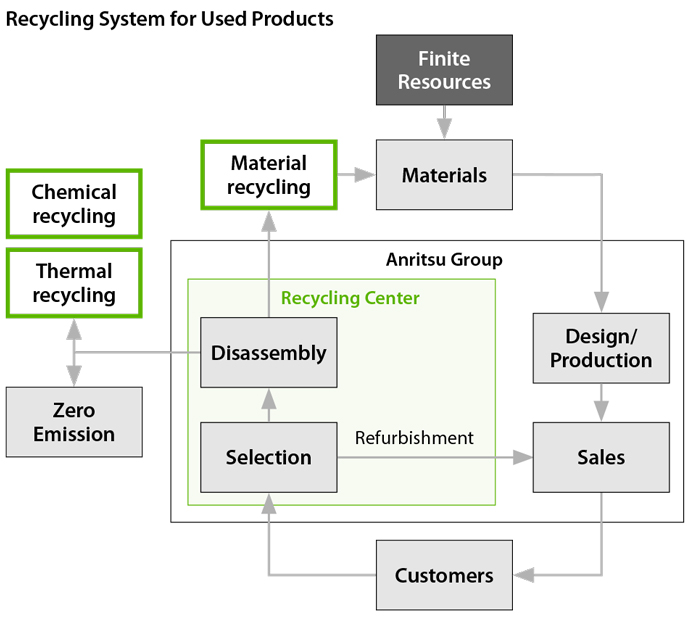
We promote the establishment of a supply chain in which used products are recycled as materials for our own products, aiming to realize resource recycling.
- Effective use of resources
We will strive to use resources effectively in all aspects of our business through the use of environmentally friendly materials and refurbishing*2.
*1 Zero emissions: Condition in which the percentage of waste placed directly in landfills or simply incinerated is less than 0.5%. Anritsu has maintained zero emissions since 2004.
*2 Refurbish: Repairing and calibrating recovered products and selling them
Target and Progress
Anritsu has established targets related to resource recycling in products, plastic waste, and industrial waste.
Achieving resource recycling (circular economy) in products
| Targets for FY2026 | Results for FY2024 |
|---|---|
| Release products that support resource recycling | Reviewing measures |
Plastic waste-related targets
| Scope | Targets for FY2030 | Targets for FY2026 (Mid-Term Targets) *1 |
|---|---|---|
| Plastic bottles used at business sites | Zero usage | Reduce usage by half, and outsource all bottle-to-bottle recycling |
| Products shipped to customers | Zero plastic packaging materials *2 | We will reduce by half the use of fossil-based virgin plastic by reducing or eliminating the use of plastic packaging materials and replacing them with plant-derived or recycled materials. In addition, we will endeavor to collect and reuse or outsource the recycling of plastic packaging materials. *3 |
| Purchased parts | Zero plastic packaging materials *2 | We will reduce the volume and weight of plastic packaging materials used for purchased parts and materials, and promote the replacement of such materials with plant-derived or recycled materials, as well as the recycling of all materials. |
| Food productsused at business sites | Zero plastic waste for food packaging | We will promote the material recycling of food packaging plastics used in cafeterias. |
*1 Calculated on a FY2021 basis, with plastic packaging materials used for product packaging and purchased parts and materials calculated as a percentage of sales.
*2 Biomass and recycled materials are used for packaging materials where plastic is indispensable to guarantee product performance.
*3 Customers who do not wish to be included are excluded.
Industrial waste-related targets
| Target | Results for FY2024 |
|---|---|
| Maintain zero waste emissions in the Domestic Group | Maintained zero waste emissions |
| Reduce industrial waste emissions in the Domestic Group by 3.5% or more per unit of sales compared with the FY2019 | 21.6% reduction |
Activities and Achievements
Achieving resource recycling (circular economy) in products
We are considering products from the PQA business, which has a higher recovery rate for used products compared to products from other businesses. This fiscal year, we will explore establishing a supply chain to recycle recovered stainless steel for reuse in products.
Progress of Zero Plastic Waste
In order to achieve the goals set out in the Zero Plastic Waste Policy, the Anritsu Group has formed four project teams to address the following: beverages in plastic bottles used at business sites, packaging for delivered products, packaging for purchased parts, and food packaging used at business sites.
| Eligibility | FY2024 Targets | Key Measures | Results |
|---|---|---|---|
| Beverages in plastic bottles | Reduce usage to 3.8 tons or less compared to the standard usage amount for FY2021 (5.7 tons) |
|
2.7t |
| Product packaging | Reduce the use of plastic packaging materials by 25% |
|
36.8% |
| Packaging for purchased parts | Exchange information with suppliers that use a large amount of packaging materials and request cooperation in reducing plastic waste using Anritsu as a model case |
|
Hold information sessions and request cooperation |
| Food packaging | Enter into a consignment contract with a recycling company and commence business operations |
|
Emissions began in April 2024 |
Managing and Reducing Waste
The Anritsu Group, under the leadership of the Chief Environment Officer, has established internal regulations, is managing and treating waste in accordance with laws and regulations, and is working to reduce waste through the 3Rs (Reduce, Reuse, Recycle). The Domestic Group manages specially controlled industrial waste as defined in the Act on Waste Management and Public Cleansing as hazardous waste. In FY2024, 5.3 tons of hazardous waste were generated, and 100% was recycled.
Management of Waste Disposal Contractors
In principle, every three years, the domestic group checks the status of intermediate treatment and final disposal sites (in cases where waste is directly discharged without going through intermediate treatment) of waste disposal contractors. The validity of industrial waste disposal contractor licenses, the content of contracts, and the management status of manifests are checked through internal environmental audits.
Recycling End-of-Life Products
The Anritsu Kousan Recycling Center is licensed to dispose of industrial waste. It processes used Anritsu products collected from our customers. In FY2024, it accepted 113 tons of used products and equipment. Almost 100% of the waste was recycled through dismantling and sorting, and 93% of it was removed as valuable resources.
Operation of Electronic Manifest System for Waste Disposal
The Domestic Group operates an electronic manifest system* for industrial waste generated in Japan in accordance with the Act on Waste Management and Public Cleansing, and the person responsible for waste disposal ensures that it is handled appropriately until final disposal is complete.
* Electronic manifest system: This system prevents the illegal dumping of industrial waste by managing its flow up to final disposal, fulfilling the responsibility for disposal as the waste generator.
Compliance with the European Waste Framework Directive (WFD)
Anritsu registers information on substances of very high concern in its products with the SCIP database* managed by the European Chemicals Agency to comply with the Waste Framework Directive (WFD).
* SCIP database: Abbreviation for Substances of Concern In articles as such or in complex objects (Products). This is a database of information on substances of very high concern in articles or composites (products).
Compliance with the EU Directive on Waste Electrical and Electronic Equipment (WEEE)
In order to comply with the WEEE Directive, we have specified the products that are subject to the directive, the recycling rate and the recovery rate, and we are evaluating them in our global product assessment. The recycling rate (design value) for FY2024 was 99% or more.
* WEEE Directive: Abbreviation for Waste Electrical and Electronic Equipment Directive. This is an EU directive on waste electrical and electronic equipment.
Refurbished Products from the Test and Measurement Business
Anritsu promotes refurbishing used products. Reusable products are selected from the products that are collected, for repair and calibration by Anritsu Customer Support. Anritsu Kousan obtained an antique dealer's license in 2003. It sells products to universities and other educational institutions with a one-year warranty after delivery, thereby contributing to extending the life of the products through reuse.
Digitization of Product Documentation
Previously, in the Test and Measurement Business, explanatory documentation on how to use measuring instruments were provided on CDs and DVDs included with products. From the viewpoint of the effective use of resources and waste reduction, this documentation is now available as downloads from our website and is no longer included with products.
Eco-Friendly Packaging
The domestic group seeks to reduce packaging materials while promoting material recycling and maintaining the strength to protect products from vibration and shock during transportation. As part of this initiative, we are reviewing the packaging method for large products for overseas markets in the PQA business and promoting packaging that uses lightweight and recyclable reinforced cardboard. This results in a 40% reduction in the mass of packaging materials and a 50% reduction in packaging waste compared to conventional wooden box packaging. In FY2024, 1769 units were transported in this packaging, exceeding the target of 1375 units.
| Packaging Method | Target Product Group | Action | Result |
|---|---|---|---|
| Reinforced cardboard packaging | Large-scale products for overseas markets in the PQA Business | Use lightweight, recyclable, reinforced corrugated board |
|
| Cardboard as a cushioning material packaging | Handheld measuring equipment for domestic and overseas market | Adopted cardboard as a cushioning material, package standard attachments and optional parts in the open spaces within the cardboard cushioning material | Reduction in material waste volume (waste material is cardboard)*1: Volume reduction of 40% (compared to urethane foam packaging of handheld measuring equipment for fiber optics) |
| Transportation of products by reusable boxes | Domestic products (mainly calibration and measurement equipment) | Adopt reusable boxes for delivery and pickup (cushioning material is also reused) | Reuse of packaging materials results in reduction in waste volume by 94% compared to conventional packaging*2 |
| No packaging | Large-scale products for the domestic market (mainly PQA business products) | Changed from stretchable film packaging to a method of placing the product in a pipe frame | Zero waste emissions due to reuse of pipe frames |
*1 Reduction in packaging material based on a comparison of urethane foam waste with waste when the item in parentheses is used.
*2 Assuming reusable boxes are reused 20 times.
Supporting the Kanagawa No Plastic Waste Declaration
Kanagawa Prefecture, which has been certified as an SDG Future City by the Cabinet Office, has established the Kanagawa No Plastic Waste Declaration and is working to reduce the use of plastic products that are causing serious marine pollution.
Anritsu supports this initiative and, in addition to participating in cleanup activities around our offices and the Sagami River Clean-up Campaign.

Toppic
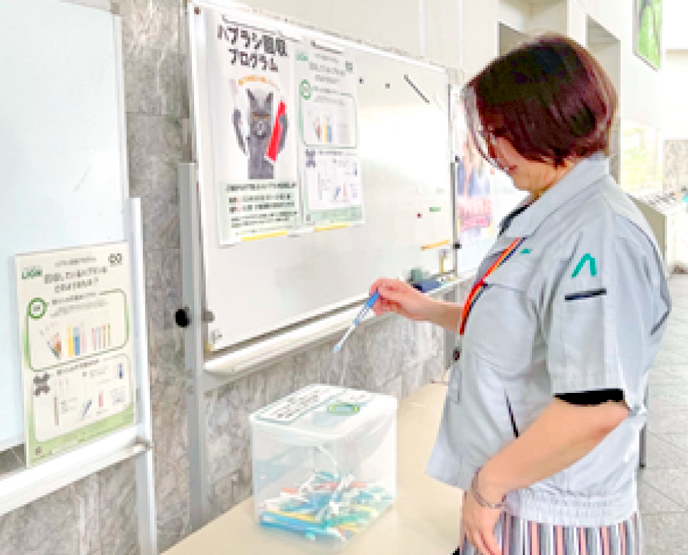
Implementing a Toothbrush Collection Program
On the Atsugi Site, with the aim of raising awareness among employees about reducing their environmental impact and providing them with opportunities to help with recycling, we launched a toothbrush collection program in FY2023. The collected toothbrushes are disassembled and sorted by TerraCycle Japan, a company affiliated with Lion Corporation, and then recycled into new products such as flowerpots and rulers.
To date, 1,000 toothbrushes have been collected. This program awards points based on the amount collected, which can be used as a donation fund.