


Groundwater Management
In 1970, the domestic Group completely phased out the use of trichloroethylene, and in 1993, it completely phased out the use of 1,1,1-trichloroethane, which are organic chlorine compounds that are regulated by the Soil Contamination Countermeasures Act and local ordinances and are easily leaked and lead to groundwater contamination.
In the past, the Atsugi site carried out plating, painting and printed circuit board manufacturing that required the use of organic chlorine solvents, but this is no longer the case. In addition, the Atsugi site is the only Anritsu Group site that draws groundwater, and we are working to prevent contamination and replenish the groundwater.
Groundwater Analysis
In the Atsugi area, we voluntarily conducted soil analysis under the guidance of the local government in fiscal 2011 and 2012, and confirmed that there was no soil contamination caused by organic chlorine solvents. In addition to the two water withdrawal wells, three monitoring wells have been added and groundwater analysis is ongoing. As a result, substances we have used in the past do not exceed environmental standards. The survey shows that tetrachloroethylene, which has not been used, is continuously exceeded. However, it has been confirmed that it is not caused by our business activities on the Atsugi Site. Toilet flush water discharged to the sewer does not exceed effluent standards.
Groundwater Recharge
In the Atsugi area, to prevent groundwater depletion and river flooding caused by torrential rain, a rainwater permeation basin* has been installed and efforts are being made to recharge groundwater.
* A facility for allowing rainwater to seep into the ground. Unlike a normal rainwater gutter, it has holes in the bottom and sides to allow rainwater to seep through.
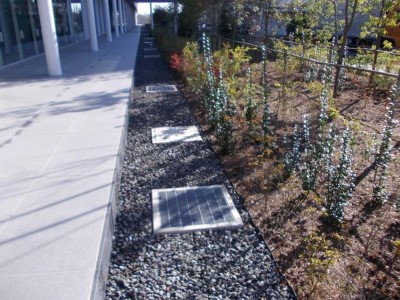
Rainwater permeation basin (Atsugi site)