Measures to Prevent False Rejects in Metal Detectors: External Noise Part 2
In the previous technical note*, we explained false rejects in metal detectors caused by electrical noises such as radiation noise, conduction noise, and static noise. In this paper, we will focus on false rejects and countermeasures caused by two types of noises. One is the noise that occurs when metal parts of production equipment move within the magnetic field generated by the metal detector, and the other is the noise caused by electromagnetic induction occurring in peripheral equipment such as roller conveyors and packaging machines.
*Please refer to "Measures to Prevent False Rejects in Metal Detectors: External Noise Part 1".
Noise associated with moving metals and electromagnetic induction and its solutions
Noise from moving metal
Just as metal contaminants in the product can disturb the magnetic field generated by a metal detector, noise that affects a metal detector's magnetic field may be generated when metal parts in the vicinity of the detection head moves. Let's take a look at these in the following experiments.
Experiment
The metal plate was held in hand and kept in a stationary position approximately 8 cm in front of the detection head. The indicator of the metal detector remains green. There is no disturbance in the magnetic field.
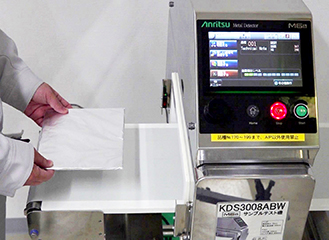
【Stationary state】
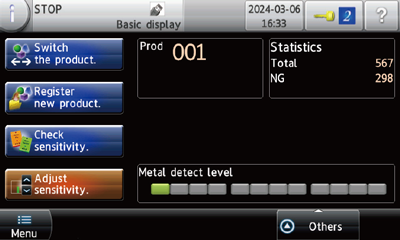
【No disturbance in magnetic field】
The metal plate was moved up and down at the same position. you can see that the magnetic field is disturbed, and the indicator is swinging to the limit.
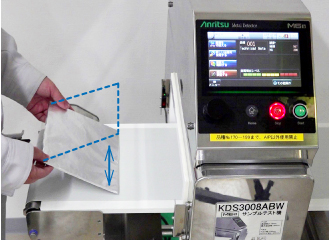
【When shaken】
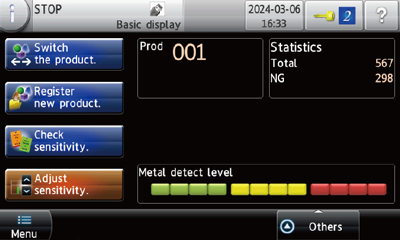
【Disturbance in magnetic field】
From this experiment, we can see that the metal parts near the detection head could potentially affect a metal detector's magnetic field when they vibrate. Now, let's take a look at some examples that frequently occur on the actual production line.
Common cases that often occur on-site 1
【Loosening of fittings】
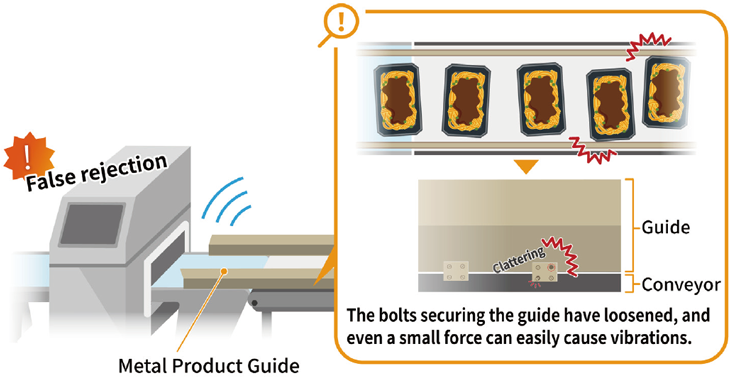
If the metal product guide for the upstream conveyor extends over the conveyor of the metal detector, the guide will vibrate when the product collides, causing noise that can lead to false rejects.
Solution 1
1. Regularly tighten the bolts ensuring there is no looseness.
2. If that does not solve the problem, change the metal product guide to a resin one.
Yet, be cautious as the resin can degrade and may break off. We provide a Guide Bank that does not come into direct contact with the inspected item for non-packaged products.
The same phenomenon might occur if the bolt of the stainless steel crossing plate which smoothly transfers from the upstream conveyor to the conveyor of the metal detector loosens up. As the camera stand attached to the chassis may shake if the fixing stay does not have adequate strength, it is recommended to place it in a different location.
Common cases that often occur on-site 2
【Metal frame of the wall separating production and packaging rooms】
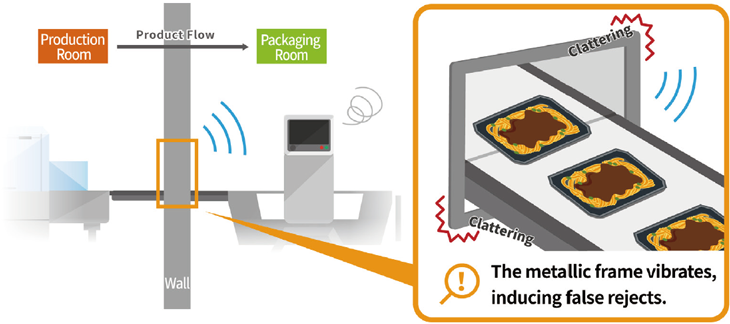
As shown in the figure, if the aluminum or stainless steel frames on the wall separating the production room and the packaging room are loose, the magnetic field of the metal detector in the packaging room may be disturbed and false rejection may occur.
Countermeasure 2
Glue or bolt the frame to prevent it from vibrating.
Electromagnetic Noise
When metal objects near the detector touch each other or separate, electromagnetic waves may be generated by electromagnetic induction. These electromagnetic waves interfere with the magnetic field of the detector, which may lead to false rejects. Let's try to replicate this phenomenon using a copper wire.
Experiment
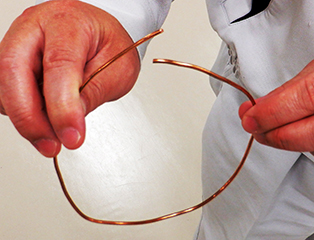
The copper wire is coiled up, but the indicator hardly fluctuates in a state where both ends are separated.
【Released state (enlarged view)】
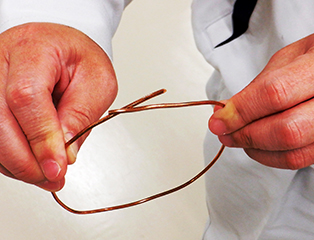
When both ends of the wire are made to touch, creating a loop shape, the indicator oscillates significantly for a while.
【In contact (enlarged view)】
By wrapping one side with vinyl tape it becomes insulated, and even when both ends touch the swing of the indicator is minimal.
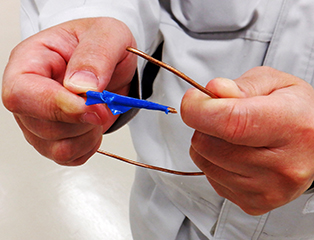
【Insulated state where vinyl tape was wrapped (enlarged view)】
Here, we introduce some examples of electromagnetic induction which occur on the actual line.
Electromagnetic waves are still produced via electromagnetic induction even when the power supply of surrounding equipment is OFF.
Common cases that often occur on-site 1
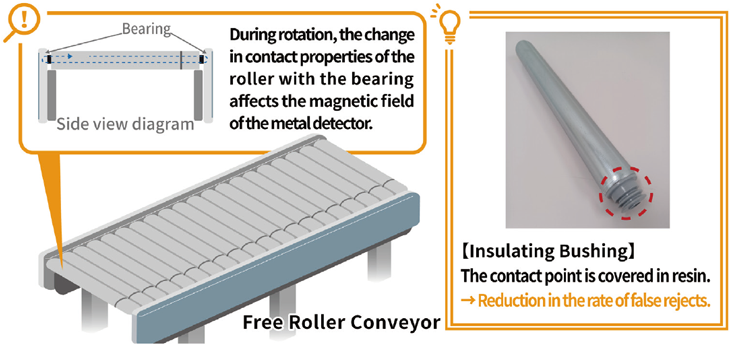
【Free Roller Conveyor】
When a free roller type conveyor is used in the upstream and the downstream, it is possible the insulating bushing may come off during cleaning. If the shaft of the roller with the removed bush directly touches the bearing of the conveyor casing, the degree of contact will subtly change during rotation, causing the electromagnetic waves generated to disrupt the magnetic field of the metal detector.
Solution 1
After cleaning, check that the insulating bushing has not come off, and if it has come off, reattach the
bushing.
(Note) There are free roller conveyors that don't include an insulating bushing.
Common cases that often occur on-site 2
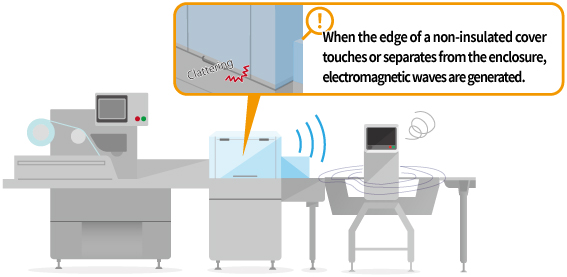
【Metal openable/closable cover】
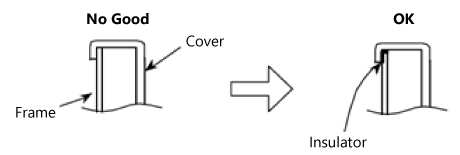
Meanwhile, with the presence of metal openable/closable covers installed on a packaging machine placed at the upstream of a metal detector, electromagnetic waves may be generated just by the edge of the cover touching or moving away from the chassis.
Conclusion
In this paper, we explained false rejects caused by the noise generated when metals move around metal detectors. The principle rule of metal detectors is not to place any metallic parts or stands nearby; however, if placement is unavoidable, visually or manually check for any looseness or rough points. The insulation measures for the upstream and downstream equipment involve things like fitting resin sheets or bushings at the appropriate positions. Please implement the measures while considering whether it does not hinder the opening and closing of the cover, and whether the insulator does not fall off. When a series of false rejects occur suddenly, it can be disturbing, but please try to identify the cause using this paper as well as the previous technical note as references.
Reference Material
【Distance to avoid installing metal objects】
Excerpt from page 5 of M6-h Series Metal Detector Installation Guide (84W279066-02) issued by Anritsu Corporation.
Caution: If the size of the moving metal is large, false rejection may occur even if the metal object is outside the following range.
(7) To avoid the effect of magnetic fields, do not allow any of the metallic objects listed in (1) to (4) near the metal detector within the shaded parts in the drawing below.
[1] Fixed metallic objects;
[2] Rotating metallic objects such as rollers and bearings;
[3] Moving metallic objects such as cams and links;
[4] Electromagnetic parts such as solenoids and clutches that might generate magnetic fields.
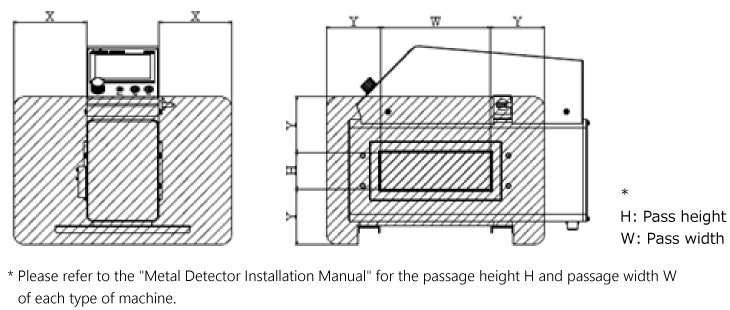
See the table below for X and Y.
| Item |
X |
Y |
| [1] Fixed metallic objects |
2 h |
1.5 h |
| [2] Rotating metallic objects such as rollers and bearings |
3 h |
2 h |
| [3] Moving metallic objects such as cams and links |
3.5 h |
2.5 h |
| [4] Electro-magnetic parts such as solenoids and clutches that may generate magnetic field |
4 h |
3 h |
Note: The mentioned values are typical and vary with metal type and dimensions.
【Insulation measure】
Excerpt from page 9 of M6-h Series Metal Detector Installation Guide (84W279066-02) issued by Anritsu Corporation.
(2) Do not construct covers such as motor covers to hook on the frame and secure them using screws instead. Insert an insulator when one metal portion is constructed to repeat contact and non-contact with another metal portion.
Related Links
PDF >
Technical Note (For general use) >
Products & Solutions > Metal Detection >
Glossary: Metal Detectors >
