


Responding to Climate Change
The Anritsu Group positions "Responding to Climate Change" as a materiality in its sustainability management. We will contribute to the realization of a sustainable society through the following initiatives.
- Achieve carbon neutrality
We aim to reduce greenhouse gas emissions across all corporate activities, both direct and indirect, in line with the Paris Agreement. Furthermore, we aim to achieve a balance between emissions and absorption by transitioning all energy used in our business activities to 100% renewable energy. - Reduce greenhouse gas emissions
We will not make investments that lead to increased use of fossil fuels. Instead, we will install our own solar power generation equipment to increase the ratio of private power generation from renewable energy sources, and thoroughly implement energy conservation activities at our factories and offices. - Provide education and training on environmental issues
We will deepen dialogue with internal and external stakeholders, including employees, customers, suppliers, investors, and local communities, and engage in educational activities aimed at solving environmental issues.
In addition to these initiatives, we will contribute to solving environmental issues and help realize a sustainable future society by not funding climate change deniers or organizations that oppose climate-related regulations.
TCFD Compliance
Endorses the TCFD
Anritsu endorses the TCFD and discloses its initiatives related to climate change in accordance with its recommendations.
* TCFD: International task force established in 2015 by the G20 Financial Stability Board. It was disbanded after completing its role in October 2023, and its functions were integrated into the International Sustainability Standards Board (ISSB).
For more information, click here
Targret・Progress
Targets for Reducing Greenhouse Gas Emissions
The Anritsu Group aims to achieve Scope 1+2 carbon neutrality by 2050, under the United Nations Framework Convention on Climate Change (UNFCCC) Race To Zero and the Japan Climate Initiative (JCI). To achieve carbon neutrality, we have set KPIs for both reducing greenhouse gas emissions with SBT certification and increasing the ratio of in-house power generation from renewable energy sources.
| KPI | Target | Results for FY2024 | |
|---|---|---|---|
| Reduction of greenhouse gas emissions | Scope1+2 (1.5°C target) | Achieve carbon neutrality by 2050 | 31.1% reduction |
| Reduce by 42% reduction compared with FY2021 by FY2030 *1 | |||
| Scope3 Category1+11 (Well-below 2°C target) | Reduce by 27.5% compared with FY2019 by FY2030 *1 | 37.3% reduction | |
| Increase in the ratio of private solar power generation | Increase the Anritsu Group’s solar power generation ratio, which was 0.8% in FY2018, to approximately 30% by around 2030, based on the electricity consumption of that same fiscal year. (Anritsu Climate Change Action PGRE 30) |
12.5% | |
*1 Targets certified by the SBT initiative
*2 Excludes the electricity consumption of AT Techmac (currently Anritsu Techmac), which was not a wholly owned subsidiary of Anritsu at the time this target was formulated
Targets Related to Energy Consumption
The Domestic Group has also set targets for reducing energy consumption in line with the Carbon Neutrality Action Plan*1 formulated by the Keidanren (Japan Business Federation) and the Act on the Rational Use of Energy and Shift to Non-Fossil Energy (Energy Conservation Act).
| Target | Results for FY2024 |
|---|---|
| Improve the basic unit of energy by 1% every year, compared with the base year (FY2020), by FY2030 under the Carbon Neutrality Action Plan by the electric and electronics-related industries in Japan. | 12.8% reduction |
| Achieve annual reductions of at least 1% in the basic unit of energy consumption per real sales for the past five fiscal years. (Energy Conservation Act)*2 |
7.7% reduction |
*1 Formulated by Keidanren. This policy is to achieve carbon neutrality by 2050 through the reduction of greenhouse gas emissions and the development of innovative technologies in business activities.
*2 This target is for Anritsu only.
Activities and Achievements
Value Chain CO₂ Emissions by Scope
The Anritsu Group is working to monitor and reduce CO₂ emissions generated throughout its value chain.
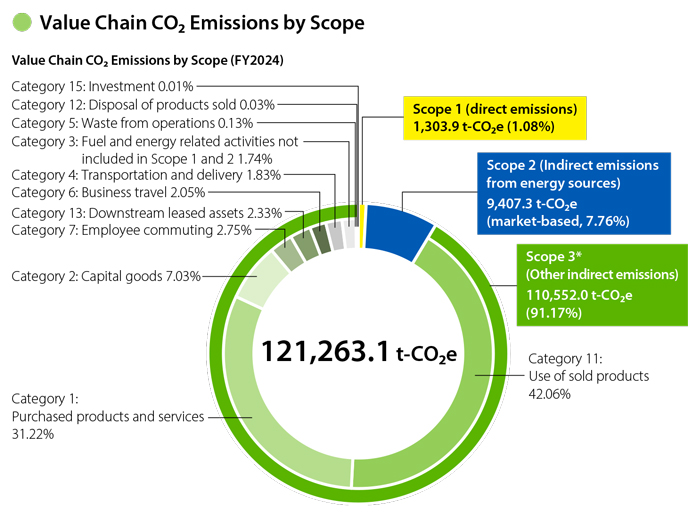
* Categories 8, 10, and 14 are not related to Anritsu Group's business, and therefore there are no CO₂ emissions. Category 9 is not calculated because it is difficult to calculate.
Data for the past 5 years can be found here
CO₂ Emission Reduction in Scope 1+2
The Anritsu Group is implementing measures to reduce Scope 1+2 greenhouse gas emissions, including private solar power generation and consumption under the Anritsu Climate Change Action PGRE 30 (PGRE 30) program, as well as comprehensive energy-saving measures in business activities. We are also working to offset emissions through contracts with electric power companies that supply electricity derived from renewable energy sources and by utilizing the J-Credit System*1. As a result of these activities, emissions for Scope 1+2 in FY2024 were 31.1% lower than in FY2021, which is the base year for the SBT 1.5°C target, and 7.4% lower than in FY2023.
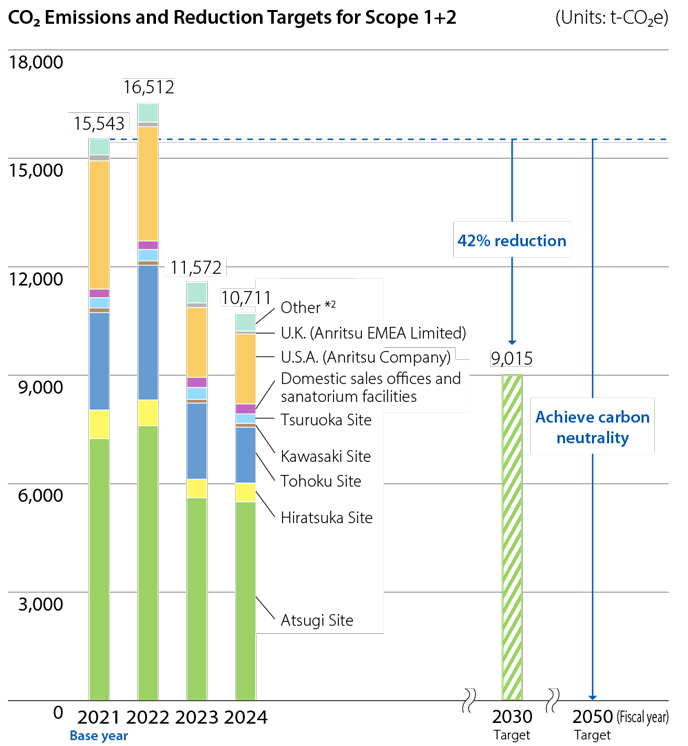
*1 J-Credit System: This is a system under which the government certifies as "credits" the amount of CO₂ emission reductions resulting from the introduction of energy-saving equipment and the use of renewable energy, as well as the amount of CO₂ absorbed through appropriate forest management. Companies and local governments can purchase these credits and use them to reduce their own greenhouse gas emissions.
*2 Anritsu Solutions S.R.L., Anritsu Infivis Inc., Anritsu Industrial Systems (Shanghai) Co., Ltd., and Anritsu Infivis (THAILAND) Co., Ltd.
■ Progress on PGRE30
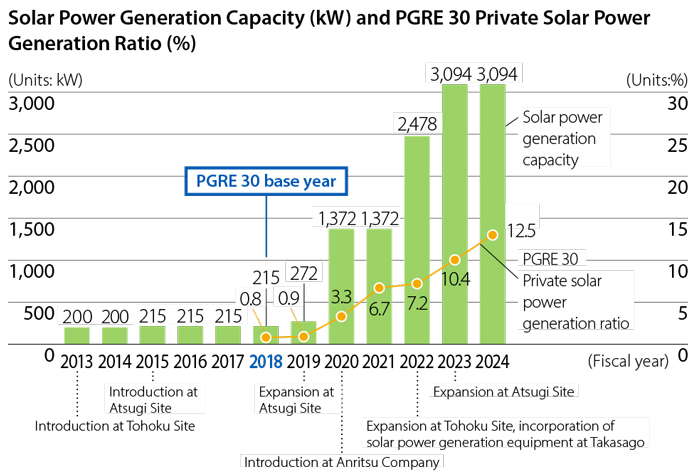
The Anritsu Group has been introducing solar power generation systems since the 2010s. In FY2019, as part of our long-term, steady efforts to reduce CO₂ emissions, we established PGRE 30. This initiative aims to increase the ratio of private solar power generation - which stood at 0.8% in FY2018 - to approximately 30% by around 2030.
PGRE 30 will install solar power generation facilities equivalent to a total of 8,000 MWh of annual power generation at the Atsugi Site, Koriyama Site, and Anritsu Company for private generation and consumption. As of the end of March 2025, the solar power generation capacity is 3,094 kW. At the Koriyama Site, large-capacity storage batteries (NAS batteries; Rated output: 400 kW, Rated capacity: 2,400 kWh) have also been introduced. By utilizing stored electricity during nighttime hours, these batteries help mitigate the risk of power shortages after sunset when solar power generation declines.
The ratio of in-house solar power generation in FY2024 was 12.5%.
Private Solar Power Generation
Units: MWh
| FY2019 | FY2020 | FY2021 | FY2022 | FY2023 | FY2024 | |
|---|---|---|---|---|---|---|
| Private Solar Power Generation | 246 | 892 | 1,791 | 1,941 | 2,765 | 3,340 |
Atsugi Site
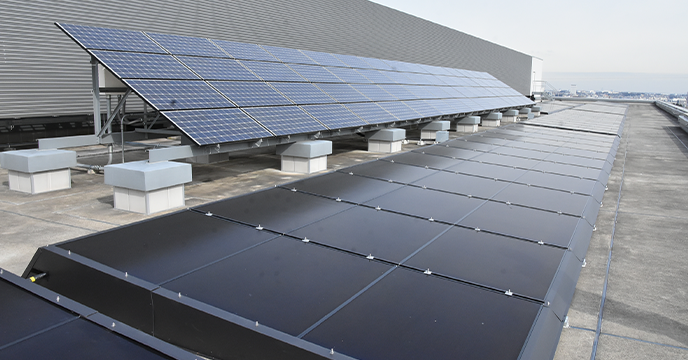
Solar power generation facilities
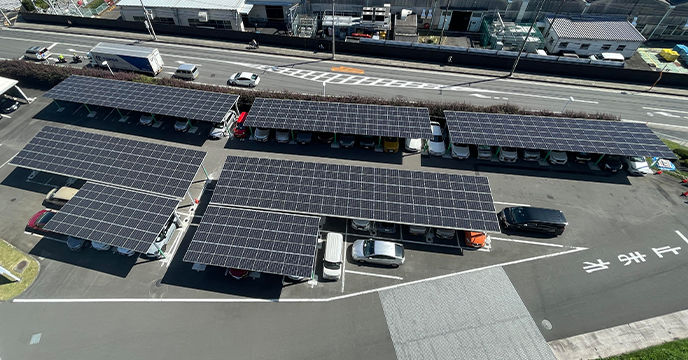
Solar carport
Tohoku Site
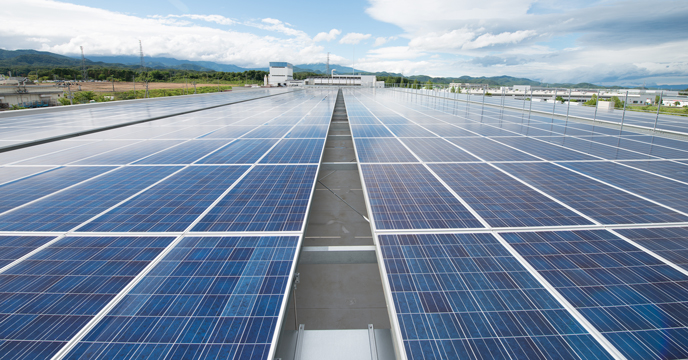
Solar power generation facilities
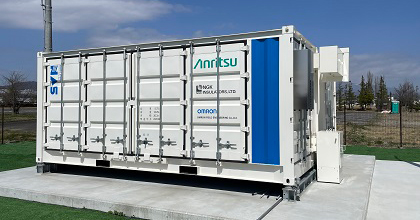
Storage batteries
Anritsu Company
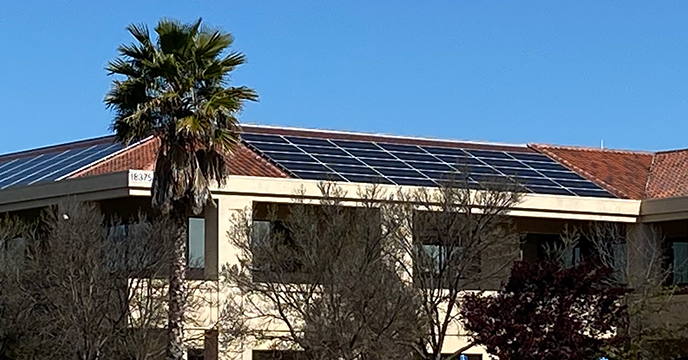
Solar power generation facilities
■ Reduction of Energy Consumption in Business Activities
In the domestic group, the energy conservation team carried out the following activities.
- Encouraged energy conservation in laboratories and workplaces, and promoting proper management of air conditioning
- Provide employees with monthly information on electricity usage and electricity charges at the Atsugi and Tohoku Sites, which have high electricity consumption
As a result of these initiatives, the Anritsu Group's energy consumption in FY2024 was 273,345 GJ, a 1% reduction from FY2023.
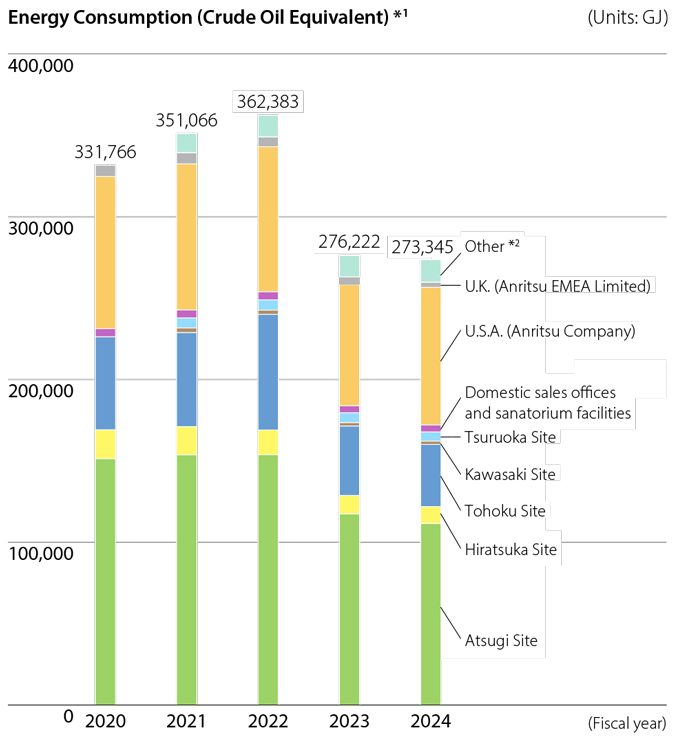
*1 This energy consumption represents more than 95% of the total energy consumption of Anritsu Group.
*2 Anritsu Solutions S.R.L., Anritsu Infivis Inc., Anritsu Industrial Systems (Shanghai) Co., Ltd., and Anritsu Infivis (THAILAND) Co., Ltd.
■ CO₂ emission reduction initiatives implemented in FY2024
| Site | Initiative | Reduction volume (t-CO₂e/year) |
|---|---|---|
| Atsugi Site | J-Credit purchase *1 | 130 |
| Energy-saving initiatives *2 | 96 | |
| Replacement of chiller for air conditioning | 51 | |
| Replacement of substation equipment | 19 | |
| Hiratsuka SIte | Installation of roof insulation sheet | 18 |
| Replacement of air compressor | 17 | |
| Tohoku Site | Energy-saving initiatives *2 | 86 |
| Tsuruoka Site | Manual switching of the exhaust fans | 3 |
| Replacement of air conditioning equipment | 1 | |
| Total | 421 | |
*1 This is a system under which the government certifies as "credits" the amount of CO₂ emission reductions resulting from the introduction of energy-saving equipment and the use of renewable energy, as well as the amount of CO₂ absorbed through appropriate forest management. Companies and local governments can purchase these credits and use them to reduce their own greenhouse gas emissions.
*2 Appropriate air conditioning management, thorough energy saving, etc.
■ CO₂ Emission Reduction in Scope3
The Anritsu Group is focused on reducing Category 1 (purchased products and services) and Category 11 (use of sold products) in Scope 3. We are continuing our efforts to collaborate with suppliers, develop environmentally friendly products, and promote them to our customers.
Category 1 aggregation uses a total emissions allocation method and reflects the emissions reduction efforts of suppliers. We collect CO₂ emissions data provided as primary data for the calculation of Scope 3 emissions from suppliers with the highest procurement value for product groups that account for approximately 60% of consolidated sales. In addition to the lifetime operating hours of the product, the Category 11 calculation also reflects the adoption rate of renewable energy for some customers.
In FY2024, CO₂ emissions in Category 1 were reduced by 39.7% compared to the base year of FY2019, which is the target year for the Well-below 2°C target, and by 21.3% compared to FY2023. Category 11 emissions were reduced by 35.5% compared to FY2019 and by 1.2% compared to FY2023.
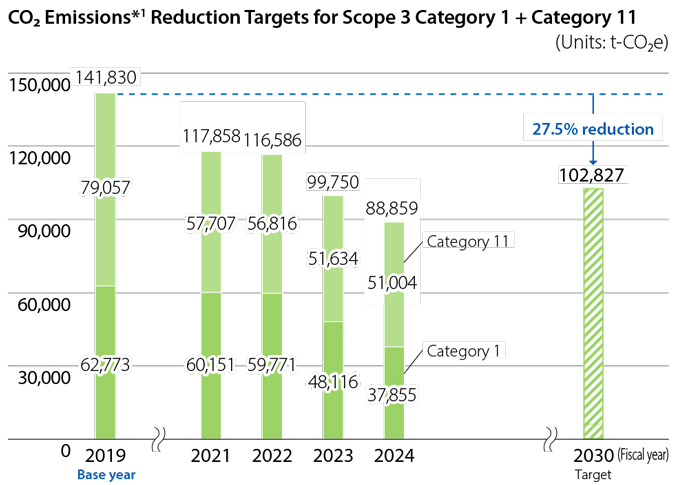
*1 CO₂ emissions in FY2024 account for 80.3% of the total emissions in Scope 3.
■ Reduction of CO₂ Emissions in Category 1
During information exchange meetings with suppliers, we request cooperation in achieving our SBT targets. We use the Anritsu Environment Newsletter to introduce the Anritsu Group's climate change measures and achievements, request the introduction of energy conservation and renewable energy, and use questionnaires to confirm how companies are responding.
CO₂ emissions in relation to consolidated sales in FY2024, calculated based on data from suppliers, dropped by approximately 25% compared with the base year (FY2019).
■ Reduction of CO₂ Emissions in Category 11
The Anritsu Group has introduced an environmentally friendly product certification system to certify “Excellent Eco-Products” and “Eco-Products” based on our own standards, and we are working to reduce the power consumption of our products. CO₂ emissions are monitored at each stage of the product life cycle and that data is utilized to develop the next product. We disclose the carbon footprint of Excellent Eco-Products. For products other than Excellent Eco-Products, we also respond to inquiries about products for which we have calculated the carbon footprint.
Since FY2020, the PQA Business Division, which has product groups with large CO₂ emissions, and the Environment Promotion Department have been collaborating on activities to reduce CO₂ emissions. In FY2024, we developed the XR76 series, an X-ray inspection system that uses the latest X-ray control technology to reduce power consumption by about 30% compared to previous models, and began selling it in April 2025.
■ Reduction of CO₂ Emissions in Category 4
In Japan, the Domestic Group is working to reduce CO₂ emissions related to Scope 3 Category 4 (transport and distribution) by switching from truck transport using dedicated containers to rail transport for large products in the PQA business.
In FY2024, we set a goal of transporting 70% of products shipped from the Atsugi Site to Kyushu by rail. As a result, we achieved 77.3%, exceeding the target. Sea transportation from the Atsugi Site to the Shikoku region was started as a means of transporting small lots.
In FY2025, we will work toward the following goals.
- 90% of products shipped from the Atsugi Site to the Kyushu region will be transported by rail.
- Four maritime transports will be conducted a year from the Atsugi Site to the Shikoku region.
Third-Party Assurance
Anritsu sought and received third-party verification for CO₂ emissions (Scope 1, Scope 2 marketbased and location-based, Scope 3*), energy consumption, and annual renewable energy power generation from Sustainability Accounting Co., Ltd. The above values for FY2024 were verified by the firm in accordance with International Standard on Assurance Engagement ISAE3000 and ISAE3410, and received limited assurance.
* Scope 3 applies to Categories 1 to 7, 11 to 13, and 15.
The independent third party assurance report is available here
Topic
Climate Change Survey Results by CDP
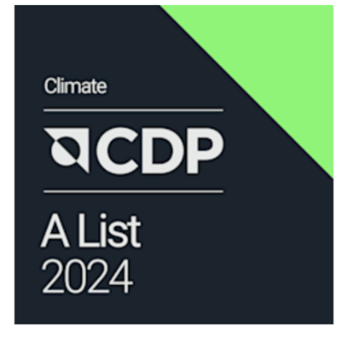
A-List selection
CDP sends surveys to companies and local governments, uses the responses to evaluate their efforts to combat climate change, protect water resources, and preserve forests. Anritsu has previously been rated 'A-: Leadership Level' in climate change surveys. In the FY2024 survey, we were selected for the first time as an “A-List Company,” the highest rating.
The A-List Company rating is awarded to companies that demonstrate strong climate action and transparency in their disclosures. This selection demonstrates that Anritsu's sustainable management initiatives have gained international recognition.
For more information, click here

Recognized as a Supplier Engagement Leader
Anritsu received the highest rating of "Supplier Engagement Leader" in CDP's Supplier Engagement Assessment (SEA). CDP evaluates companies that responded to the survey on supplier engagement regarding climate change in four categories (Governance, Targets, Scope 3 Management, and Value Chain Engagement) and selects particularly outstanding companies as "Supplier Engagement Leaders". This marks the fourth time Anritsu has been selected, in 2021, 2022, 2023, and now in 2025.
For more information, click here