


Materiality・Sustainability Goals
Materiality
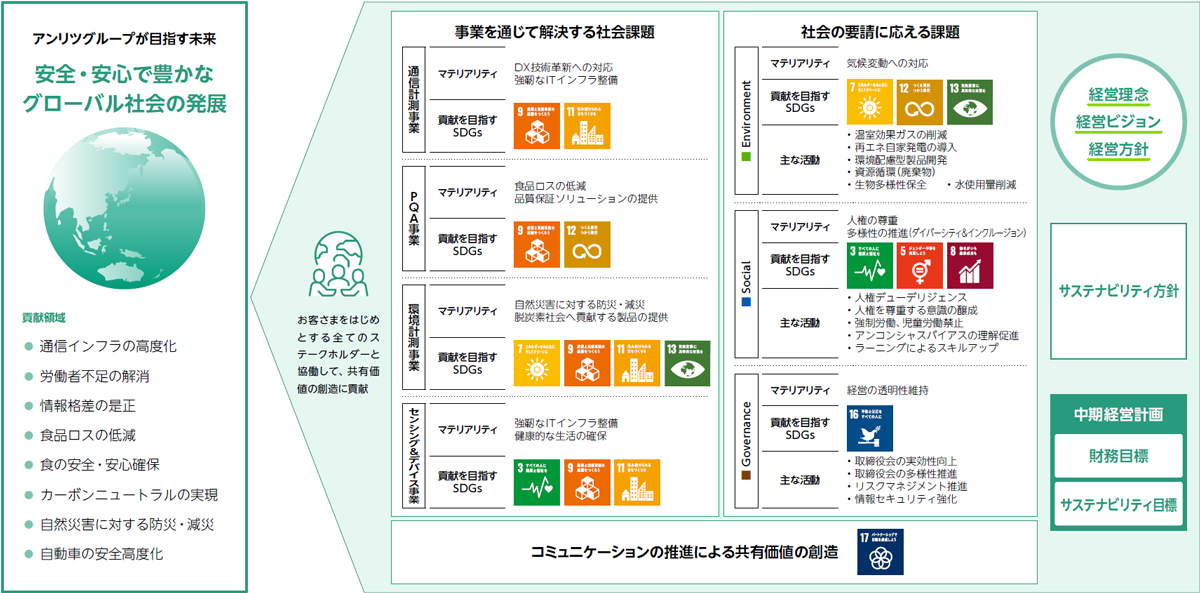
The Anritsu Group has established materialities (key issues) for each business and ESG by focusing on our two pillars of sustainability management: solving social issues through business and taking on challenges to meet the needs of society (ESG). With the review of our company vision, company policy, and sustainability policy in April 2021 and the change in structure within the segment, as well as the addition of Takasago to the group in January 2022, we reviewed the materiality in FY2022.

Materiality by Business
- Test and Measurement Business
Adapt to DX technological innovation and develop a robust IT infrastructure
Support customers who aim for new social transformation through digital innovation and contribute to the construction of safe and secure communication infrastructures with communication test solutions.
- PQA Business
Reduce food loss and provide solutions for quality assurance
Support customers who aim for a stable supply of safe and reliable food and pharmaceutical products, with highly reliable and sensitive inspection equipment and quality management control systems that contribute to the automation of quality inspection processes in production lines and the reduction of food loss.
- Environmental Measurement Business
Prevent and mitigate natural disasters, and provide products that contribute to a decarbonized society
Support customers who aim for new social transformation through digital innovation. Contribute to the transformation of a new digital society through information and communication solutions, and to the realization of a decarbonized society through EV (electric vehicle) and battery evaluation solutions.
- Sensing & Devices Business
Develop a robust IT infrastructure, and ensure healthy lifestyles
Support customers who aim for new social transformation through digital innovation, and contribute to the realization of a safe, secure, and comfortable society through optical device businesses and ultra high-speed electronic devices.
Materiality by ESG
- Environment
Respond to climate change
Addressing climate change is the most important materiality. This is because global climate change has a tremendous impact on social life and industry, causing natural disasters such as floods and droughts. The first factory at Tohoku Anritsu in Koriyama-shi, Fukushima-ken, an Anritsu Group manufacturing location, has suffered flood damage due to a river flooding on two previous occasions. Suppliers were also affected by the disaster, and we recognize that this is an issue that affects the entire value chain of Anritsu Group procurement, manufacturing, and logistics. In order to reduce greenhouse gas emissions, which have a significant impact on climate change, we will prioritize the in-house generation and consumption of renewable energy.
- Social
Promote respect for human rights and diversity & inclusion
We will promote respect for human rights and the promotion of diversity and inclusion as concepts for the entire Anritsu Group and disseminate these values throughout the company. We recognize that in order for a company to continue to grow in today's complex, ever-changing, and unpredictable world, we must harness the power of human resources with diverse values. We will also work to develop human resources, as improving the abilities of each individual is essential for the company's growth.
- Governance
Maintain management transparency
We aim to be a company that maintains management transparency and lives up to the trust and expectations of society.
In addition to working to improve the effectiveness of the Board of Directors to strengthen corporate governance, we will promote risk management, and enhance information security as a part of our social responsibility.
The Future Sustainability Management Aims to Create
The Anritsu Group aims to contribute to the creation of a sustainable future for global society through the use of sustainability management. Through our business, we aim to create innovations centered on the Anritsu Group's competency in measurement technology and contribute to providing solutions to social issues together with our customers. We will also tackle issues that respond to the demands of society, place importance on communication with all of our stakeholders, and work toward the development of a global society.
Sustainability Goals and Progress
The Anritsu Group's business divisions, corporate divisions, and group companies have formulated the three-year Mid-Term Business Plan (GLP: Anritsu Global Long Plan). GLP2026, our med-term business plan covering FY2024 through FY2026, sets sustainability targets in the ESG field. The targets and KPIs to be achieved by FY2026 are shown below.
Sustainability Goals for the “GLP2026” Mid-Term Business Plan
The targets and KPIs to be achieved by FY2026 under the new three-year GLP2026, which begins in FY2024, are shown below.
| Target | KPI | Results for FY2024 | |
|---|---|---|---|
| Environment | Reduce greenhouse gases | Greenhouse gases (Scope 1 + 2) *1: 23% or more reduction compared to FY2021 | 31.1% reduction |
| Greenhouse gases (Scope 3) *1: 17.5% or more reduction compared to FY2019 | 37.3% reduction | ||
| Increase in the share of in-house power generation (PGRE 30) *2 | In-house power generation ratio: 14% or more | 12.5% | |
| Realization of resource recycling (circular economy) | Release products that support resource recycling | Implementation measures are being considered | |
| 100% material recycling of plastic waste | 77% material recycling | ||
| Social | Promote diversity management | Advancement of women: A proportion of women in management positions of 15% or more (consolidated) | 12.0% (March 31, 2025) |
| Promote employment of people with disabilities: Achieve the legally mandated employment rate of 2.7% through job development | 2.9% | ||
| Realization of a rewarding work environment | Positive response rate for job satisfaction in employee satisfaction survey: 80% or more | 72% | |
| Promote global CSR procurement (social responsibility in the environment, labor environment, human rights, etc.) | Strengthening of supply chain due diligence: A cumulative total of 10 or more companies per year | Implemented by 10 companies | |
| Developing awareness on CSR procurement to suppliers at least three times per year, and provide training at least twice each year | Dissemination of information: conducted 3 times, Training: conducted 2 times | ||
| Governance | Improve global governance | Promoting the diversity of the Board of Directors: Ratio of female directors: 20% or more | 10% |
| Intensive discussion of management issues at board meetings: 6 times per year | Conducted 6 times |
*1 Scope 1: Direct emissions of greenhouse gases by businesses themselves (fuel combustion, industrial processes), Scope 2: Indirect emissions from the use of electricity, heat, and steam supplied by other companies, Scope 3: Indirect emissions other than Scope 1 and Scope 2 (emissions of other companies related to the activities of the project operator).
Anritsu has adopted Category 1 and 11 as KPIs for Scope 3.
*2 PGRE 30, an Anritsu initiative, is based on the Anritsu Group's electricity consumption in FY2018. The goal of this action is to increase the ratio of in-house solar power generation, a renewable energy source, from 0.8% in FY2018 to approximately 30% by around 2030.