


Environmentally Friendly Global Headquarters Building
The Global Headquarters Building, completed at Atsugi site in March 1995, incorporated the concept of contributing to the creation of an environmentally friendly society and features a number of environmental designs. The building qualifies for the S-rank, the highest recognition given by Kanagawa Prefecture under its “CASBEE Kanagawa” assessment system for global warming countermeasures in building plans, which requires companies to submit a plan that includes measures against global warming for new construction or renovation of buildings exceeding a certain size
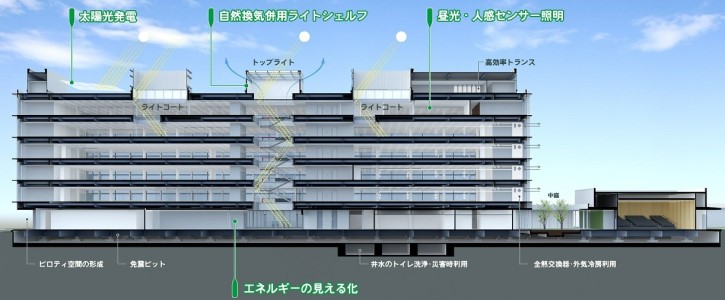
Environmentally friendly facilities at the global headquarters building
Solar Power Generation System
The global headquarters building has a solar power generation system with a maximum output of 72 kW, and the entire Atsugi site has a total output of 688 kW.
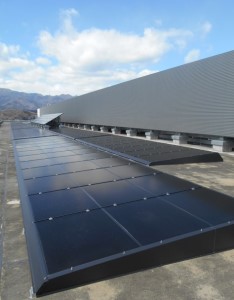
Power Generation Solar Facility
LED Lighting
We have significantly reduced electricity consumption by using LEDs for all lighting. LED lighting on the second to sixth floors is controlled by sensors that detect daylight and the presence of people, allowing us to reduce the luminance in bright areas near windows and automatically turn it off in bright areas near windows and automatically turn off lights where people are not present automatically switch off lights where people are not present, further reducing electricity consumption.
Skylight and Light Courtyards
We installed a skylight in the central atrium and two light courtyards on the fifth and sixth floors to capture natural light.
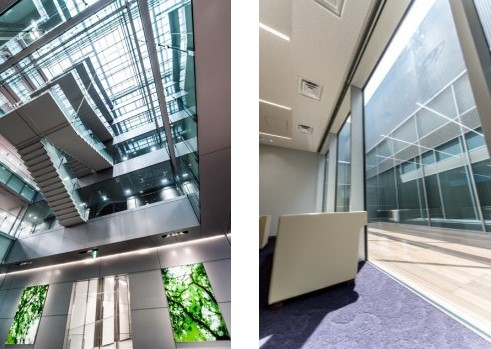
Skylight and Light Courtyards
Light Shelves
Light shelves that take in natural light are installed on the second to sixth floor windows, running north to south. Natural light from these shelves and daylight sensors in the LED lighting system limit the electricity used for lighting.
Natural Ventilation System
The light shelves are also fitted with air intakes for a natural circulation of air. The natural ventilation intake monitors temperatures inside and outside the building as well as humidity and wind direction, and central surveillance will control the opening and closing of the intake when certain conditions are met. The flow of outside air exits from the uppermost window of the central atrium.
This efficient, natural air conditioning reduces electricity consumption, especially in the spring and autumn.
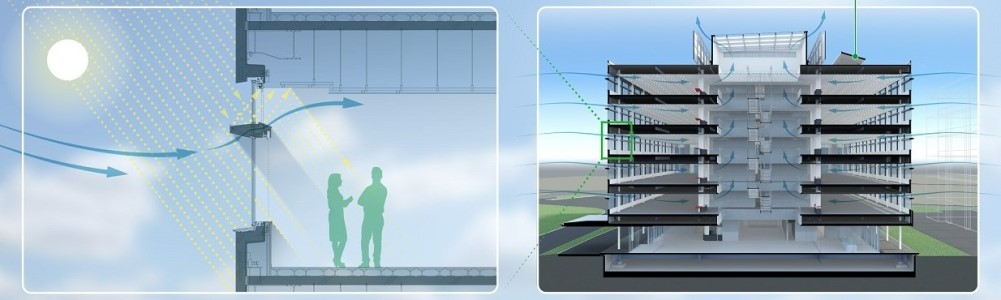
Light Shelves and Natural Ventilation System
Highly Efficient, Multi-Split Air Conditioning and Ventilation Systems
The air conditioners reduce input to the compressor through inverter control and stabilize room temperatures. We also installed an air conditioning system capable of separately controlling partitioned zones in the building, such as by story, floor or area. This helps to reduce electricity consumption by setting separate temperatures for air conditioning in each zone and by turning off the air conditioning in others. We also use CO2 sensors to take in outside air in order to prevent indoor CO2 density levels from rising too high.
Thermal Insulation
Low-E multiple layer glass is used for the windows, which lets light inside but blocks heat. The walls also feature strong insulation properties.
Water Conservation
The water-efficient toilets and urinals use sensors to conserve water.
Rainwater Infiltration
Considering the possibility of groundwater depletion and flooding caused by heavy rainfall, we installed a rainwater permeation basin to facilitate the penetration of rainwater into the ground.
Greening
In the inner court and outer perimeter of the building, we are planting vegetation with due consideration for the climate and soil of Atsugi City as well as plants that are indigenous to the region (potential natural vegetation)
Visualizing Electric Power Consumption
We disclose electric power consumption data for the Global Headquarters Building and other buildings via monitors and the corporate intranet to raise employee awareness of energy conservation.
BCM Function
The Global Headquarters Building, which is built on a seismic-resistant structure, is designed to be safe in the event of an earthquake. In the event of a power outage, in addition to solar power generation, the building is equipped with emergency power generation facilities that can maintain the operation of critical equipment in the Atsugi area for six days. The building is also equipped with a water tank that can hold enough water to supply the Global Headquarters Building for six days.