The Impact of Wind on Checkweighers and the Effectiveness of Windshield Covers
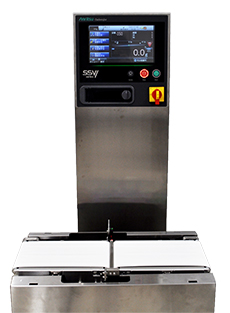 Similar to static scales and electronic balances, checkweighers are recommended for use in wind-free environments. However, in actual onsite conditions, airflow from air conditioning systems or wind entering from outside can affect weighing accuracy.
In this paper, we will reproduce this phenomenon through simulated experiments and explain the effect of a cover in mitigating wind influence.
Causes of Wind Blowing into Checkweighers
There are multiple possible causes for wind infiltration.
Air conditioning airflow directly impacting the scale
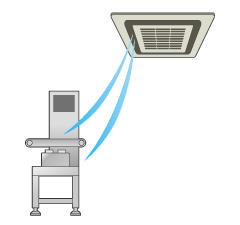
Air conditioning airflow reflecting off the floor or walls and striking the scale or walls and striking the scale or the underside of the conveyor
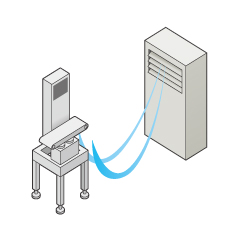
Wind blows in from the opening of the room
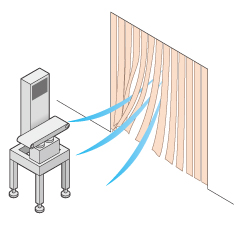
In this experiment, small holes were made in several places on a hose through which compressed air is passed, allowing air to be blown out at the same pressure. We will conduct experiments by fixing the hose with fasteners and changing the location where the wind is applied.
What happens when wind strikes the weighing unit*?
*Composed of the scale and casing. The conveyor placed on top is not included.
The display of the checkweigher is 0 g when nothing is placed on the conveyor. However, what happens when wind is applied to the weighing unit?
Since the wind pressure applies a load to the weighing unit, the display will show a positive number greater than 0.
The checkweigher can start operation (weight measurement while the conveyor is running) even in this condition due to its automatic auto-zero setting function. However, the difference between the actual weight and the measured value will be greater than when there is no wind influence. Let's observe that in the following experiments.
Experiment 1
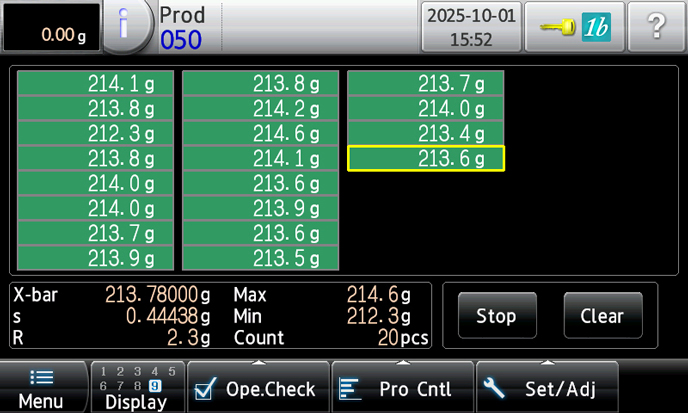
Apply wind directly to the weighing unit. In that state, run the conveyor and feed a product (actual weight 214.2 g) through it 20 times. Check the 20 measured values on the monitor of the checkweigher.
Experiment 2
To prevent wind from hitting the weighing unit, a cover will be installed on the front. Run the conveyor and feed the same product through it 20 times as before. Confirm the 20 measured values on the checkweigher's monitor.
The individual measurement values are displayed in green. Since there are 20 numbers lined up, it is difficult to grasp the difference between the two sets, so let's compare them using statistical values.
Without front cover
With front cover
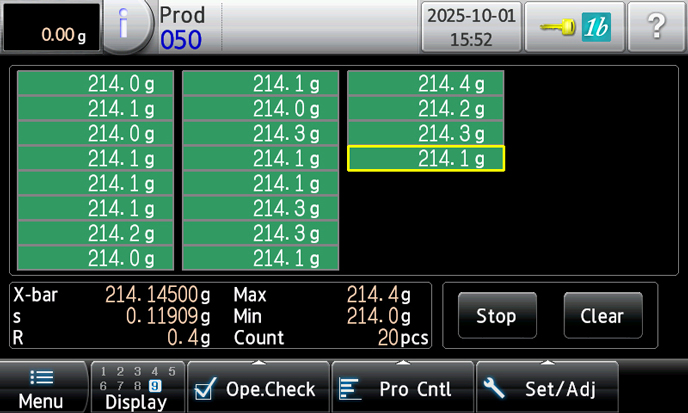
The values used are the mean (X-bar), standard deviation (s), and the range obtained by subtracting the minimum value from the maximum value (R). Comparing the statistical values, it is evident that measurements with the front cover in place yield results closer to the actual weight and exhibit less variability.

What happens when wind is applied from below the conveyor?
The weighing section of the checkweigher is installed under the conveyor, assuming that the weight of the conveyor is not included. What would happen if wind were applied from below the weighing unit?
The wind reached the conveyor and became an upward force, causing the display to show a negative number less than 0. Since the checkweigher has an automatic auto-zero set function, operation (measurement while running the conveyor) can be started even in this state, but the difference between the actual weight and the measured value will be greater than in a windless state. Let's examine this through an experiment.
Experiment 1
Wind is applied from below the weighing unit. In this condition, operate the conveyor and feed a specific product (actual weight 214.2g) 20 times. We will check the 20 measured values and statistical data on the checkweigher's monitor.
Experiment 2
Let's attach a cover to the bottom sur face to prevent wind from entering from below the weighing unit. Operate the conveyor to feed the same product 20 times as before. Check the 20 measurement values and statistical data on the checkweigher's monitor.
Similar to the first experiment, when comparing the statistical values, measurements with the bottom cover yield results closer to the actual weight and show less variation.

What happens when wind passes over the conveyor?
Windshield covers are installed to protect against wind coming from the top, front, and back. However, the entrance/ exit of the conveyor cannot be blocked by a cover because the product passes through it. Wind is applied to the conveyor from one side.
By blowing air, the air pressure above the conveyor becomes lower than the air pressure below the conveyor. As a result, lift is generated on the conveyor, and the display shows a negative number. Even in this state, operation (measurement while running the conveyor) can be initiated. A specific product (actual weight 214.2 g) is conveyed 20 times. The statistical values are compared with and without windshield covers.
Surprisingly, performance improved when there was no windshield cover. This is because removing the cover disperses the airflow, reducing the lift force on the conveyor.
Conclusion
In production facilities with large windows, the airflow of the air conditioning may increase during winter to rapidly raise the room temperature. In such cases, attention should be paid to the increased impact of wind on the checkweigher.
Unfortunately, there is no effective cover against wind that blows through the conveyor from upstream to downstream (or in the opposite direction). Generally, the filling and packaging room in the clean area is separated from the semi-clean area, where the checkweighers are installed by a wall. However, many factories have openings in the wall to allow the conveyor that supplies products to the checkweigher to pass through. The clean area is set to positive pressure to prevent the entry of dust and insects. As a result, air flows from the openings into the semi-clean area, adversely affecting the measurements of the checkweigher. If mitigating the wind proves difficult even with measures such as installing a reed screen at the opening, please consider countermeasures such as adding a connecting conveyor to move the checkweigher away from the opening, or changing the orientation of the checkweigher.
We hope that this paper will serve as a valuable reference for all users of checkweighers.
Related Links
PDF >
Technical Note (For general use) >
Products & Solutions > Weight Inspection >
 Weight Inspection >
Glossary: Checkweighers >
