Advanced Application of Missing Product and Shape Inspection using X-ray Inspection System
X-ray inspection devices are utilized in many fields as multitasking inspection machines that are capable of various types of inspections simultaneously, not limited to foreign object detection. Manufacturers of X-ray inspection systems use different terminologies, but the mechanism of detecting defective products by applying multiple image processing technology to x-ray images is the same.
In the previous issue, we provided a basic introduction to missing product and shape inspection functions.
In this issue, we explain in an advanced application how to approach making a close-to-accurate evaluation when selecting between two available functions for the same inspection purpose.
Reviewing each function and its usage
Let's review the functions introduced in the previous issue.
Count Inspection

Identify defects related to quantitiy based on the number of shadows
Split Shape Inspection

Detects defects based on the length of the shadow's perimeter (increases if broken)
Quantity Inspection

Detects if there are thinner parts than the standard by observing the overall thickness
Broken Shape Inspection

Detects anomalies based on missing parts of the shadow
Relative Virtual Weight Inspection

Finds lighter or heavier items based on the relative mass of products with varying shades
When there are two options, which to choose?
Depending on the product, some may only be inspected using one function, while others may have two functions available for selection. When there are two options, we experiment to determine which function provides a more reliable evaluation.
Case ➊ One slice missing in prepackaged cheese slices
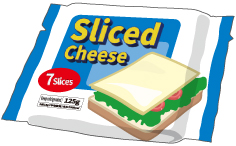 Prepackaged cheese slices often sold in supermarkets and convenience stores in Japan comes in various amounts, such as packs of 5, 7, 10, or 12 slices. When inspecting for one missing slice, which inspection function should be used? "Count Inspection" is excluded from the options as it cannot count due to overlapping or contact of contents. Given the characteristics of this item it can be assumed that:
- Only one slice missing seems to change the X-ray transmission amount (the shadow becomes lighter).
- Both quantity inspection and relative virtual weight inspection can be potentially used.
To detect the absence of one slice, there needs to be a corresponding decrease in the effect value.
One slice missing from a packet with 7 slices
If one slice is removed from a pack of 7 slices of cheese, dividing 100% by 7 slices results in 14.29% per slice. Our experienced staff set the threshold of the X-ray inspection machine to 84%, taking measurement errors into account. Next, we will feed the same product with one missing slice over ten times. The effect values at the time were as follows.
Average effect value of Quantity Inspection: 80%
Average effect value of Relative Virtual Weight Inspection: 82%
Both resulted in the evaluation of one slice missing (NG) all 10 times.
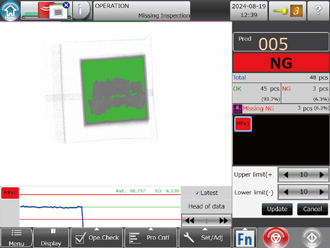
Detectable with Quantity Inspection
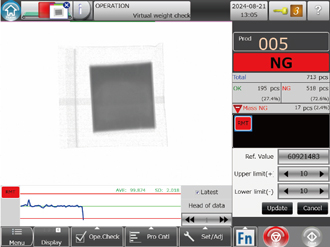
Detectable with Relative Virtual Weight Inspection
One slice missing from a packet with 10 slices
The reduction for one missing sheet out of 10 sheets is 10% per sheet, which is 100% divided by 10 sheets. Similarly, our experienced employee set the threshold at 88% considering measurement error, and feed the product with one missing slice 10 times.
Average effect value of Quantity Inspection: 85%
Average effect value of Relative Virtual Weight Inspection: 91%
Although Quantity Inspection detected one slice missing (NG) all 10 times, the Relative Virtual Weight Inspection was not able to detect a single slice missing because the effect value did not fall below the threshold.
However, based on the aforementioned results, by slightly adjusting the setting conditions of the relative virtual weight inspection, we were able to reduce the average effect value to 87%, so it cannot be said that it is completely unusable.
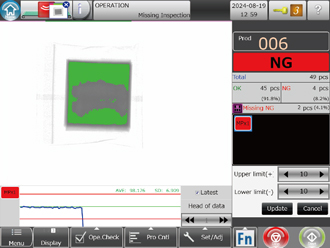
Detectable with the Quantity Inspection
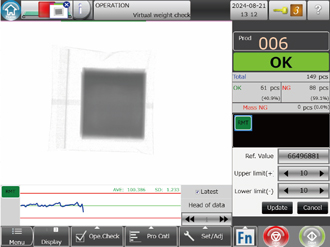
Undetectable with the Relative Virtual Weight Inspection
Case ➋ One missing piece in a 16-piece, two-layer stacked chocolate
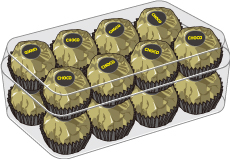 The 16 spherical chocolates are arranged in two layers of 8 pieces each. Due to the divider that keeps the chocolates from moving, the chocolates in the upper and lower layers are in the same position relative to the vertical direction, so the transmission image viewed from above shows them as if they are in a 8-piece package. Since spherical-shaped products do not have a uniform thickness, we cannot say that the transmission volume is half that of one piece when there are two pieces, depending on the position through which the X-rays pass. However, it is expected that there will be a clear difference in the transmission volume between one piece and two pieces in any position.
Since one piece is missing from a 16-piece package, the percentage would be 100% ÷ 16, equating to 6.25% per piece. Our staff considered measurement errors and set the X-ray inspection machine's threshold to 92%. When a product with one piece removed was examined,
Average effect value of Quantity Inspection: 87.5%
Average effect value of Relative Virtual Weight Inspection: 92.2%
In Quantity Inspection, a single missing piece could be identified with a value surely below the threshold, but in Relative Virtual Weight Inspection, as the effect value and the threshold are almost identical, the evaluation becomes unstable. While the effect value alone suggests that Relative Virtual Weight Inspection is more accurate, Quantity Inspection is easier for setting limits to detect missing items.
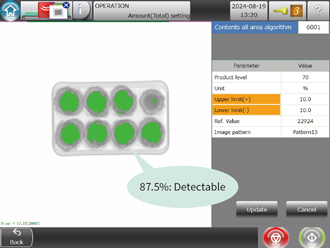
Detectable with Quantity Inspection
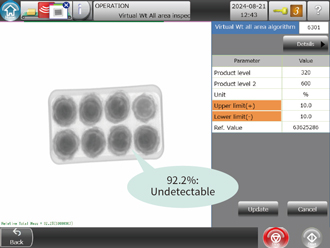
Undetectable with Relative Virtual Weight Inspection
Case ❸ One missing bag from 7 bags of biscuits
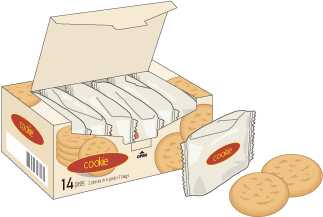 To detect one missing bag (deficiency) in this product, which contains 7 bags of biscuits with 2 pieces per bag, which inspection function would you use?
The decrease percentage of one missing bag is 100% ÷ 7 bags, which comes to 14.29% per bag. After considering measurement errors, we set the X-ray inspection machine's threshold to 84%.
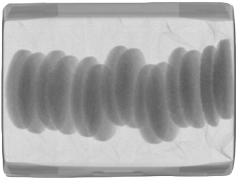
In Quantity Inspection, products are evaluated based on the area of the denser parts compared to a predetermined concentration. On the screen, those parts are filled with a specific color. The edges of the box, which have similar effect values, are automatically filled in as well, increasing the effect value even for normal products. Even if one bag is missing, the effect value does not fall below the threshold of 84%, so it is not determined as defective (NG).
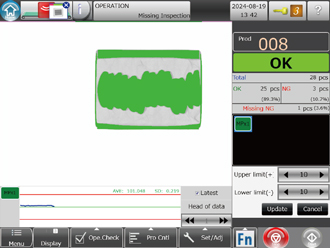
PASS product
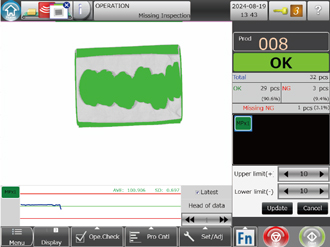
One missing bag, but it did not fall below the lower limit
In Relative Virtual Weight Inspection you can add a limit that ignores the effect of the box. Therefore, you can consider only the effect value of the biscuit parts. Even if there are shades in the shadow of the biscuit, the overall calculated volume does not change, even if the bag positions vary within the box. When one bag is missing, the effect value falls below the threshold of 84%, and it was reliably detected.
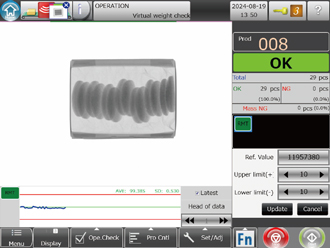
PASS product
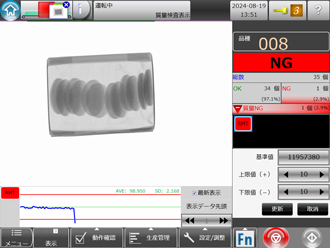
One missing bag, and it fell below the lower limit
Case ➍ Broken or chipped tablet candies
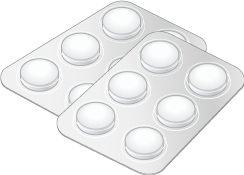 When inspecting for shape defects, you can use either the Split Shape Inspection or Broken Shape Inspection.
Split Shape detection evaluates whether a product is cracked based on the length of the outer perimeter of the product's shadow, and Broken Shape detection evaluates a defect based on the area of the shadow. There are instances where products with cracks or chips are not evaluated as defective if the perimeter length does not change. Therefore, it is recommended to select both functions during product type setting.
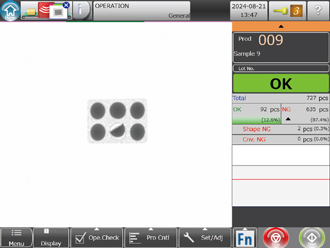
Using Split Shape Inspection only
Chipped product is incorrectly evaluated as PASS product because the perimeter is almost the same.
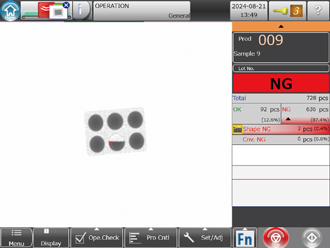
Using both Split Shape Inspection and Broken Shape Inspection
Chipped product exhibits a change in area, and thus is correctly evaluated as defective by Broken Shape Inspection.
However, while it is possible to detect products that are broken or chipped before packaging, if a product breaks after packaging due to applied force, as shown by the arrow in the figure below, it cannot be determined as defective (NG) by X-ray inspection because the area and perimeter remain unchanged.
Cases where cracks are present but not evaluated as defective
Conclusion
This time, we experimented using two options: Quantity Inspection and Relative Virtual Weight Inspection. In either case, it can be said that the larger the difference between the effect value and the threshold, the easier it is to use. In actual operation, it is commonly practiced to enable both Quantity Inspection and Relative Virtual Weight Inspection and determine an NG evaluation if either of these limits is exceeded. We hope this paper provides useful hints to make more effective use of x-ray inspection as a composite inspection system.
Shape defects can vary depending on the product and the manufacturing process, so in cases where high sensitivity and stability are needed, other methods like mass inspection machines, camera inspection machines, or near-infrared inspection machines may be more effective than X-ray inspection machines. We recommend you consider various inspection methods with a broad perspective.
Related Links
PDF >
Technical Note (For general use) >
Products & Solutions > X-ray Inspection >
 X-Ray Inspection >
Glossary: X-ray Inspection System >
