
Tips for Effective Use of X-ray Inspection Systems:
Noise Removal and Detection Limit
Anritsu X-ray inspection systems generate X-ray transmission images and set the contaminant detection limit after the product to be inspected is fed 10 times. The image is monochrome and the density changes depending on the amount of X-ray transmission. If the limit value is set in consideration of variations in the amount of X-ray transmission (shadow density) of PASS product, it is possible to make accurate OK/NG (PASS/FAIL) evaluation for the products conveyed one after another on the production line. When the product in the same condition as when the detection limit was set is continuously conveyed on the production line, the darkness of the shadow appears on the x-ray image will be constant, so false rejections do not occur repeatedly. In contrast, when there are variations in production lots or in the conveyed conditions, etc., the change in the shade of the transmitted image becomes steeper than usual, and the peak of the waveform that indicates the change exceeds the detection limit (threshold) and may be falsely evaluated as a defective product. Such changes in product effect becomes noise. Since noise can be reduced by image processing, contaminant detection sensitivity can be maintained while suppressing frequent false rejections. *
When making the "detection limit (threshold)" stricter to improve the detection sensitivity, it is effective to adjust the "noise removal" first.
This paper explains how to make adjustment using the monitor screen of Anritsu X-ray Inspection System.
Also, examples of applications that are prone to change in product effects (the cause of noise) will be introduced.
* X-ray inspection systems manufactured by other companies use noise removal methods that are different from Anritsu x-ray systems.
Evaluation signal
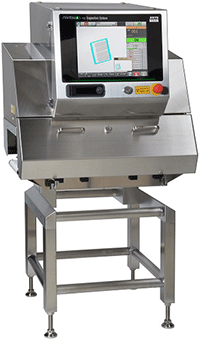
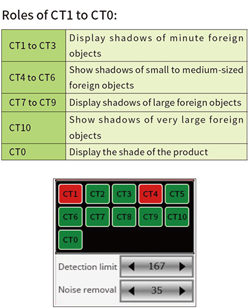
Anritsu XR75 Series X-ray Inspection System has a display window from CT0 to CT10 that shows foreign body detection signals (red, orange, yellow, and green). CT0 is used for the purpose of showing the overall density of the product. CT1 to CT10 independently make evaluation according to the characteristics of the foreign matter. All CTs allow two adjustments: noise removal and detection limit. If any of CT1 to CT10 has product effect that exceeds the threshold (the signal turns red), the X-ray system evaluates the product as NG (Defective).
Noise removal
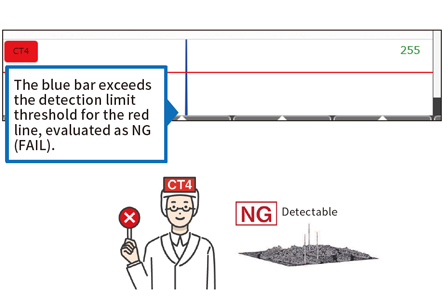
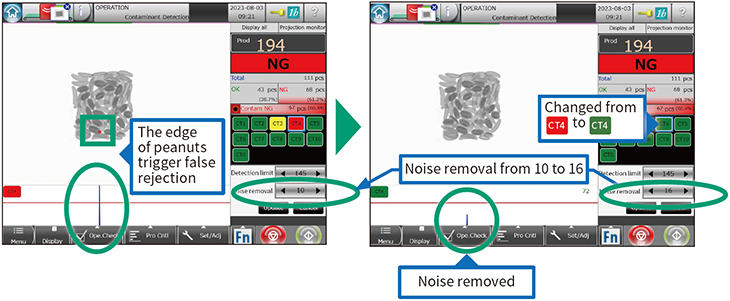
We refer to the variation between individual test items and sudden changes in product effect caused by external factors as noise. Eliminating noise (reducing it by image processing) is effective in suppressing false rejections. Increase the noise removal value on each CT so that the top of the blue line representing the product effect peak is below the detection limit indicated by the orthogonal red line (threshold).
Raise the noise removal limit and adjust it to below the detection limit > Eliminate false rejection
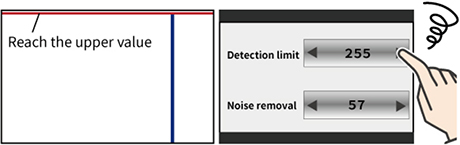
In the example below, the detection limit of the red line touching the blue bar has reached its upper limit and cannot be raised any further. In such a case, there is no choice but to move the noise reduction first.
False rejection occures, but the detection limit has reached the upper limit and the red line (threshold) cannot be raised any further.
Let's take a look at the noise removal when false rejection occurred using "Kaki no Tane", rice cracker and peanuts in a package. This item is a representative example of inspection products in which loose contents do not stay in one place and tend to change orientation and overlap during conveyance. False rejection occurred due to the edge of the peanut (pointed part), so we adjusted it with noise removal. The CT4 signal changed from red indicating NG (FAIL) to green indicating OK (PASS).
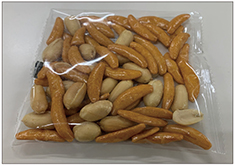
Individually wrapped rice cracker and peanuts
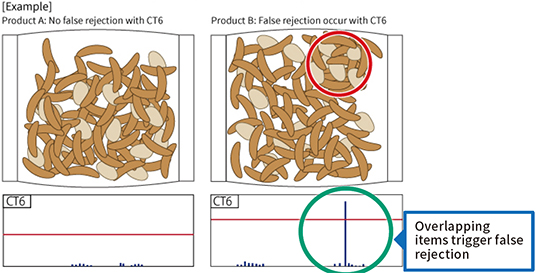
False rejection can also occur in areas where the overlap of content is concentrated. In this case as well, it will be effective to reduce the effect with noise removal.
Because the contents move freely in the package, false rejections occur where the contents overlap closely within the package.
Detection limit
A test piece to be detected is placed on the inspected item, and while watching CT0 (overall shading) and CT1 to CT10 (reaction according to the characteristics of the foreign object) on the monitor of the X-ray inspection system, you can see the evaluation result changed from OK (PASS) to NG (defective) and NG (defective) to OK (PASS) when you change the detection limit up and down.
Adjustment of the detection limit is performed when you want to improve the sensitivity as much as possible, but it may be necessary to adjust the noise removal limit first.
The image on the right is an example of a false evaluation that occurs where the test piece is not placed. One red dot circled in green can be seen separating from the other four red dots in series indicating the test piece. Use the noise removal limit to eliminate this remote red dot before adjusting the detection limit.
By eliminating the noise in the false rejection area, the influence of the test piece also decreased. Next, gradually lower the detection limit and tighten the criteria. One red dot indicating a test piece has been added. This shows that there are no false positives and that the test piece one size down can be detected.
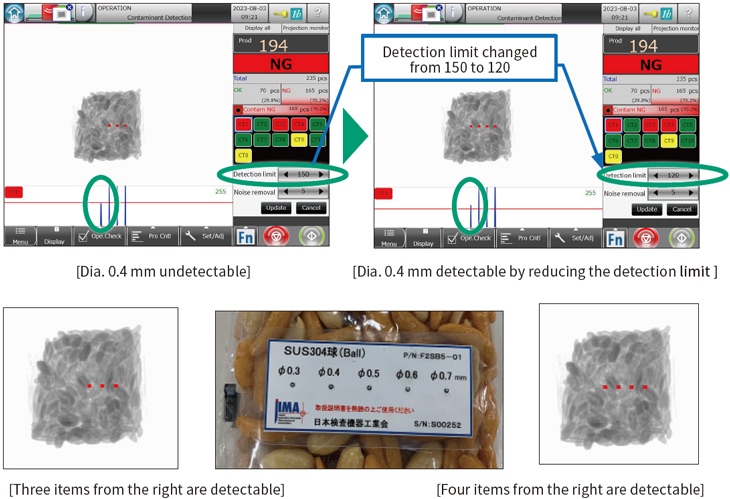
Example of false evaluations and measures
“Salad Chicken,” precooked steamed chicken breast, that is usually packaged in a vacuumed seal and sold at convenience stores or grocery stores in Japan. Because of its uneven thickness and shapes, wrinkles and air bubbles are likely to occur around the contents when the product is vacuum sealed with a plastic film and poly coated paperboard. In recent years, there has been a trend to make the paperboard thinner to reduce costs, and wrinkles and warping of the film are more likely to occur. Unevenness of the contents and wrinkles on the seal can cause false rejection.
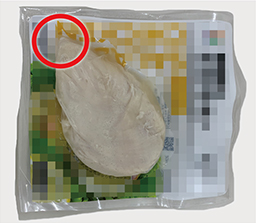
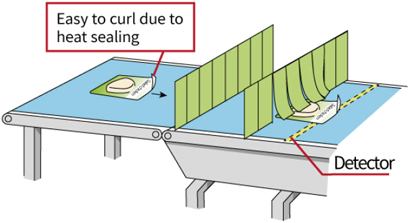
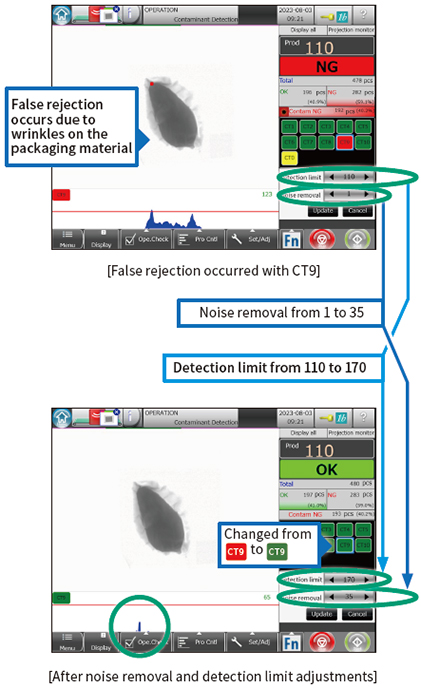
When the product with wrinkles on the seal area where the contents were trapped was conveyed through the x-ray system, CT9 was displayed in red on the screen. Then, gradually increase the value of the noise removal limit so that the red dot disappeared. However, the signal remained yellow, so increase the detection limit until CT9 turned green. The detection limit has been loosened, so check if test pieces can be detected according to in-house standards before production starts.
Useful function
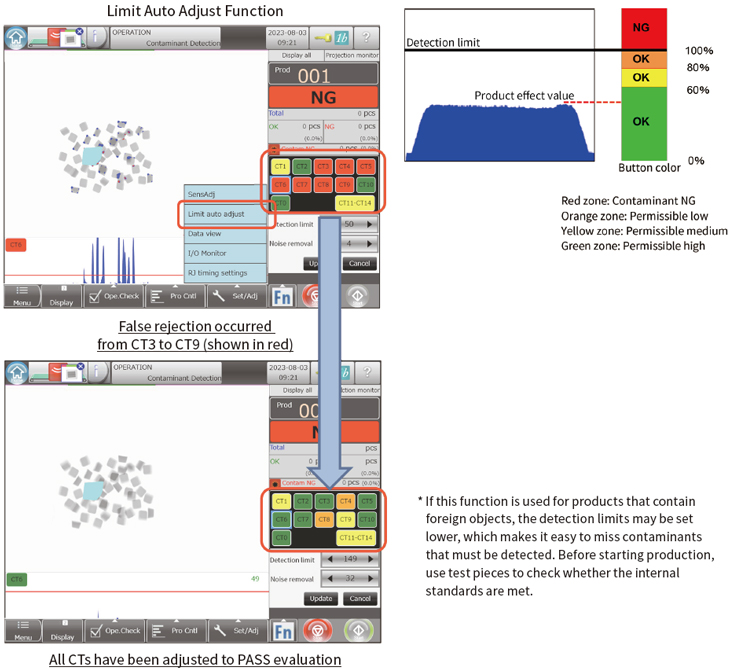
We explained using examples where the signal turned red (false rejection) at one of CT1 to CT10. If the signal turns red in multiple CTs, it is possible to adjust them at the same time using the Limit Auto Adjust function. The X-ray machine adjusts the noise removal and detection limit collectively to a level that does not cause false rejections, but not all limits turn green, and some CTs remain yellow or orange. Even with the same OK evaluation, the margin to the detection limit differs depending on the color (orange, yellow, or green).
Conclusion
If false rejections occur frequently, the correct procedure is to adjust the noise removal limit to prevent the product effect from exceeding the detection limit, and then fine-tune the product with the contaminant detection limit. Please note that if either limit is loosened too much, the evaluation may be incorrect; therefore, foreign objects or test pieces according to in-house standards may not be detected. If false rejections have not occurred for a long period of time after the x-ray system has been in operation, but suddenly false rejections begin to occur frequently, there may be a change in ingredients or packaging form that cannot be resolved by the adjustment methods described in this paper. In that case, we recommend that you perform Product Registration (initial setup) again.
Related Links
PDF >
Technical Note (For general use) >
Products & Solutions > X-ray Inspection >
 X-Ray Inspection >
Glossary: X-ray Inspection System >
X-Ray Inspection >
Glossary: X-ray Inspection System >
