Promoting of in-house power generation using renewable energy

In December 2022, Anritsu made a Carbon Neutrality Declaration to achieve virtually zero greenhouse gas emissions from its business activities (Scope 1 +2) by 2050.
In terms of climate change countermeasures, Anritsu will install solar power generation facilities at the Atsugi Site, the Tohoku Site, and at Anritsu Company (U.S.A.), and promote Anritsu Climate
Change Action PGRE 30 (PGRE 30), which emphasizes the private generation and consumption of renewable energy, as a priority until around 2030. Furthermore, we aim to be carbon neutral by 2050 by
purchasing green electricity certificates and considering the use of hydrogen energy through fuel cells and other means.
Progress on PGRE30
With PGRE30, solar power will be generated at the Atsugi Site, the Tohoku Site, and at Anritsu Company (U.S.A.) and consumed as energy for business. The budget has been approved by the Management
Strategy Conference and the Board of Directors.
Long-Term, Reliable Reduction of CO₂ Emissions
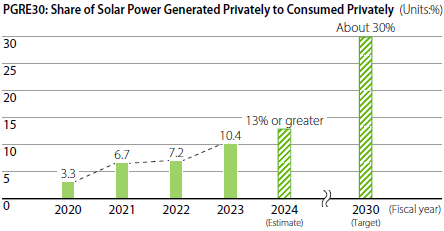
The Anritsu Group has been introducing solar power generation systems since the 2010s. In FY2019, we formulated the “Anritsu Climate Change Action PGRE 30” (PGRE 30) to steadily
reduce CO₂ emissions over the long term, increasing the ratio of private solar power generation from 0.8% in FY2018 to around 30% by around 2030.
Purchasing green electricity certificates is one way to reduce CO₂ emissions, but it does not count as a CO₂ emission reduction additionality from our company. PGRE 30 is a measure that
positions the introduction of private solar power generation as an investment. It is a policy that will lead to a reduction in CO₂ emissions by introducing solar power generation facilities that
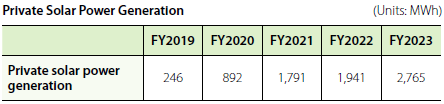
will generate a total of 8,000 MWh per year.
Making Effective Use of the Power Generated by Storage Batteries
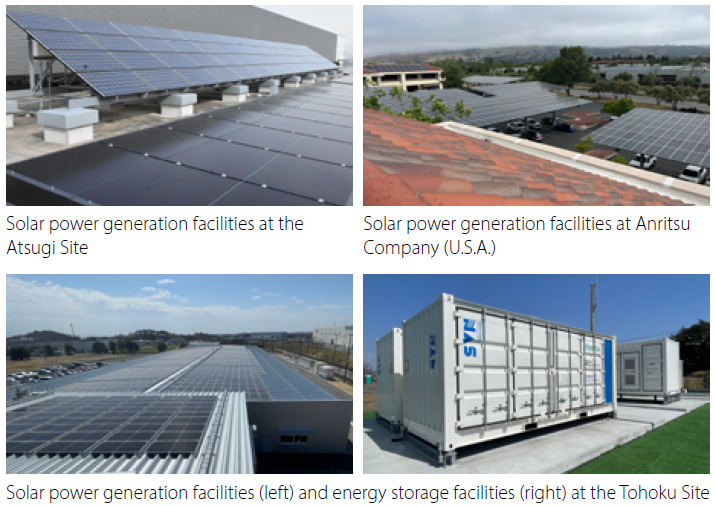
On the Tohoku Site, we have constructed and started operation of a power generation system that combines a 1,100 kW solar power generation system with a large-capacity storage battery (NAS
battery, Rated output: 400kW, Rated capacity: 2,400kWh). The use of stored electricity at night increases the rate of self-consumption. It also contributes to measures against the risk of power
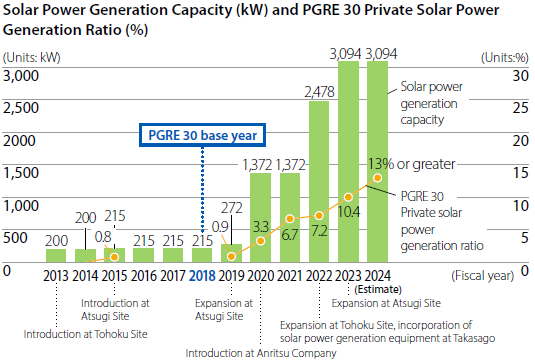
shortages starting in the evening, when there is a drop in the generation of solar power generation. On the Atsugi Site, we have added 616 kW of solar power generation capacity, bringing the
total solar power generation capacity to 3,094 kW as of the end of March 2024.
Aiming to Achieve Initiatives on Par with RE100 Companies
RE100 is an initiative that aims to have companies use 100% renewable energy (RE) to power their operations. Companies that consume 100 GWh or more of electricity per year (50 GWh or more for
Japanese companies) are eligible to join. The Anritsu Group's annual power consumption is about 30 GWh, so it is not included in the scope of this initiative, but our goal remains the same. In
order to achieve carbon neutrality by 2050, we are promoting PGRE 30, which involves the private generation and consumption of renewable energy, rather than relying solely on the purchase of
green electricity certificates.
Towards Achieving the Goals of the International Community
At COP28 (the 28th Conference of the Parties to the United Nations Framework Convention on Climate Change) held in 2023, it was determined that “there is still a long way to go before
achieving the 1.5°C target agreed to in the Paris Agreement.” In response to this, it was announced that the transition from fossil fuels to renewable energy would be accelerated, and
that the global renewable energy generation capacity would be tripled by 2030 (compared to 2022). Through PGRE 30, the Anritsu Group is working to achieve a ratio of private solar power
generation that is approximately four times that of FY2022, and will contribute to achieving the goals of the international community.


