


Health and Productivity Management
The Anritsu Group believes that the health of its employees is one of the most factors in contributing to the realization of a sustainable society through its business activities. Based on the idea that the source of corporate value is the health and vitality of each and every employee, the Anritsu Group Health and Productivity Management Policy brings together the Domestic Group and the Anritsu Health Insurance Union to maintain and improve the health of employees with the aim of achieving health and productivity management.
Our collective agreement with the Anritsu Labor Union sets forth certain matters concerning health and safety. More specifically, it stipulates that we, as the owner of the business, shall implement appropriate measures to ensure the safety of employees and maintain and improve the health of employees, establish the Occupational Safety and Health Committee and generate selection criteria for the committee; conduct educational programs on health while providing health checkups for employees, and restrict employees from engaging in dangerous or hazardous work.
Policy
| Anritsu Group Health and Productivity Management Policy |
|---|
| Anritsu Group believes our corporate value is founded on the ability of each employee to work to the best of their abilities and in good health. With the goals of creating an environment in which all employees have an interest in health, are aware of their own health challenges, and take measures on their own to maintain and improve their heath, the Anritsu Group companies and the Anritsu Health Insurance Association work together to promote effective health and productivity management throughout the Group. |
System
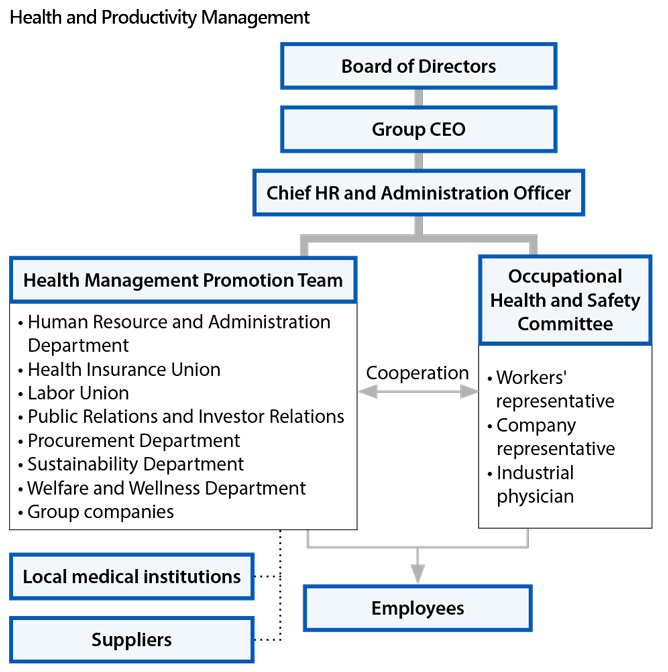
Anritsu's Board of Directors oversees the company's health and productivity management initiatives. Under the Group CEO, the Chief Human Resource and Administration Officer is responsible for promoting these initiatives throughout the Domestic Group. In daily activities, the cross-departmental Health and Productivity Management Promotion Team implements various measures in cooperation with the Occupational Health and Safety Committee. We promote health and productivity management by utilizing industrial counselors, building relationships with local medical institutions, and actively exchanging and sharing information with suppliers, as well as by building a collaborative system that includes external stakeholders.
We report on measures and progress related to health and productivity management to the Board of Directors every month, and we are working to establish an appropriate supervisory and review system.
Target
Anritsu has established three key indicators for health and productivity management and is addressing each of these challenges. For each initiative, we set KPIs primarily benchmarked against the average data of participating companies in the health and productivity management program, with a focus on enhancing employee health.
Targets and Results of the Mid-Term Health and Productivity Management Plan
Mid-Term Health and Productivity Management Plan (Phase III: FY2024–2026) targets and results
<Goals to be achieved through health and productivity management>
By having domestic group employees take an interest in health and continuing to work autonomously to maintain and improve their health, we aim to achieve sustainable improvements in corporate value.
| Indicators | KPI | Benchmark | Results for FY2023 | Results for FY2024 | FY2026 Targets |
|---|---|---|---|---|---|
| Indicators related to employees' performance | Absenteeism (leave rate) (1) | ― | 1.1% | 1.1% | 0.9% or less |
| Presenteeism (productivity loss ratio) (2) | ― | ― | 22.0% | 17% or less | |
| Work engagement (Satisfaction with work) (3) | ― | 71.1% | 71.8% | 80% or greater | |
| Indicators related to changes in awareness and behavior among employees | Percentage of patients with poorly controlled glucose metabolism (HbA1c 8.0 or higher) | 1.3%(4) | 1.1% | 1.0% | 1.0% or less |
| Ratio of employees at high risk of high blood pressure (Blood pressure 180/110 mmHg or higher) | 1.7%(4) | 0.3% | 0.1% | 0.5% or less | |
| Ratio of employees with proper body weight (BMI from 18.5 to less than 25.0) | 63.5%(4) | 65.1% | 63.3% | 70.0% or greater | |
| Ratio of employees who regularly exercise (Exercise at least twice a week, for at least 30 minutes each time) | 23.5%(4) | 29.8% | 31.2% | 29.8% or greater | |
| Percentage of people who get sufficient rest through sleep | 65.6%(4) | 63.7% | 65.1% | 66.0% or greater | |
| Percentage of habitual drinkers (Percentage of respondents who drink alcohol at least once a week and consume the equivalent of at least two cups of sake per day) | 17.2%(4) | 18.0% | 13.0% | ― | |
| Smoking rate | 25.6%(4) | 17.6% | 17.6% | ― | |
| Secondary examination attendance rate (ascertained from secondary examination response forms) | ― | 67.5% | 68.4% | 70% | |
| Ratio of employees experiencing high levels of stress | 13.7%(4) | 8.2% | 11.2% | ― | |
| Indicators regarding the status of health investment policy initiatives | Regular health checkup participation rate | ― | 100% | 100% | 100% |
| Implementation rate of specific health guidance | ― | 12.6% | 64.9% | ― | |
| Ratio of stress check examinations | ― | 93.9% | 97.6% | 100% | |
| Walking event participation rate (pepup) | ― | Approx. 10% | 10.7% | ― | |
| Participation rate in health lectures | ― | 26.7% | 13.1% | ― |
* Some items do not include aggregate values for some locations.
(1) Absenteeism: Unable to come to work due to illness or poor health
Leave rate: Percentage of mental health absences of regular employees (new absentees in the fiscal year + continued absentees from before the current fiscal year)
(2) Presenteeism: A state in which an individual commutes to work while suffering from some illness or symptoms, resulting in reduced work performance and productivity.
Productivity loss ratio: Measured using the SPQ (Single-Item Presenteeism Question, University of Tokyo Single-Item Version) for all employees within the domestic group. Measured from FY2024
(3) Satisfaction in the engagement survey for all domestic group employees
Satisfaction = Positive responses (ratio of those who are "Strongly agree" and "agree")
Survey ratings were made on a 4-point scale. In addition to the above responses, respondents could also choose "disagree" and "completely disagree."
(4) Average of companies participating in the Ministry of Economy, Trade and Industry's 2018 Health and Productivity Management Survey
Ongoing target indicators for health and productivity management
| Target Indicator | Measurement Items (%) | FY2022 | FY2023 | FY2024 | FY2025 |
|---|---|---|---|---|---|
| Reduce absenteeism | Rate of sick leave*1 | 0.6 | 1.1 | 1.1 | (Measuring) |
| Mental health absence rate*2 | 0.5 | 0.5 | 0.8 | (Measuring) | |
| Reduce presenteeism | Productivity loss ratio | - | - | 22.0 | 21.9 |
| Improve work engagement | Satisfaction with work | 71.9 | 71.1 | 71.8 | (Measuring) |
*1 Percentage of regular employees taking sick leave including due to mental health issues (new sick leave cases in the fiscal year + those on sick leave from before the current fiscal year)
*2 Percentage of mental health absences of regular employees (new absentees in the fiscal year + continued absentees from before the current fiscal year)
Activities
Anritsu clarifies management issues to be solved by health and productivity management, and formulates and implements a health and productivity management strategy map to realize these solutions.
Health and Productivity Management Strategy Map
Anritsu has created a "Health and Productivity Management Strategy Map" that outlines how employee health issues affect corporate productivity and sustainability. By using this map, we are able to clarify how health measures contribute to the achievement of management goals, allowing us to promote health in a more effective and strategic manner.
While strengthening the implementation framework that serves as the foundation, we will promote health and productivity management based on the three pillars of "physical health," "mental health," and "creating a comfortable working environment," in line with the evolution of health and productivity management.
| Goals to be achieved through health and productivity management |
|---|
| By having all employees take an interest in health and continuing to work autonomously to maintain and improve their health, we aim to achieve sustainable improvements in corporate value. |
| Final target indicators related to health |
|---|
| ・Improved subjective sense of health ・Reduced absenteeism ・Reduced presenteeism ・Enhanced work engagement |
| Health investment | Effect of health investment | Final target indicators related to health | Goals to be achieved through health and productivity management | |||
|---|---|---|---|---|---|---|
| Indicators regarding the status of health investment policy initiatives | Indicators related to changes in awareness and behavior among employees | |||||
| Physical Health | Promoting healthy behavior through the use of health checkups | Health checkup Health guidance |
Health checkup participation rate and findings rate Health guidance implementation rate |
Percentage of healthy lifestyle practices Cancer screening participation rate and results utilization rate Percentage of employees who can use health information (health literacy) Body self-care practice rate |
▸Improved subjective sense of health ▸Reduced absenteeism ▸Reduced presenteeism ▸Enhanced work engagement |
By having all employees take an interest in health and continuing to work autonomously to maintain and improve their health, we aim to achieve sustainable improvements in corporate value. |
| Cancer control measures | Cancer screening | Cancer education participation rate | ||||
| Health promotion activities | Health education and health lectures Health events Health apps Health telephone counseling Physical health consultation |
Participation rate in health education and health lectures Health event participation rate Health app event participation rate Awareness of consultation services Number of consultations |
||||
| Mental health | Mental health measures | Mental health consultation | Awareness of consultation services Number of consultations |
Percentage of counseling sessions with highly stressed persons Mental health self-care implementation rate |
||
| Health interviews for 1st to 3rd year employees | Percentage of health interviews conducted | |||||
| Stress check | Ratio of stress check examinations Ratio of employees experiencing high levels of stress |
|||||
| Refresh dialogue | Number of refresh dialogues conducted | |||||
| Mental health training | Mental health training participation rate | |||||
| Creating a comfortable working environment | Improving the workplace environment | Use of group analysis results Industrial physician workplace inspection |
Number of workplace improvement activities Number of workplace inspections |
Number of workers injured in falls Percentage of individuals at high risk of falls |
||
| Response to infectious diseases | Influenza Mass vaccination | Influenza vaccination coverage Percentage of leave related to infectious diseases |
Infection control status in the workplace | |||
| Measures to prevent falling accidents | Exercise | Exercise implementation rate | Employee awareness of smoking cessation measures | |||
| Measures to prevent passive smoking | Status of smoking ban during work hours | |||||
| Support for the active engagement of diverse talent | Various health seminars | Participation rate in various health seminars | ||||
| Women's health support | Rate of self-care implementation for women's health | |||||
| Support for balancing treatment and work Health support for seniors Support for balancing work with childcare and nursing care Health support for the employment of persons with disabilities Health support for foreign employees |
Promotion of diverse human resources and understanding in the workplace | |||||
| Efforts to improve productivity | Appropriate working hours and work style | Status of efficient business execution and proper working hour management | Overtime hours, paid leave utilization rate, etc. | |||
■ Specific health and productivity management initiatives
<Health checkups and measures against lifestyle-related diseases>
- Health checkups, various health promotion activities
- Implementation of tests that go beyond the legally required items in regular health checkups
- Implementation of special, employment, and overseas assignment health checks
- Implementation of group dental checkups and checkups for female-specific diseases
- Follow-up on various health checkup results
- Individual interviews with high-risk individuals
- A ddressing individuals at high risk for lifestyle diseases by promoting medical examinations of those eligible for detailed examinations
- Raising health awareness through health events and seminars
- Measures for mental health challenges
- Prevention of potential health problems through implementation of stress checks and follow-up using various data
- Questionnaire screening, interviews by industrial physicians,and health maintenance measures for employees working significant amounts of overtime
- Mental healthcare training and counseling for managers
- Employee engagement improvement initiatives
- Visualization of work styles and analysis of stress check results
- Promotion of efficient work styles by encouraging employees to take leave and correct long working hours
- Establish a safe and secure workplace and system
- Introduction of systems to support work-life balance and promote diversity
- Promotion of infectious disease countermeasures, formulation of Business Continuity Plan
Through these efforts, the domestic group is working to reduce employee health risks, increase engagement, and create a safe and secure work environment.
In FY2024, we added a question about presenteeism to the stress check. We will assess the situation and consider measures to prevent a decline in labor productivity. We have also put in place a system for using the Web to quickly provide feedback on the results of questionnaires.
Main activities for FY2024
■ Improvement of health literacy
The health education programs implemented in FY2024 are shown below.
September 2024 (National Occupational Health Readiness Period)
- Lecture by industrial physician: "Insights on Stress Management: Cognitive-Behavioral Change Approach and Mindfulness"
- Health video education by industrial physician: "Making Physical Health a Habit - Lifestyle and Diet - and Fostering Mental Health through Stress and Sleep Management"
December 2024
- Health education: "Status of Infectious Disease Outbreaks and Alcohol"
February 2025
- Video streaming: "Infectious Diseases and Heat Shock"
■ Promotion of health activities
- As a registered participant in "Corporate Action to Promote Cancer Control*", we held a lecture by a medical specialist on the theme of "Understanding Cancer."
- In order to improve dietary habits, the company increased the amount of vegetables and offered reduced-sodium miso soup in the employee cafeteria, and thereby obtained Healthy Meals and Food Environment (commonly known as Smart Meals*) certification.
* Corporate Action to Promote Cancer Control
An initiative to promote cancer screening participation rates through corporate collaboration and foster a societal atmosphere that proactively addresses cancer. Companies are taking the lead in promoting the importance of cancer screenings, aiming for a participation rate of 60% or higher.
* Smart Meals
A nutritionally balanced diet that contributes to health promotion. The Smart Meals standard is based on the Ministry of Health, Labour and Welfare's "Guidelines for Meals Provided for the Prevention of Lifestyle-Related Diseases and Other Health Promotion Purposes" (September 2015).
Response at the consultation desk
■ Physical health consultation
Anritsu has a health management center, which is operated by industrial health staff led by industrial physicians and industrial counselors. The Health Management Center provides individual health consultations for employees, conducts various health checkups, and performs stress assessments.
Anritsu Health Insurance Union
Domestic group companies are enrolled in the Anritsu Health Insurance Union. All employees directly employed by Anritsu, including contract employees, are covered by health insurance as members of the Anritsu Health Insurance Union. Appropriate insurance benefits are provided through My Number health insurance cards and health insurance cards, and their accuracy is verified through regular audits by the competent authorities.
Certified as an Excellent Enterprise of Health and Productivity Management in 2026
Anritsu has been recognized as a 2026 Certified Health and Productivity Management Outstanding Organization in the Large Enterprise Category under the Health and Productivity Management Outstanding Organizations Recognition Program, jointly administered by the Ministry of Economy, Trade and Industry (METI) and the Nippon Kenko Kaigi (Japan Health Council).
This recognition acknowledges Anritsu’s approach to employee health management from a managerial perspective and its strategic implementation of outstanding health and productivity management initiatives.

Addressing Global Health Challenges
Anritsu Group, as a company with an overseas presence, is addressing global health challenges, including the world's three major infectious diseases (tuberculosis, malaria, and HIV/AIDS). We provide information on infectious diseases, vaccinations, health checks, and local medical assistance to employees posted overseas and their families. As a way to contribute to the community, we also conduct the in-house manufacture of nonwoven masks, which are approved by the National Mask Industry Association through rigorous testing. We provide these masks to nearby medical institutions, fire stations, police stations, and other organizations. In FY2024, we donated 55,000 masks to facilities in the region.