Anritsu Corporation (President: Hirokazu Hamada) launched the AH15203A/B — a 140 Gbaud wideband linear amplifier*1 with integrated bias tee*2 — on August 28, delivering broadband signal conditioning for characterizing optical transmission devices in the coming Beyond-1 Tb era.
This newly developed wideband linear amplifier with integrated bias tee delivers a broad frequency response of 200 kHz to 125 GHz (−6 dB bandwidth) and amplifies PAM4*3 signals up to 140 Gbaud to a maximum output of 2.0 Vpp. The amplifier gain*4 of +15.0 dB and jitter*5 of 300 fs faithfully amplifies and reconstructs high-quality signal waveforms attenuated by the transmission path.
The AH15203A amplifies 140 Gbaud PAM4 signals from DSP*6 and other signal sources, and directly drives devices, such as modulators, requiring offset at high amplitudes, making it an ideal drive amplifier for characterizing optical modulators used by next-generation 800GbE and 1.6TbE digital coherent*7 transmission systems now attracting significant industry attention, as well as for IM-DD*8 optical modulators deployed widely in optical communications.
By releasing this wideband linear amplifier with integrated bias tee, Anritsu is advancing deployment and smooth operation of faster data centers and network infrastructure.
Development Background
Rising AI and machine-learning traffic is driving demand for ever-faster communication speeds in servers and network equipment.
The IEEE 802.3dj next-generation Ethernet standard underpinning high-speed networks is advancing standardization of both 200 Gbps/lane IM-DD modulation and digital coherent configurations including 800GBASE-LR1 (10 km), 800GBASE-ER1-20 (20 km), and 800GBASE-ER1 (40 km). In parallel, IEEE 802.3ds standardization is underway to replace the electrical interconnects used previously for short-reach communications (<30 m) with optical links operating at 200 Gbps per wavelength. However, higher communication speeds inherently increase signal attenuation, creating demand for high-output linear drivers with integrated bias tee to faithfully amplify PAM signals and directly drive EML, DML, and VCSEL.
Product Outline
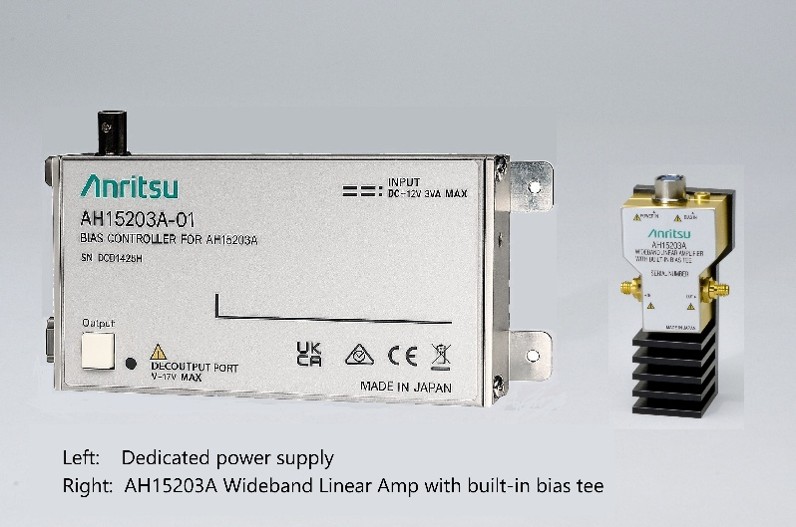
The AH15203A high-output linear amplifier supports 140 Gbaud PAM4 signal evaluation at up to 2.0 Vpp. Despite the integrated bias tee, it achieves a broad bandwidth of 125 GHz while delivering high-speed, high-output (2.0 Vpp) data transmission at 140 Gbaud and consuming just 1.5 W of power. The Gbaud unit denotes the symbol rate, with 140 Gbaud representing a signaling rate of 140 billion symbol changes per second.
It features a dedicated power supply, reducing the risk of improper power handling damaging the amplifier.
Target Markets and Applications
Target Markets: High-speed optical and electrical device manufacturers; optical signal test and measurement-instrument manufacturers
Applications: High-speed optical device characterization at up to 140 Gbaud
Technical Terms
- *1 Linear Amp
- Amplifier that magnifies input signal by fixed ratio and outputs result. Linear amplifiers are essential for driving devices, such as optical modulators, used in optical communications networks.
- *2 Bias Tee
- Component that superimposes and supplies — or extracts — DC voltage or current onto RF signal line.
- *3 PAM4
- PAM is abbreviation for Pulse Amplitude Modulation scheme that increases transmission capacity through amplitude modulation. PAM4 uses four amplitude levels (00, 01, 10, 11) to encode two bits per symbol.
- *4 Gain
- Characteristic describing relationship between input signal frequency and corresponding output amplification ratio.
- *5 Jitter
- Measure of timing fluctuations in digital signal. Excessive jitter causes incorrect recovery of digital signal values, resulting in bit errors.
- *6 DSP
- Abbreviation for Digital Signal Processor — microprocessor optimized for processing digital signals.
- *7 Digital Coherent
- Transmission scheme that encodes information using light phase and polarization. Its low signal degradation makes it ideal for high-capacity, long-distance optical transmission.
- *8 IM-DD
- Abbreviation for Intensity Modulation – Direct Detection. Transmission scheme that encodes information by modulating intensity of light and recovers it at receiver by direct detection.
